Agia Triada, Gouverneto & Katholiko: The Honest Guide to the Akrotiri Monasteries
Three monastic sites on the Akrotiri peninsula above Chania make one half-day: the easy, ticketed Agia Triada, the stricter working monastery at Gouverneto, and a stone path below it past a cave to the ruined Katholiko and a small cove. Here is what the hours, the dress code and the climb back actually mean.
The Akrotiri peninsula north-east of Chania has three monastic sites that make one good half-day. Agia Triada Tzagarolon is the easy one, open most of the day. Gouverneto, a few kilometres on, is a working monastery with short hours and strict rules. Below it, on foot only, a stone path drops past a cave chapel to the ruined Katholiko and a small cove. Go in the morning, dressed for a church, and not on a Wednesday or a Friday. Described from our own visits; hours, fees and rules are a check of published sources, October 2026.
The honest facts
- Where
- Agia Triada about 15 km from Chania, near the airport; Gouverneto about 19 km, 4–5 km further north.
- Agia Triada
- 08:00 to sunset in summer, 08:00–14:00 and 16:00 to sunset in winter — verify seasonally; €2.50, under-18s free.
- Gouverneto
- published hours 09:00–12:00 and 17:00–19:00 Monday, Tuesday, Thursday; 09:00–11:00 and 17:00–20:00 at weekends; closed Wednesdays and Fridays; roughly €2.50 reported, on unofficial pages only.
- Dress
- shoulders and knees covered — no shorts, swimwear or sleeveless tops.
- The walk
- Bear cave about 20 minutes from Gouverneto, then Katholiko, then the cove; roughly 45 minutes down, longer up. No swimming.
- Fire-season order
- none of the three is named in the Region’s 2026 list.
Agia Triada Tzagarolon, the easy one
Agia Triada sits at the foot of the Stavros hills, close to the airport. Two brothers of a Venetian-Cretan family, Jeremiah and Lavrentios Tzagarolos, built it in the last decades of Venetian rule, and Jeremiah’s design drew on the Italian architect Sebastiano Serlio — which is why the church looks Venetian rather than Byzantine. A small museum holds icons, among them three by the painter Skordilis dated 1635–1645, and a twelfth-century altar cloth; the monks’ oil, wine and honey are sold on site. The Chania Tourism Bureau’s listing gives the hours and ticket. Half an hour to an hour covers it.
Gouverneto, the strict one
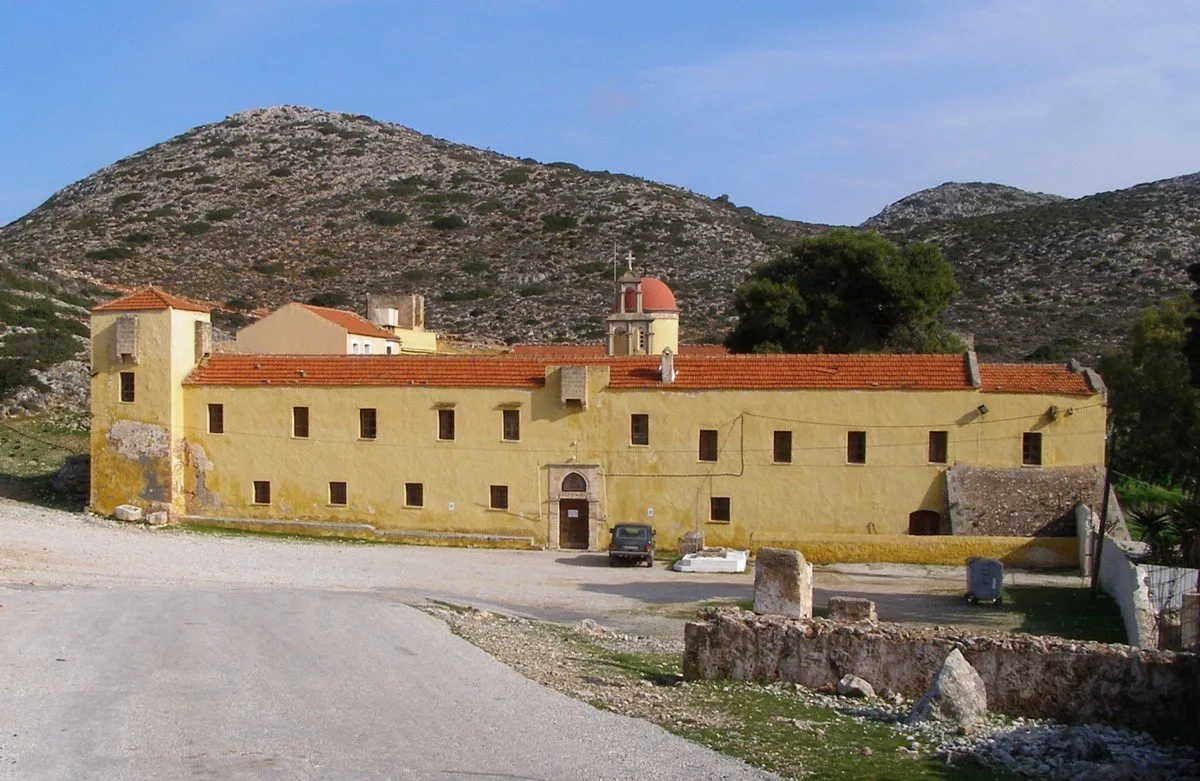
Gouverneto, dedicated to Our Lady of the Angels, is older and more austere: built between 1537 and 1548 according to the Region of Crete, a rectangular precinct of cells, refectory and storerooms around a domed, three-apsed church. Monks from Mount Athos re-established communal life here in 2005. Hours are short, photography inside is reported not allowed, and the dress code is applied. The land down to the sea is the monastery’s and the path starts through it (gates on the approach road reached a question in the Greek Parliament in 2021), so treat the published hours as the window for the walk too.
The path down: the Bear cave, Katholiko and the sea
From behind Gouverneto a stone-paved path drops north into the Avlaki ravine. After about twenty minutes it reaches the cave of Panagia Arkoudiotissa, named for a stalagmite shaped like a bear; the Church of Crete’s page on the site records traces of the worship of Artemis there, and a small chapel to the Virgin stands at the entrance.
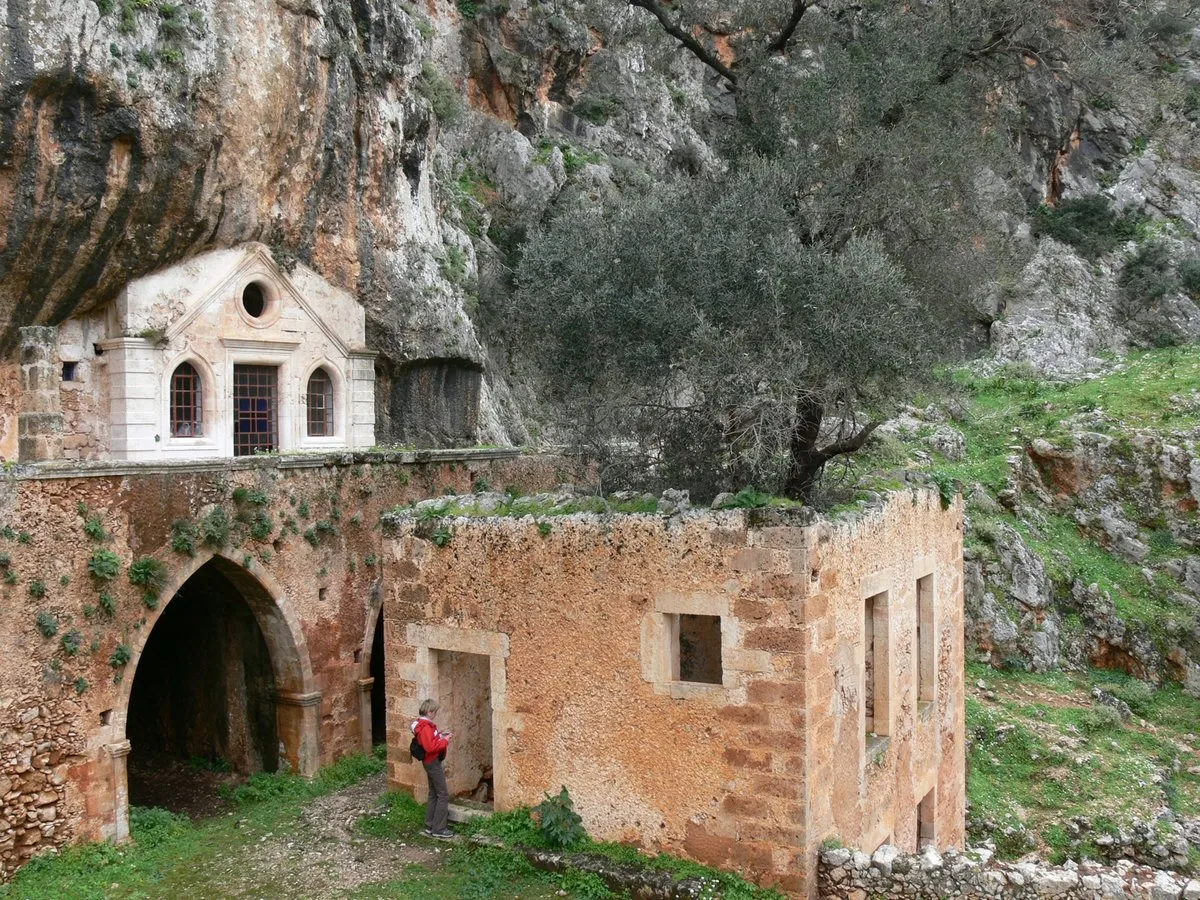
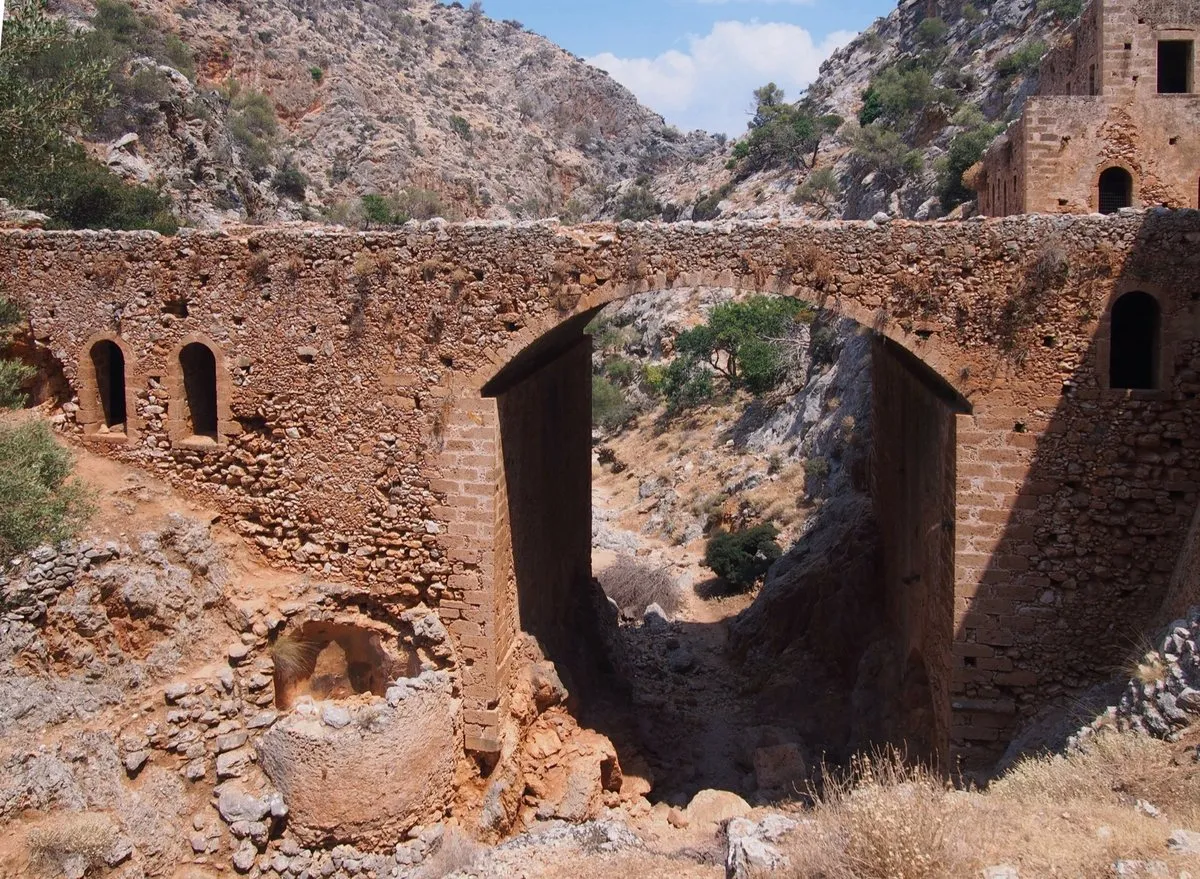
Further down is the Katholiko, the monastery of St John the Hermit. Hermits are recorded in the gorge from the tenth century, and the saint is believed to have lived in a cave beside the church. What survives is a church cut into the rock with a Renaissance-style stone front, and a great single-arched bridge across the ravine. The monks later moved up to Gouverneto. About ten minutes beyond, the ravine meets the sea in a narrow inlet with traces of the monks’ small harbour — clear water, and no swimming.
The descent is easy on a dry day, roughly 45 minutes; the climb back on stone steps and paving is the honest part, tiring in summer. Walking sources put the round trip at up to three and a half hours; carry water, wear real shoes.
When to go
Mornings are best: cooler for the climb, and the longer of Gouverneto’s weekday windows. Avoid Wednesdays and Fridays entirely. The feast of St John the Hermit in early October brings pilgrims down the path.
The Region of Crete’s fire-season order of 16 June 2026 does not name the monasteries or the ravine; the nearest listed place is the Kathiana windmill park, a separate area on the peninsula, closed on category 4 and 5 days. On red-alert days check the fire-risk map and 112 alerts before any walk.
Fitting it into an Akrotiri day
The monasteries are the natural other half of a beach day. Stavros and Kalathas are a short drive away for the swim the Katholiko cove will not give you, and Seitan Limania is about ten minutes off. Agia Triada’s position near the airport also makes it a departure-day stop.
The honest downside
The best part is also the most restricted: Gouverneto’s short, split hours and two closed weekdays govern the path, the dress and photography rules are enforced, and the cove at the bottom is off limits for swimming. The climb back is tiring and hot from late spring to early autumn.
Worth it if: you can go on a morning that is not a Wednesday or Friday, dressed modestly, and want a cave chapel, a rock-cut church and a bridge over a ravine in one short walk. Skip it if: you want a swim at the end, or a steep climb back in the heat is not your idea of a morning.
Photos on this page: Gouverneto by Frente (CC BY-SA 2.0 DE), the Katholiko church and ruins by Wolfgang Sauber (CC BY-SA 3.0) and the Katholiko bridge by C messier (CC BY-SA 4.0), via Wikimedia Commons, resized for the web. Described from our own visits; distances, access, rules and any figures were checked against the Region of Crete’s tourism pages, the Chania Tourism Bureau’s listing, the Church of Crete’s monuments site, a 2021 parliamentary question, the Region’s 2026 fire-season order and its restriction maps, and published walking sources for the date shown at the top of this guide. Nobody pays to be featured in a guide — no business, no sponsor, no paid mention, ever. Adverts, where they appear, are labelled as adverts.
-
Drive to the first two, walk to the rest
1 Agia Triada Tzagarolon 2 Gouverneto monastery 3 Arkoudiotissa (Bear) cave 4 Katholiko monastery
Tap a name to open it in your map app. These are options, not an order — pick by the day you have.
What are the opening hours of Gouverneto monastery?
Published visiting hours for Gouverneto monastery are a morning slot (09:00–12:00 on Monday, Tuesday and Thursday, 09:00–11:00 at weekends) and a late-afternoon slot (17:00–19:00 on weekdays, 17:00–20:00 at weekends). The monastery is closed to visitors on Wednesdays and Fridays. Hours can change with the season and with church services, so check before driving out.
Can you walk from Gouverneto to the Katholiko monastery?
Yes. A stone-paved path leaves Gouverneto monastery and drops through the Avlaki ravine, passing the Arkoudiotissa (Bear) cave after about 20 minutes and then the abandoned Katholiko monastery, with a small cove about ten minutes beyond. Walking sources put the descent at roughly 45 minutes; the climb back is the hard part, especially in summer heat.
What should you wear to visit Gouverneto monastery?
Gouverneto monastery turns away visitors in shorts, swimwear or sleeveless tops, and the rule is reported to apply at the gate to the Katholiko path as well. Cover shoulders and knees, and wear proper walking shoes if you plan to go down to Katholiko.
Can you swim at the Katholiko cove on Akrotiri?
No. The monks of Gouverneto do not allow swimming in the small cove at the end of the Katholiko ravine, which the monastery regards as its own land. For a swim nearby, Stavros and Seitan Limania on the same peninsula are the usual choices.
How much does it cost to visit Agia Triada monastery in Chania?
The Chania Tourism Bureau's website gives an entrance fee of €2.50 for Agia Triada Tzagarolon monastery, with under-18s free. It lists the monastery as open daily from 08:00 to sunset in summer, and 08:00–14:00 and 16:00 to sunset in winter.
Are the Akrotiri monasteries closed on high fire-risk days?
Neither Agia Triada, Gouverneto nor the Katholiko ravine is named in the Region of Crete's fire-season order of 16 June 2026. The nearest place it does list is the Kathiana windmill park, a separate area on the peninsula closed on category 4 and 5 days. Island-wide warnings on red-alert days still apply to any walk.
One email a month — only when something on this island actually changes. No spam, no partners, one-click unsubscribe. Read past issues before you decide.