Aptera: The Honest Guide to the Ruined City Above Souda Bay
A Greek city-state on a plateau 200m above Souda Bay, with Roman cisterns you can walk inside, an Ottoman fort and two German bunkers.
Most people driving from Chania to Rethymno pass within two kilometres of one of the largest ancient city-states in Crete and have no idea. Aptera sits on a plateau two hundred metres above Souda Bay, it was inhabited for roughly three thousand years, and on an ordinary weekday morning you may share it with a dozen other visitors. It is not a polished visit. It is a very good one.
The one-minute version. Twenty-five to thirty minutes from Chania via the E75, exit at Megala Chorafia. Free parking at the gate. Closed Tuesdays. Summer roughly 08:00–20:00, winter 08:30–15:30 — verify seasonally. Ticket in the region of €8–10; the Ottoman fort is included. Almost no shade, no reliable food or water on site, uneven ground. Allow two hours.
What survives, and what it feels like
The city was there from Minoan times — it appears in Linear B tablets from Knossos as a-pa-ta-wa — but its great period was Hellenistic, in the fourth and third centuries BC, when it minted its own coins and its archers hired themselves out as mercenaries across the eastern Mediterranean. Two harbours served it, at what are now Marathi and near Kalyves. The earthquake of 365 AD broke it, and pirate raids finished the job centuries later.
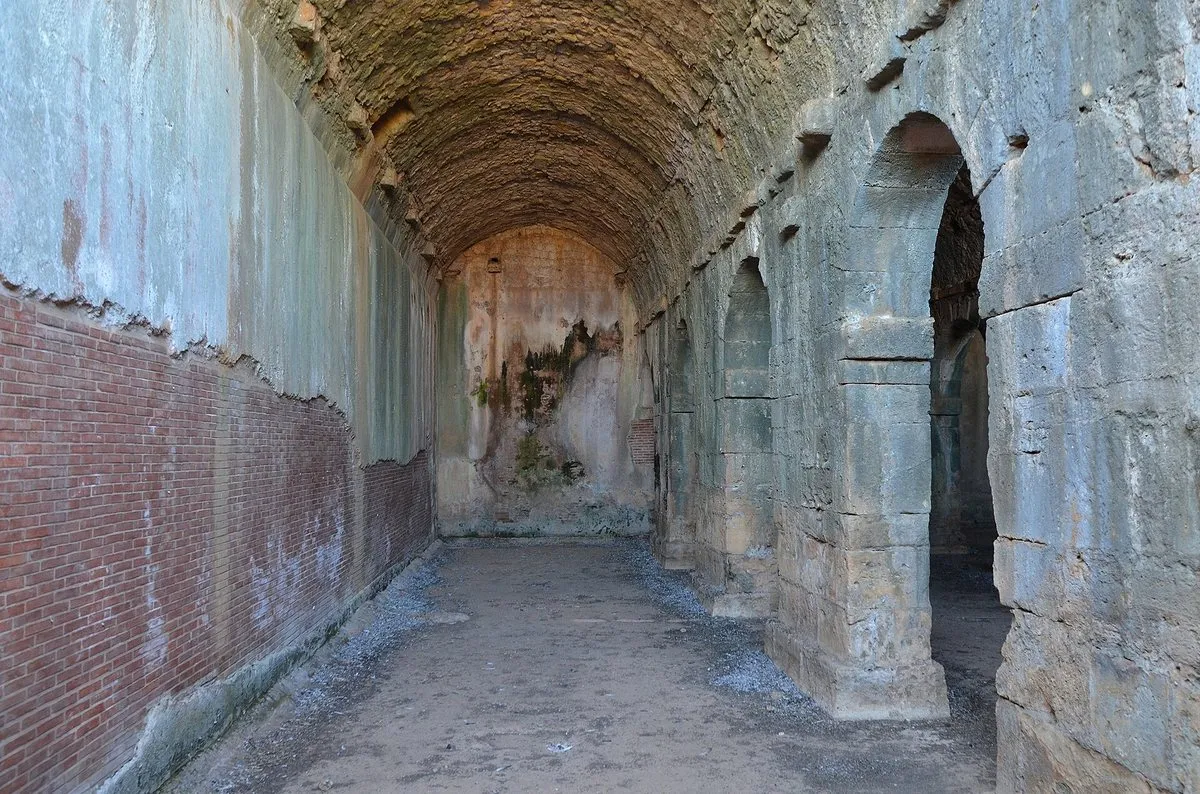
What you walk through is layers rather than a single period. A twelfth-century monastery of Agios Ioannis Theologos at the entrance, with a small display room worth five minutes before you set off. A Hellenistic-Roman theatre, restored enough to sit in. A two-room temple from the fifth or fourth century BC. Roman baths. Polygonal city walls that once ran nearly four kilometres. And the cisterns — two Roman water systems, the larger one a triple barrel-vaulted chamber you descend into, still watertight-looking two thousand years on. Stand in the middle and speak; the acoustics do something you will not expect.
Then, on the western edge, two German pillboxes from 1941. Nobody warns you about those, and finding them is oddly the moment the whole hilltop clicks together as a place people kept choosing to defend.
The honest downsides
Signage is thin. You will pass significant structures with a small sign and no context. If you arrive knowing nothing, you will see attractive stonework in a field. Watch the presentation in the monastery first, or read about the place before you drive up — it changes the visit completely.
No shade, no shop. The plateau is open and hot from late June onward. There may be a kiosk near the entrance; do not plan around it. Bring water, wear proper shoes rather than sandals, and go early. There are tavernas in Megala Chorafia just before the turn.
Excavation is ongoing, which means fenced-off sections and the occasional scaffold. That is a good thing for the site and a mildly annoying one for the photograph you had in mind.
The finds are elsewhere. The best material from Aptera — bronze Artemis, marble Apollo, the coins — is in the Archaeological Museum of Chania. Which, inconveniently, is also closed on Tuesdays.
Making a day of it
Aptera is a morning, not a day, and it sits perfectly for combining. Kalyves and Almyrida are ten minutes downhill for a swim and lunch on the front. The Apokoronas villages — Vamos, Gavalochori, Kefalas — are fifteen to twenty minutes inland and are the better half of this corner of Crete for anyone on a second or third visit. Lake Kournas is half an hour east.
If you are car-free, this one is genuinely hard: there is no service up to the site, and the bus network will only get you to the junction at the bottom of the hill.
Worth the detour for the cisterns and the view, and worth more than that if you do ten minutes of reading first — this is a site that rewards knowing what you are looking at and punishes arriving cold. Go early, bring water, and do not skip the fort. Skip it on a Tuesday, obviously, and skip it altogether if you want interpretation boards, a café and a clear route around: Aptera gives you a hilltop, some spectacular Roman engineering and very little hand-holding.
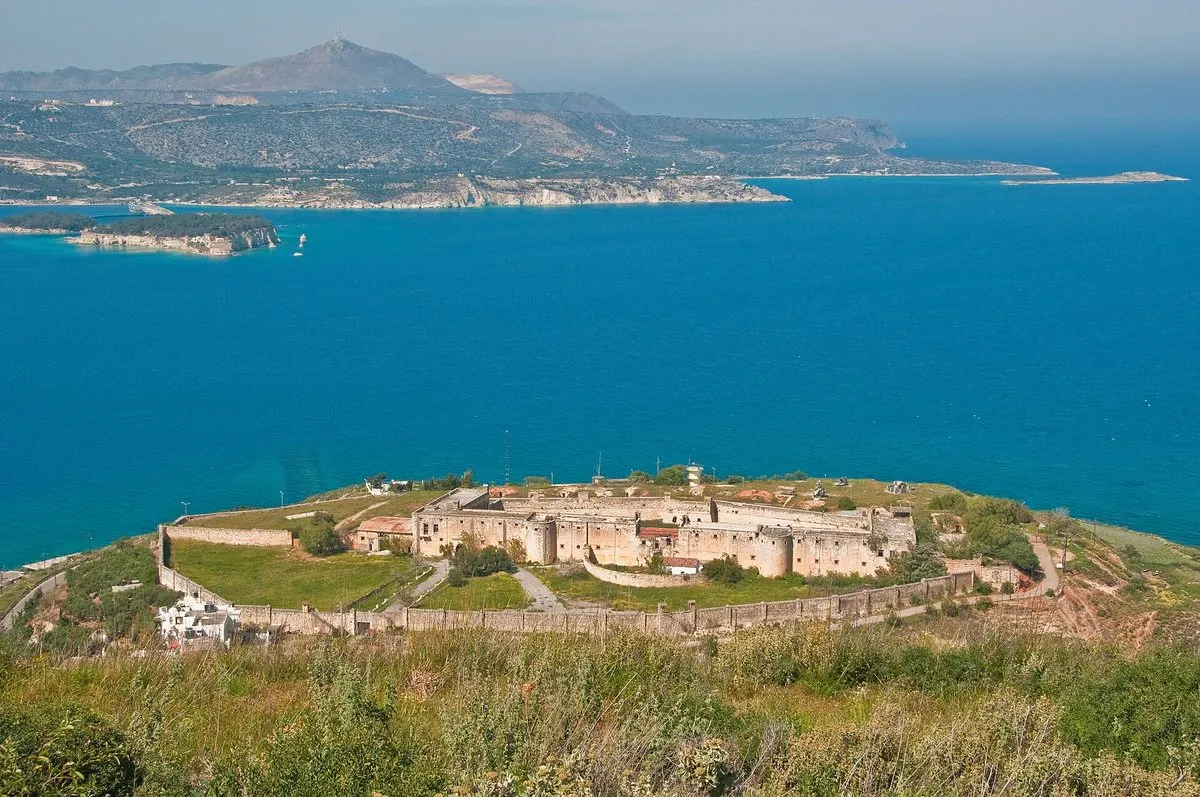
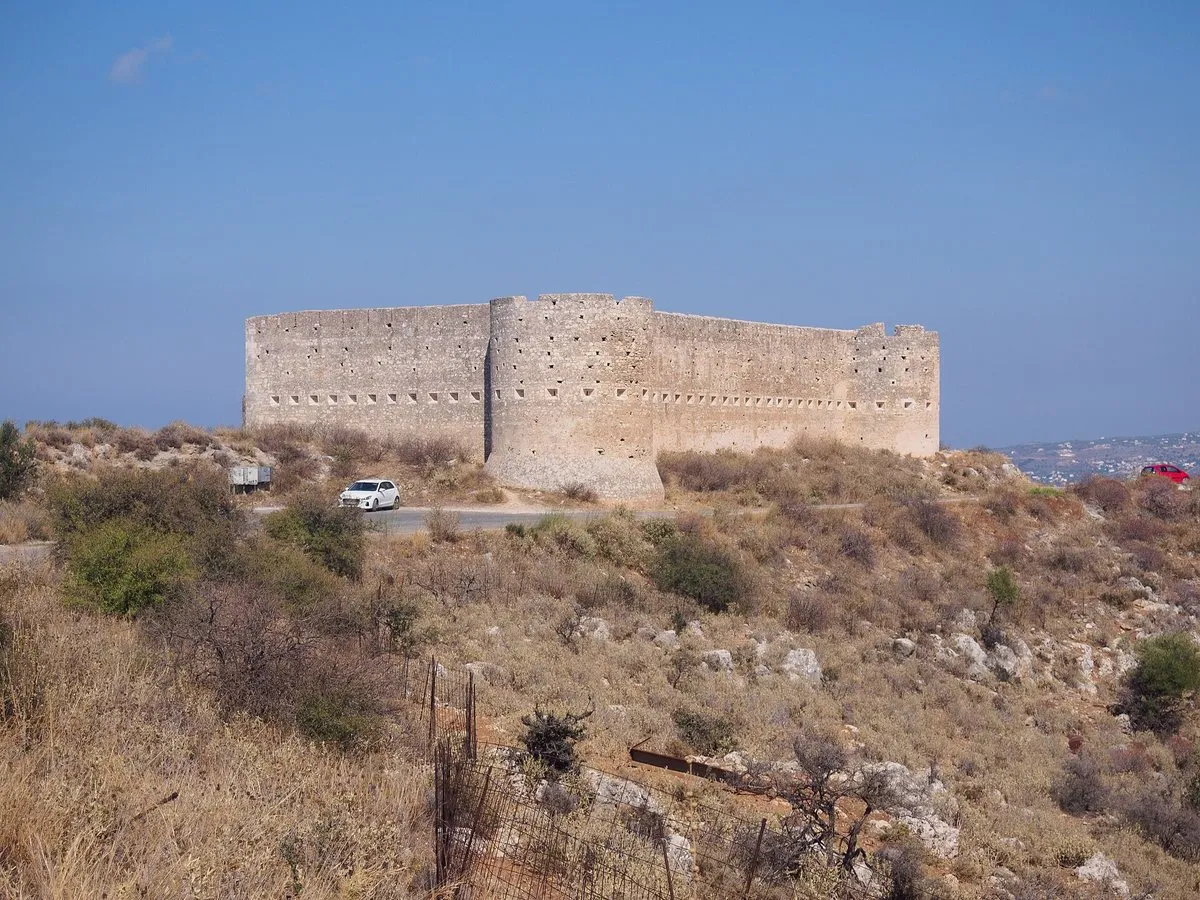
Photos on this page: Roman cistern interior by Carole Raddato (CC BY-SA 2.0); Souda Bay view by Graeme Churchard (CC BY 2.0); Ottoman fortress by C messier (CC BY-SA 4.0), via Wikimedia Commons, resized for the web. Nobody pays to be featured on this site.
Is Aptera closed on Tuesdays?
Yes — every Tuesday, year round. This catches people out constantly, because the two big sites most visitors know, Knossos and Phaistos, open daily. If Tuesday is your free day, go somewhere else.
How long do you need at Aptera?
An hour and a half to two hours for the main enclosure — monastery, theatre, cisterns, temple. Add another thirty to forty-five minutes if you also drive to the Ottoman fort and walk out to the wartime bunkers, which most people should.
Is the Koules fortress included in the Aptera ticket?
Yes. It sits a few hundred metres from the main entrance, reached by turning left at the last junction before the gate, and there is no separate charge. The view down over Souda Bay from its walls is the best on the whole plateau.
Can you get to Aptera by bus?
Not usefully. There is no bus service to the site itself. In theory you could take a Rethymno-bound bus, get off at the junction and walk up, but that is roughly forty-five minutes uphill on a road with no pavement. Drive, or take a taxi and agree a collection time — mobile signal on the plateau is unreliable.
Is Aptera worth it if you are not into archaeology?
For the Roman cisterns and the view, probably yes. The cisterns are vaulted chambers you walk inside, and they are genuinely impressive as engineering rather than as ruins. The panorama takes in Souda Bay, the Akrotiri peninsula and the White Mountains. What you will not get is much explanation — signage is thin.
One email a month — only when something on this island actually changes. No spam, no partners, one-click unsubscribe. Read past issues before you decide.