Ancient Lato: The Honest Guide to the Dorian City Above Kritsa
The hilltop city-state on a saddle between two peaks, three kilometres up through the olives from Kritsa, with its gate, workshop street, agora, stepped seating, prytaneion and views over the Mirabello gulf — what survives, what the ticket and winter hours are, and how to fit it into a morning with Kritsa and Panagia Kera.
Ancient Lato is the best reason to drive the extra three kilometres past Kritsa. A Dorian city-state built on a saddle between two hills, it keeps the plan of a working Greek town — gate, workshop street, agora, council hall, stepped seats — with the Mirabello gulf below it, and it is often quiet. It is a morning site, not a day: pair it with Kritsa and Panagia Kera, arrive early, and leave the ruins before the 15:30 close. Described from our own visits; distances, prices, hours and rules are a check of published sources, November 2026.
The honest facts
- Where
- about 3 km north of Kritsa, at around 380 m, overlooking the Mirabello gulf; the Ministry’s heritage page gives 4 km as the walk from Kritsa.
- Getting there
- a signposted road turns off just after the Kritsa village sign; about 8 minutes by car from Kritsa or 18 from Agios Nikolaos, by the Ministry’s ticketing site.
- Hours
- 08:30–15:30 all year, closed Tuesdays, last entry 20 minutes before closing, per the Ministry of Culture’s ticketing site; verify seasonally.
- Ticket
- roughly €5 full / €3 reduced on the ticketing site; the Ministry’s heritage database still shows the pre-2025 €3 / €2.
- Free days
- the first and third Sunday of each month from November to March, plus fixed dates including 6 March, 18 April, 18 May, the last weekend of September and 28 October, per the ticketing site.
- What survives
- walls, west gate, workshops, agora, central cistern, stepped seating, prytaneion, temples and a small theatre; only part of the city is excavated.
- Facilities
- parking and toilets at the entrance; wheelchairs cannot circulate inside, but a secondary entrance has an observation point.
A city on a saddle
Lato was one of the most important Dorian city-states on Crete, says the Ministry of Culture’s description, and may be older than the Dorians — possibly the RA-TO of the Linear B tablets. It was named after Leto, but its main goddess was Eileithyia, on its coins, and Nearchos, Alexander the Great’s admiral, was born here.
Its harbour, Lato pros Kamara, stood where Agios Nikolaos is now, and the harbour eventually won. When is where the sources part company. Wikipedia dates most ruins to the fifth and fourth centuries BC and the destruction to around 200 BC, as this site’s Kritsa guide does; a regional guide dates most buildings to the fourth and third centuries BC, with a gradual move to the port from the third; the Ministry says the administrative centre moved to the harbour by the mid-second century AD. All agree on the direction: down the hill to the sea.
What survives, walking it in order
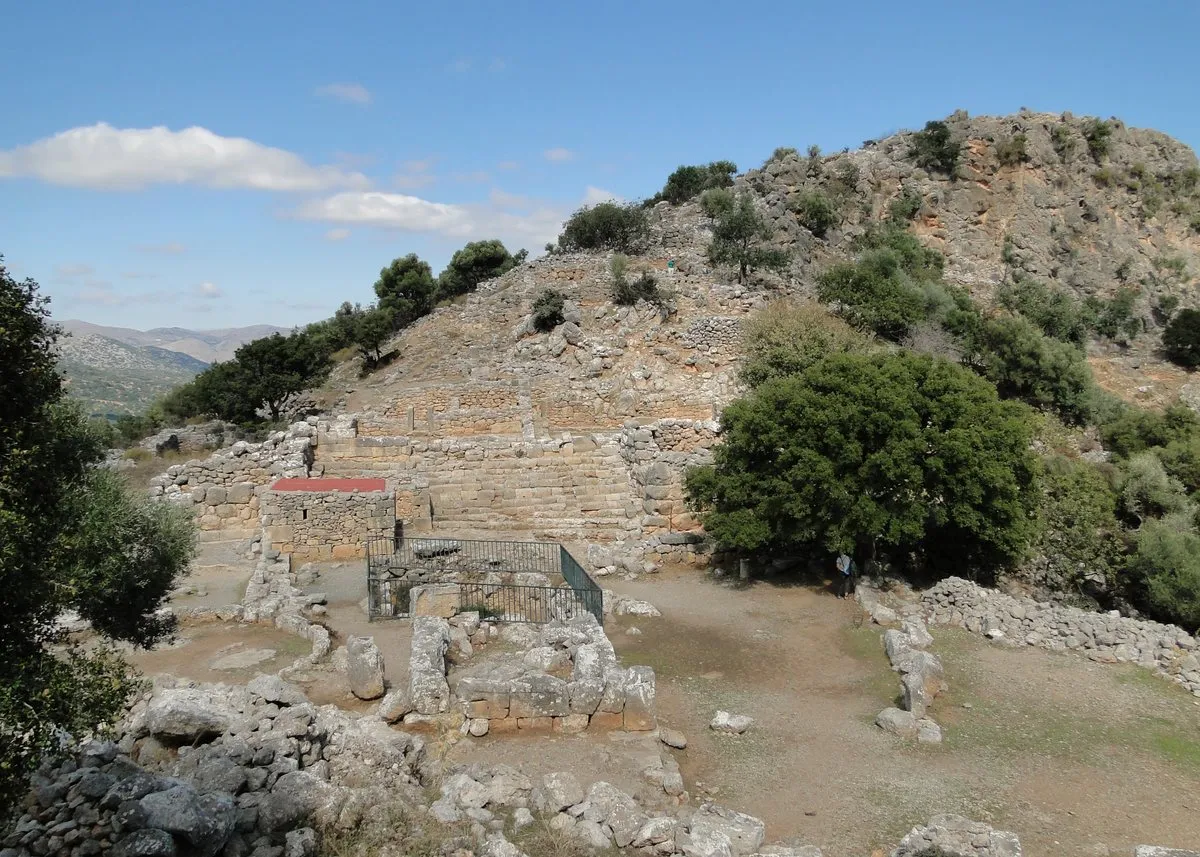
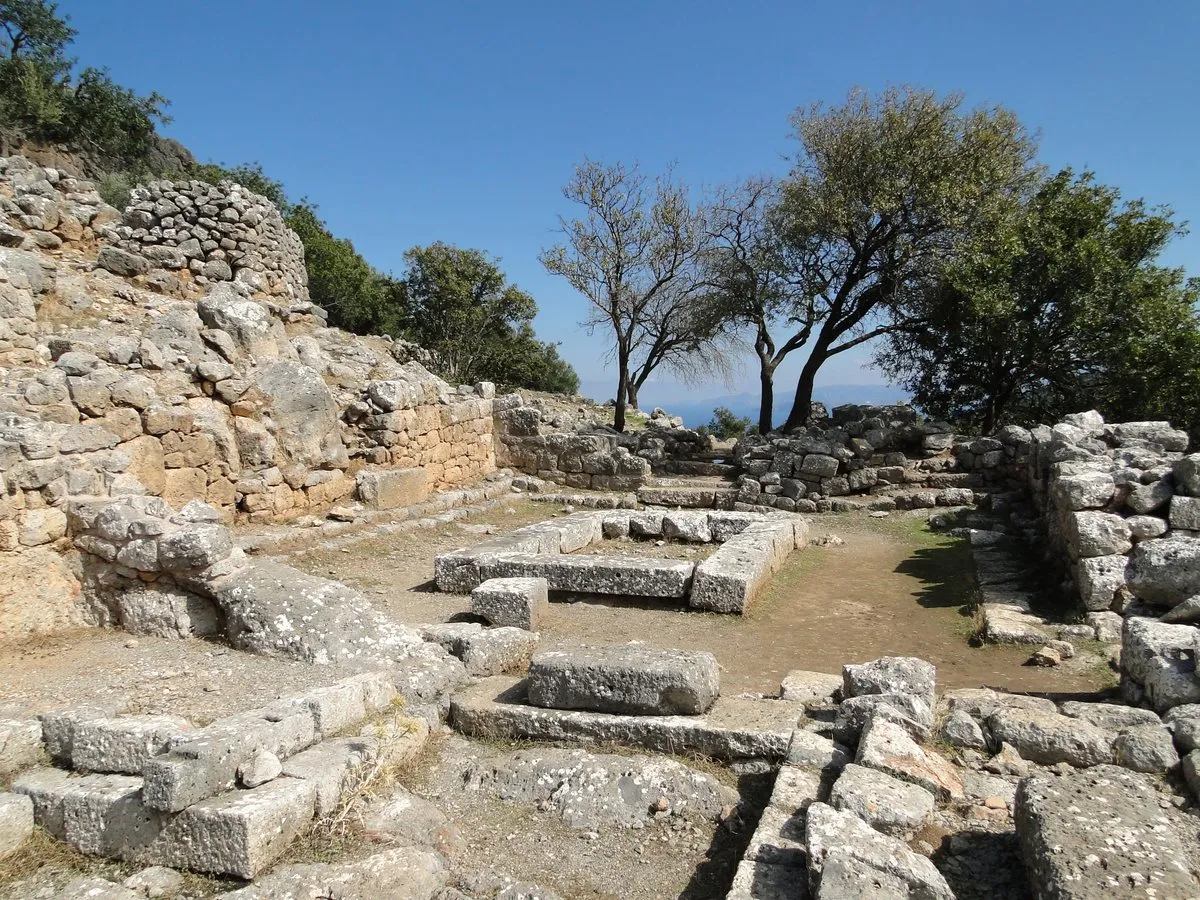
A regional guide describes the visit as the ancients made it. You enter on the west, where the gate stood, and climb a street through shops and workshops to a five-sided terrace holding the agora, with a large cistern whose roof once rested on two Doric columns. North of it, broad steps rise like a grandstand, probably seating for political or religious gatherings, and behind them stands the prytaneion, where the magistrates met. The main temple lies south of the agora, a small theatre is cut into the rock to the east, and the walls still stand impressively high in places.
Excavation began with Arthur Evans in the 1890s, ran under the French School in 1899–1901 and resumed from 1968. From the top, the view runs over the olives to the gulf and the town that replaced Lato.
Time, heat and the winter hours
No official source gives a visiting time; one visitor’s account of an hour alone there on an October morning is a fair guide. The approach runs through old olive groves, but no source promises shade among the ruins, and the paths are uneven stone: bring water, a hat and proper shoes in the warm months. In winter the 15:30 closing matters more than the heat, so arrive by early afternoon. The site shuts on the main public holidays — 1 January, 25 March, 1 May, Easter Sunday, 25–26 December — and keeps shorter 08:00–15:00 hours on others, among them Good Friday and 15 August.
Pairing it with Kritsa and Panagia Kera
Panagia Kera, the frescoed Byzantine church, stands about 1 km east of Kritsa and about 8 km from Agios Nikolaos, per the Region of Crete’s religious-monuments site; check its hours separately. A sensible order is Kera at opening, Lato before the light gets hard, then lunch in Kritsa. Without a car, the Ministry suggests the bus to Kritsa, then a walk or a taxi up.
The honest downside
Lato is mostly low walls and foundations, and it asks the visitor to supply the city. The Ministry’s own heritage database is out of date on the ticket and the free Sundays, and older guides give a different closing day. No shade is promised, the paths are rough, wheelchairs cannot get around inside, and the 15:30 closing makes it a morning trip.
Worth it if: you are already going to Kritsa, you like a site where the town plan still reads clearly, and you want a quiet hour with a view over the Mirabello gulf. Skip it if: you want reconstructed buildings or a museum, you are arriving after mid-afternoon, it is a Tuesday, or you need smooth, level paths.
Photos on this page: the agora and the prytaneion by Bernard Gagnon (CC BY-SA 4.0), via Wikimedia Commons, resized for the web. Described from our own visits; distances, prices, hours and rules are a check of published sources, November 2026. Distances, access, rules and any figures were checked against the Ministry of Culture’s ticketing site and its heritage database (the database still shows pre-2025 prices and one free winter Sunday; the ticketing site, which matches the ministry’s 2024 pricing decision, is followed here), the Region of Crete’s religious-monuments site, Wikipedia and regional guides (which disagree on when the city was abandoned), for the date shown at the top of this guide. Nobody pays to be featured in a guide — no business, no sponsor, no paid mention, ever. Adverts, where they appear, are labelled as adverts.
-
The short drive
1 Kritsa → 2 Ancient Lato
Driving times are Google's own, without traffic, checked November 2026 — the shape of the day, not a promise. Allow more on mountain roads, and more again in August.
How do you get to ancient Lato from Kritsa?
Ancient Lato is about 3 km north of Kritsa by a signposted road that turns off just after the Kritsa village sign and winds through olive groves to the entrance. The Ministry of Culture's ticketing site gives about 8 minutes by car from Kritsa, 18 minutes from Agios Nikolaos, or about 45 minutes on foot from Kritsa.
What are the opening hours of ancient Lato?
The Ministry of Culture's two official pages for ancient Lato both give 08:30–15:30 all year, closed on Tuesdays; its ticketing site adds that last admission is 20 minutes before closing. Some older guides say the site closes on Mondays instead, so check the official listing before a winter visit.
How much does ancient Lato cost?
The Ministry of Culture's official ticketing platform lists €5 full and €3 reduced for ancient Lato. The ministry's older heritage database still shows €3 and €2, figures from before the price categories were reorganised in April 2025, so budget roughly €5. Entry is free on the first and third Sunday of each month from November to March, and on a few fixed dates such as 28 October.
What can you see at ancient Lato?
Ancient Lato keeps its fortifications, a gate on the west side, a street climbing past workshops to the agora, a central cistern, broad steps that probably served as seating for gatherings, the prytaneion where the city's magistrates met, temples and a small theatre. Only part of the city has been excavated.
Is ancient Lato accessible for wheelchairs?
Only partly. The Ministry of Culture says wheelchairs cannot move around inside the site, but people with special needs can drive by another route to a secondary entrance with an observation point. Parking and accessible toilets are at the main entrance.
One email a month — only when something on this island actually changes. No spam, no partners, one-click unsubscribe. Read past issues before you decide.