Ancient Lyttos: The Honest Guide to Knossos's Old Rival Above Kastelli
Ancient Lyttos, the Dorian city on a hill three kilometres east of Kastelli that fought Knossos for centuries — what its history really is, what stands on the hill now, the 22 km Roman aqueduct, why there is no ticket office, and how the new airport fits in.
Ancient Lyttos is one of the great names of Cretan history and one of its least visited places, for a simple reason: there is little to see yet, and nobody sells a ticket to it. On a hill three kilometres east of Kastelli, the city that fought Knossos for centuries is being excavated again after forty quiet years, and what is there is a chapel, terraced walls, a view over the valley and a dig still turning up a Roman city. It suits readers who know Knossos and want the other side of the story, not anyone expecting paths and labels. Written from published sources; distances, prices, hours and rules are a check of published sources, November 2026.
The honest facts
- Where
- a hill above the village of Lyttos (Xidas until 1987), about 3 km east of Kastelli, in the municipality of Minoa Pediada; the village is about 39 km from Heraklion.
- Height
- 620 m for the acropolis by the excavation project; one regional guide says 650 m, and the village sits at about 656 m.
- Opening, tickets
- no Ministry of Culture listing, hours or fee found in this check, and not on the ministry’s 2024 ticket-price list; not presented anywhere as an organised visitor site.
- The dig
- the Lyktos Archaeological Project, since 2021, with the Heraklion Ephorate of Antiquities.
- On the hill now
- terrace and citadel walls, Roman public buildings, the chapels of Agios Georgios and Timios Stavros, ruined windmills.
- The finds
- statues of Trajan and Marcus Aurelius from Lyttos are in the Heraklion Archaeological Museum.
Knossos’s old rival
Lyttos appears in Homer’s catalogue of ships and its name is read in Linear B, so a place of that name existed in the Bronze Age. Its citizens later called themselves colonists of Sparta; one regional guide puts a Dorian foundation around 1000 BC, while noting a more recent view that settlers from Minoan Malia founded it. Its ports, by the same guide, were Hersonissos and Milatos.
In 220 BC Knossos settled the score: with the Lyttian army away fighting Hierapytna, it took the undefended city and destroyed it, and the survivors fled to Lappa, today’s Argyroupoli. Lyttos was rebuilt, and under Rome it built on a grand scale again: a council house dedicated to Hadrian was completed in 118 AD, according to press reports of the 2025 season. One more link to Knossos: Arthur Evans meant to dig Lyttos first and could not get the permits.
What is on the hill now
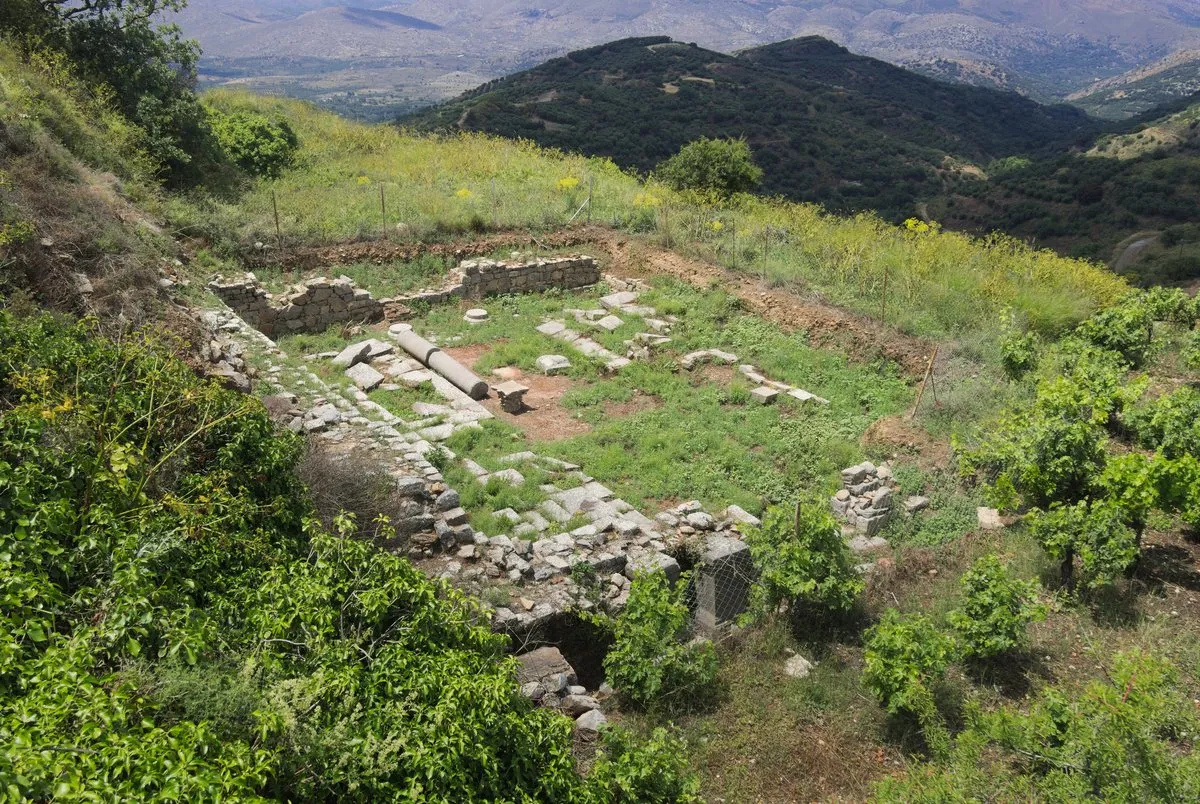
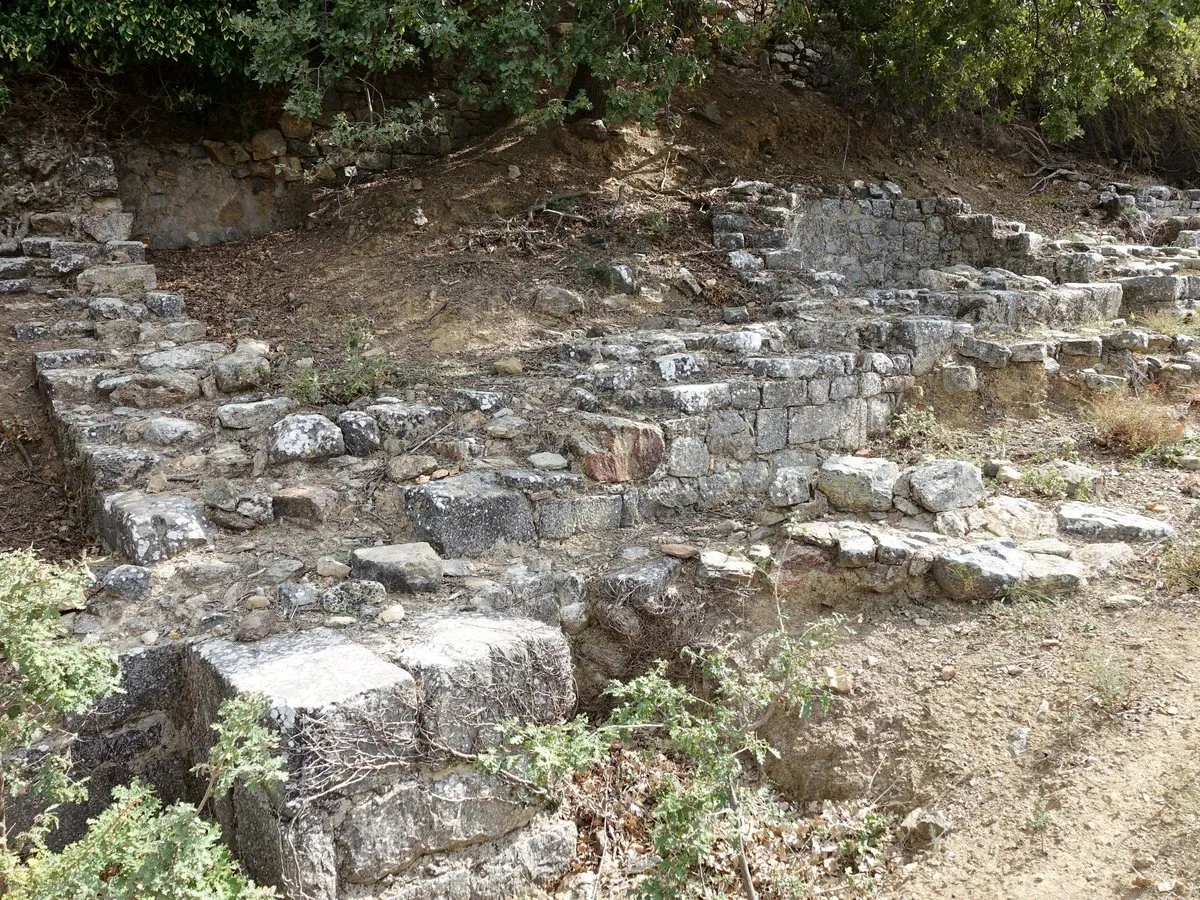
Only a small part of a city of perhaps 100 hectares is excavated. Regional guides list terrace walls, 7th-century BC citadel walls, Roman public buildings and ruined windmills, with two chapels among them: Agios Georgios on the acropolis, given as 14th-century, and Timios Stavros, given as 17th-century.
The new work began in July 2021, the first systematic excavation in about forty years, run by New York University and the Institute for Advanced Study at Princeton under the Archaeological Society at Athens, with the Heraklion Ephorate of Antiquities taking part. It has produced a headless marble Hadrian, an Archaic cemetery with pottery imported from Athens, Laconia and Corinth, more than 400 inscriptions and four seats from a theatre that Onorio Belli’s 1586 drawings called the largest in Crete. In July 2026 the project closed its sixth season and launched a second five-year programme.
None of it is laid out for visitors. No official source found gives hours, a fee or a route, and the trenches are working ground: look from the chapels and the hilltop, stay out of anything fenced, take nothing. Earlier finds are in the Heraklion Archaeological Museum.
The aqueduct and the Toichos wall
Roman Lyttos drew its water from the Lasithi foothills. One regional heritage site gives the aqueduct as about 22 km long, from the Nissimos plateau a few kilometres south of Krasi; another names the Kournia spring between Kera and Krasi. Its most visible piece is the Toichos, “the wall”, a substructure over 8 m high in places, reached from Kastamonitsa along an earth road. A 2024 survey mapped almost the whole line.
Getting there, and the airport next door
A car is the honest answer. KTEL lists winter departures from Heraklion’s central bus station that include Kastelli, valid to 23 December and again from 8 January; check the times on the timetable itself before relying on it, and remember Kastelli is still three kilometres from the site.
Kastelli is also where Crete’s new airport is being built: press reports in September 2026 gave commercial flights from November 2028. What that means for the area is in our Kasteli airport article; for now the hill is quiet.
The honest downside
There is no visitor site here: no ticket office, no published hours, no paths or panels in any official source, and the best finds are in Heraklion. The reported digging seasons have been in summer, so in November there is nothing to watch, and the aqueduct’s best wall is down an earth road. Without a car, it takes most of a day.
Worth it if: you have seen Knossos and the Heraklion museum, are driving through the Pediada anyway, and a chapel above a half-dug city is reward enough. Skip it if: you want a site with paths, labels and opening hours, you have no car, or you are hoping to see the excavation in progress in winter.
Photos on this page: the bouleuterion by C messier (CC BY-SA 4.0) and the ruins by Olaf Tausch (CC BY 3.0), via Wikimedia Commons, resized for the web. Written from published sources; distances, access, rules and any figures were checked against the Lyktos Archaeological Project at New York University, the Ministry of Culture’s 2024 ticket-price decision, Wikipedia, regional heritage and village listings (which disagree on the height and the aqueduct’s source), press reports of the 2021–2026 seasons, a University College Dublin report on the 2024 aqueduct survey, the KTEL timetables page and September 2026 airport press reports, for the date shown at the top of this guide. Nobody pays to be featured in a guide — no business, no sponsor, no paid mention, ever. Adverts, where they appear, are labelled as adverts.
-
The short drive
1 Kastelli → 2 Ancient Lyttos
Driving times are Google's own, without traffic, checked November 2026 — the shape of the day, not a promise. Allow more on mountain roads, and more again in August.
Can you visit ancient Lyttos?
Ancient Lyttos has no Ministry of Culture visitor listing, opening hours or ticket that turned up in a check of published sources in November 2026; it is not on the ministry's 2024 ticket-price list, and no source describes it as an organised visitor site. It is an active excavation on a hill above the village of Lyttos, reached by paved road. Treat it as a place to look at from the chapels and the hilltop, not as a ticketed attraction, and keep out of trenches and fenced areas.
Where is ancient Lyttos?
Ancient Lyttos sits on a hill just outside the village of Lyttos (called Xidas until 1987), in the municipality of Minoa Pediada. The village is about 3 km east of Kastelli and about 39 km from Heraklion, according to a regional gazetteer. The excavation project gives the acropolis as 620 m high; one regional guide puts the city at 650 m.
Who is excavating ancient Lyttos?
Since 2021 the Lyktos Archaeological Project, run by New York University's Institute for the Study of the Ancient World and the Institute for Advanced Study at Princeton under the Archaeological Society at Athens, has excavated at Lyttos with Vasso Sythiakaki of the Heraklion Ephorate of Antiquities. Its sixth season ended in July 2026, when a second five-year programme was launched.
What is the Lyttos aqueduct?
The Lyttos aqueduct is a Roman water channel, probably of the 2nd century AD, that carried water about 22 km to the city from springs near Krasi, according to one regional heritage site; another names the Kournia spring between Kera and Krasi. Its best-known section is a free-standing wall, called the Toichos, over 8 m high in places. A 2024 survey mapped almost its full length.
Is ancient Lyttos near the new Heraklion airport?
Yes. Ancient Lyttos is about 3 km east of Kastelli, where Crete's new international airport is being built. Press reports in September 2026 gave November 2028 as the target for commercial flights, so until then visitors still fly into the existing Heraklion airport on the coast.
One email a month — only when something on this island actually changes. No spam, no partners, one-click unsubscribe. Read past issues before you decide.