Kolymbari and Ravdoucha: The Honest Guide to the Gulf Villages West of Chania
A pebble-beach village with a working harbour and a fortified seventeenth-century monastery, and a hillside hamlet across the peninsula whose road drops to a handful of coves. Quieter than the resort strip, with more atmosphere than convenience.
Kolymbari (also spelled Kolymvari) is the most useful village west of the Chania resort strip for anyone who wants a real harbour, a fortified monastery a short walk away and a bus back to town, without the strip’s crowds. It is not a beach destination — the shore is pebbles — and Ravdoucha, over the ridge on the Kissamos side, is quieter still but really needs a car. This is a check of published sources — local, regional and official — made in October 2026, not a field visit.
The honest facts
- Where
- Kolymbari at the base of the Rodopou peninsula, Gulf of Chania side; Ravdoucha on its western side, above the Gulf of Kissamos.
- Distance from Chania
- Kolymbari roughly 23–25 km (about 25 minutes by car); Ravdoucha roughly 30 km.
- Distance from Kissamos
- Kolymbari roughly 15–20 km; Ravdoucha about 14 km.
- Bus
- KTEL from Chania’s central station, around 40 minutes; fares a few euros.
- Beach type
- Kolymbari mostly pebble with added sand near the harbour; Ravdoucha pebble coves and rock.
- Monastery
- Gonia (Moni Odigitrias Gonias), on its present site since 1618; museum roughly €2, hours verify seasonally.
- Best for
- a calm base with a bus link, a monastery visit, snorkelling at Ravdoucha.
Kolymbari: harbour, pebbles and a bus stop
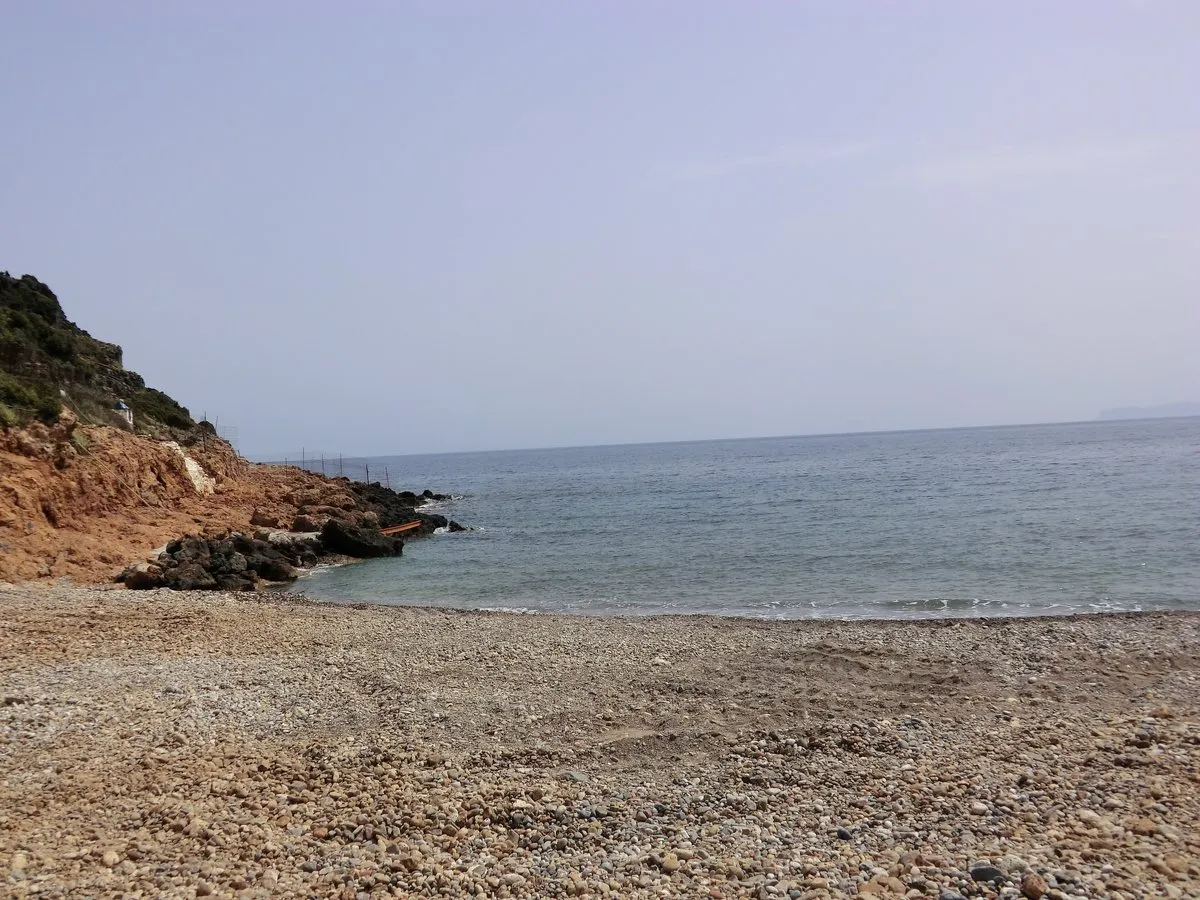
The municipality describes Kolymbari as a coastal town of about a century’s standing, with older settlements dating to the Venetian period. The beach runs for around 4 km by one account, mostly pebble, with sand added near the small harbour, where the fish tavernas and seasonal boat trips are. The municipality also lists a small fishing museum in the centre that hosts art exhibitions; opening times are not published, so verify locally.
KTEL Chania–Rethymno lists Kolymbari as a destination from Chania, and the busy Chania–Kissamos line also calls here. Through-buses to Kissamos stop at the junction on the national road, while some services run down into the village and harbour; the KTEL bus guide covers tickets and timetables. The area’s olive oil carries its own protected designation, “Kolymvari Chanion Kritis” PDO, registered in 1997 and made mostly from Koroneiki olives (see the olive oil buying guide).
Gonia Monastery: a fortress by the sea
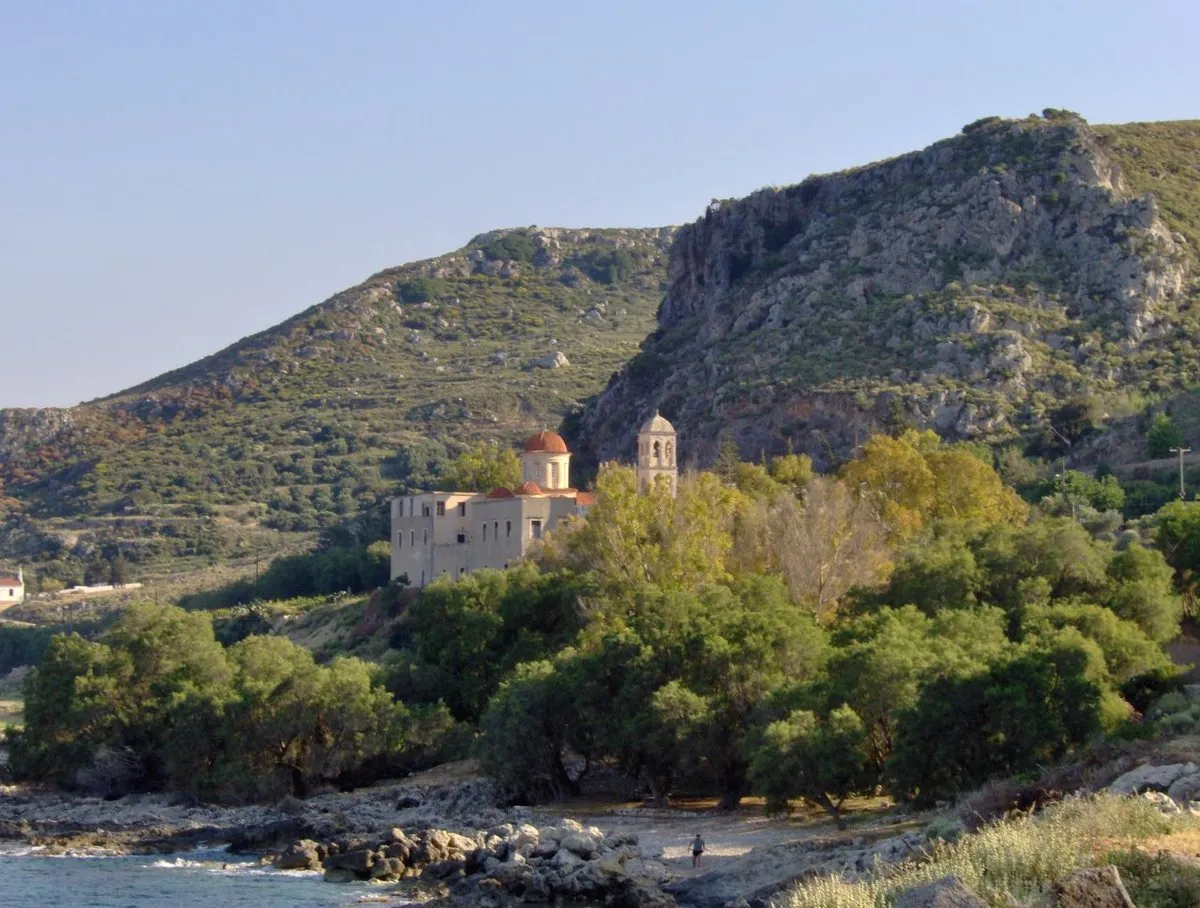
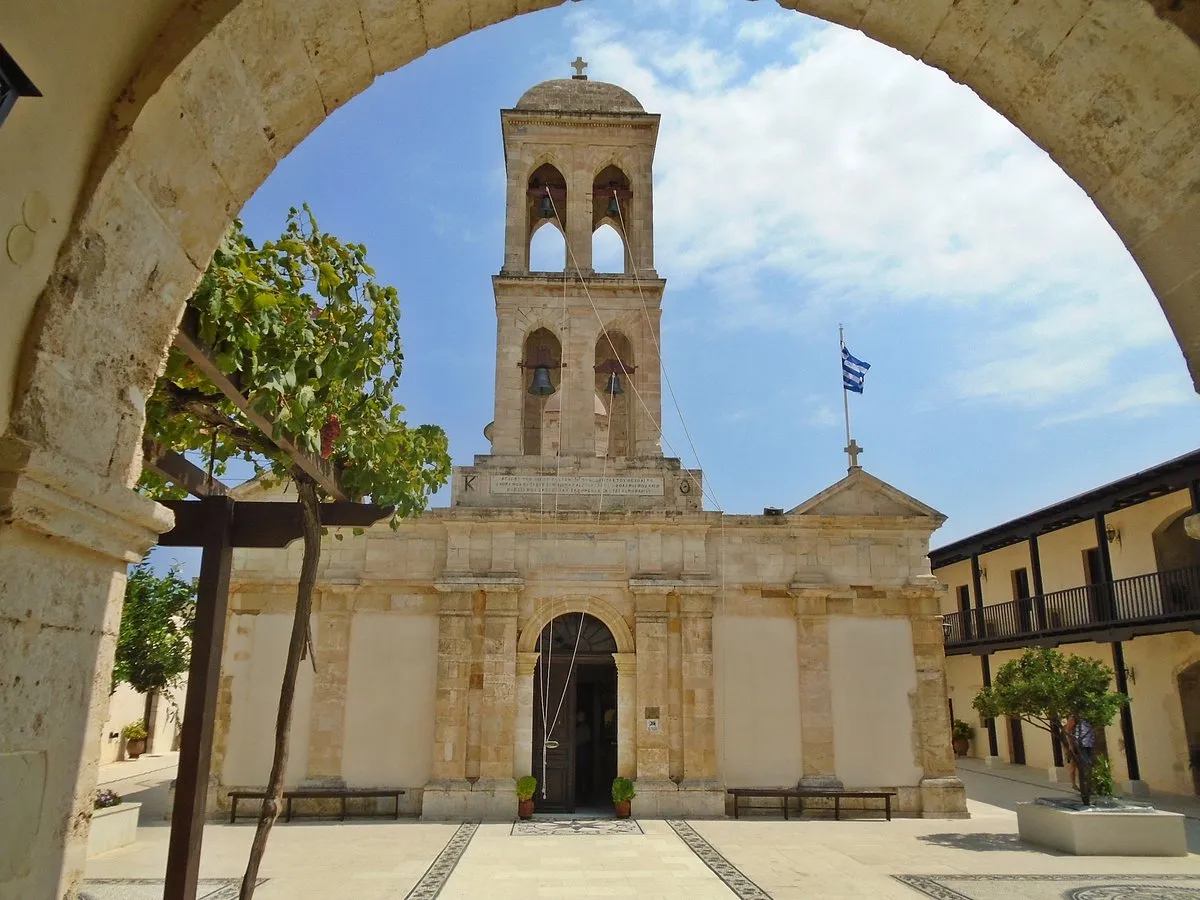
Gonia Monastery stands on the waterfront north of the village, 1–2.5 km from the centre depending on the source. The municipality traces the community to the ninth century; the monk Vlasios moved it to its present site in 1618. Its walls were bombarded repeatedly in the Ottoman era, and a cannonball, dated to 1867 during the Cretan revolt, is still lodged in the masonry. The monastery was partly destroyed by German bombing in the Second World War.
The small museum holds icons and church treasures from the fifteenth to seventeenth centuries, including Cretan icons attributed to Parthenios, Andreas Ritzos and Neilos. No photography inside; entry roughly €2. One listing gives summer hours of 09:00–14:00 and 16:00 to sunset, with only morning opening in winter, but others differ — verify seasonally. The main feast is 15 August. Cover shoulders and knees.
The Orthodox Academy of Crete
Next door, on land given by the monastery, is the Orthodox Academy of Crete, inaugurated on 13 October 1968 and recognised in 1970 as a public-benefit institution with private-law status. It is a conference and research centre for dialogue between faith, science and culture, and in 2016 hosted the Holy and Great Council of the Orthodox Church. Its original 1968 conference building has been renovated with Region of Crete funding, with reopening scheduled for 23 November 2026.
For visitors, the draws are the Botanical Museum of Cretan Plants and its gardens, the library and the icon-painting workshop. No visiting hours are published and the buildings mainly serve conference guests: a quick look, not an attraction.
Ravdoucha: the coves on the other side
Ravdoucha is a small village about 200 m up on the peninsula’s western flank, about 7 km from Kolymbari by road. A short paved road leaves the national road, and from the village a zigzag road of roughly 1.5 km drops to the coast. It splits at the bottom: one way to a tiny harbour with a couple of tavernas, the other to a pebble beach lined with tamarisks and rocky coves with natural pools. Sources mention a cave chapel in the rock but disagree on its saint. A sandy cove with a small pier, Neratzia, sits beside the harbour. Snorkelling is good; bring water shoes. Weekends bring locals; weekdays are quieter.
For Afrata, 3 km north, and remote Menies, see the Rodopou peninsula guide.
The honest downside
Ravdoucha faces west, and sources agree westerly winds often whip up the sea there, so on a blowy afternoon the snorkelling coves turn choppy and the pebble beach offers little shelter beyond a few tamarisks. No bus into Ravdoucha appears in the sources checked, so without a car you face a walk from the national road, then a steep zigzag down — and back up. At Kolymbari the beach is pebble, the shops sit along the main road rather than the shore, and the monastery’s midday closure, where it applies, catches out anyone arriving after lunch.
Worth it if: you want a calm, bus-connected base west of Chania, a fortified monastery with a genuine icon collection, and a quiet cove to snorkel on the Kissamos side. Skip it if: you need sand or nightlife — the resort strip or Kissamos will suit you better.
Photos on this page: the beach by ruud.trygve (CC BY 3.0), the monastery from the shore by Bunny1948 (CC BY-SA 2.0) and its courtyard by Plucas58 (CC BY-SA 4.0), via Wikimedia Commons, resized for the web. The guide is a check of published sources, not a site visit: distances, facilities and access were checked against the sources named for the date shown at the top of this guide. Nobody pays to be featured in a guide — no business, no sponsor, no paid mention, ever. Adverts, where they appear, are labelled as adverts.
-
Both sides of the Rodopou peninsula — Kolymbari, the monastery and the Academy sit on the Chania Gulf side within walking distance of each other; Ravdoucha is on the Kissamos Gulf side, roughly 7 km by road.
1 Kolymbari harbour 2 Gonia Monastery 3 Orthodox Academy of Crete 4 Ravdoucha
Tap a name to open it in your map app. These are options, not an order — pick by the day you have.
How far is Kolymbari from Chania?
Kolymbari is roughly 23–25 km west of Chania, about 25 minutes by car on the national road. KTEL buses from Chania's central station take around 40 minutes. Kissamos is a further 15–20 km west, depending on which source you read.
Is there a bus to Kolymbari?
Yes. KTEL Chania–Rethymno lists Kolymbari as a destination from Chania, and the busy Chania–Kissamos line also stops at Kolymbari. Some buses run down into the village and harbour, while through-buses to Kissamos stop at the junction on the national road, so check which one you are boarding.
What is the beach like at Kolymbari?
Kolymbari beach is a long strip, around 4 km by one account, made up mostly of pebbles. Sand has been added near the harbour. Water shoes make the pebbly sections more comfortable.
When is Gonia Monastery open?
Gonia Monastery publishes no single timetable, and sources disagree. One recent listing gives 09:00–14:00 and 16:00 to sunset in summer, with mornings only in winter; others give a single morning-to-afternoon block. Verify seasonally, dress modestly, and expect a museum fee of roughly €2.
Can you visit the Orthodox Academy of Crete?
The Orthodox Academy of Crete is a working conference and research centre, not a tourist attraction, and its buildings mainly serve conference guests. It runs a Botanical Museum of Cretan Plants, a library and an icon-painting workshop; ask at reception or contact the Academy before going in, as there are no published visiting hours.
How do you get to Ravdoucha beach?
Ravdoucha village sits about 200 m up on the western side of the Rodopou peninsula, reached by a short paved road from the Chania–Kissamos national road. From the village a zigzag road of roughly 1.5 km drops to the coast, where it splits: one branch goes to the small harbour and tavernas, the other to pebble coves. A car is the practical way in.
One email a month — only when something on this island actually changes. No spam, no partners, one-click unsubscribe. Read past issues before you decide.