Lissos: The Honest Guide to the Walk from Sougia to an Ancient Healing Sanctuary
An hour and a half on foot over a bare coastal plateau from Sougia to a hidden bay with a temple of Asclepius, a mosaic floor, Roman tombs and two old chapels — and a fire-season rule that can close the path.
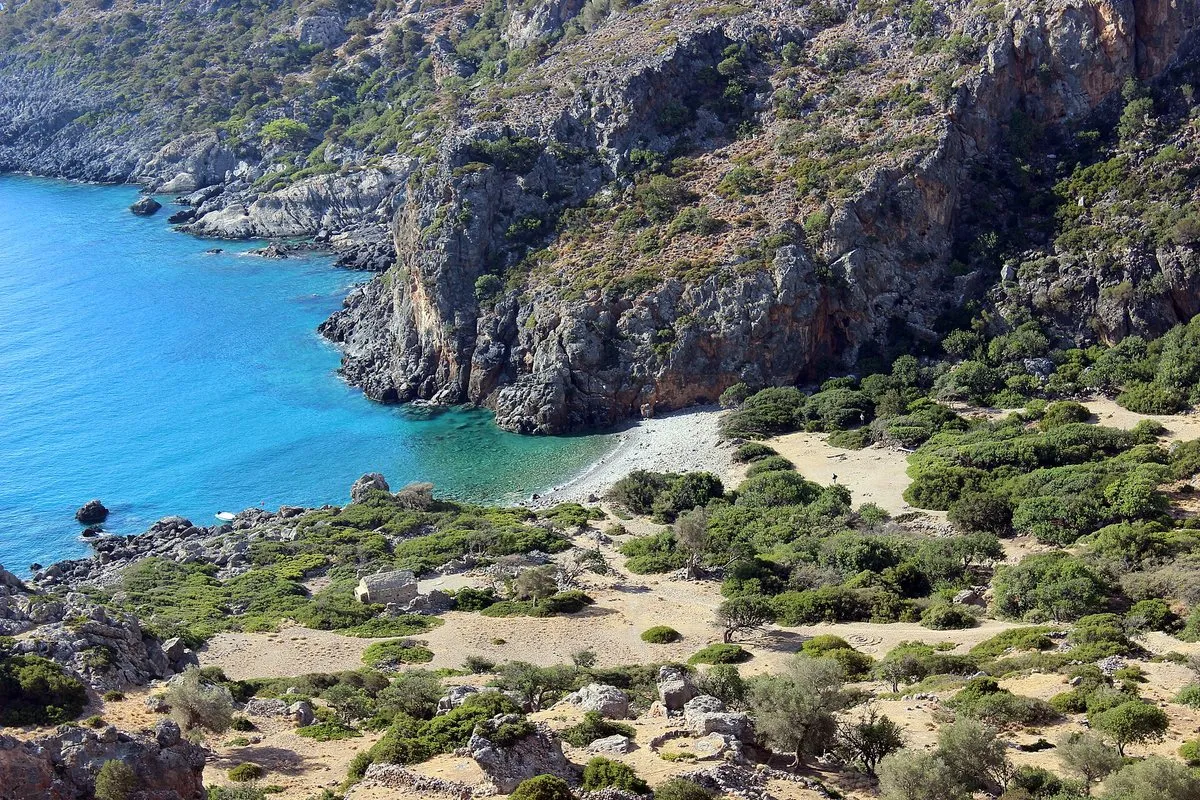
Lissos is the reward for a short, hot walk: a hidden bay west of Sougia where a small ancient city once lived off a healing sanctuary. What survives is the temple of Asclepius with its mosaic floor, a little Roman theatre, vaulted tombs on the hillside, two old chapels among the trees, and a pebble beach with nobody on it. There is no road. You walk from Sougia — about an hour and a half — or you find the small boat. Distances and times come from walking sources and the Region of Crete’s 2026 fire-season order, checked in September 2026; the walk and the site are described from our own visits.
The honest facts
- Distance
- about 3–3.5 km each way from Sougia harbour on the E4 (one source says roughly 4), with around 240 m of climbing.
- Time
- roughly 1 hour 30 each way at a steady pace.
- Shade and water
- pine shade for about the first 30 minutes, then none on the Kadouni plateau. Carry all your water.
- At the site
- the Asklepieion (3rd century BC) with its mosaic floor, a small Roman odeon, a cemetery of vaulted tombs, and the chapels of Agios Kirykos and the Panagia.
- The beach
- coarse pebble, about 200 m from the site.
- Fire season
- the E4 from Sougia towards Gialiskari is closed on category 4 and 5 fire-risk days, 1 May–31 October.
The walk
The path leaves the western end of Sougia’s harbour and climbs into a short, narrow gorge under pines — the only shade you will get. Walking sources describe a fence at the gorge entrance: open the gate and close it behind you. Above the gorge the path comes out onto the Kadouni plateau, open and stony, with the Libyan Sea on your left and the sun on your back. It is not difficult walking, but in July and August this stretch is the whole difficulty: start early, before nine if you can, and turn back if the heat is building faster than you are.
After the plateau the path drops into the valley of Lissos, and the view opens onto the bay. The descent is stony underfoot; walking shoes, not sandals.
The sanctuary
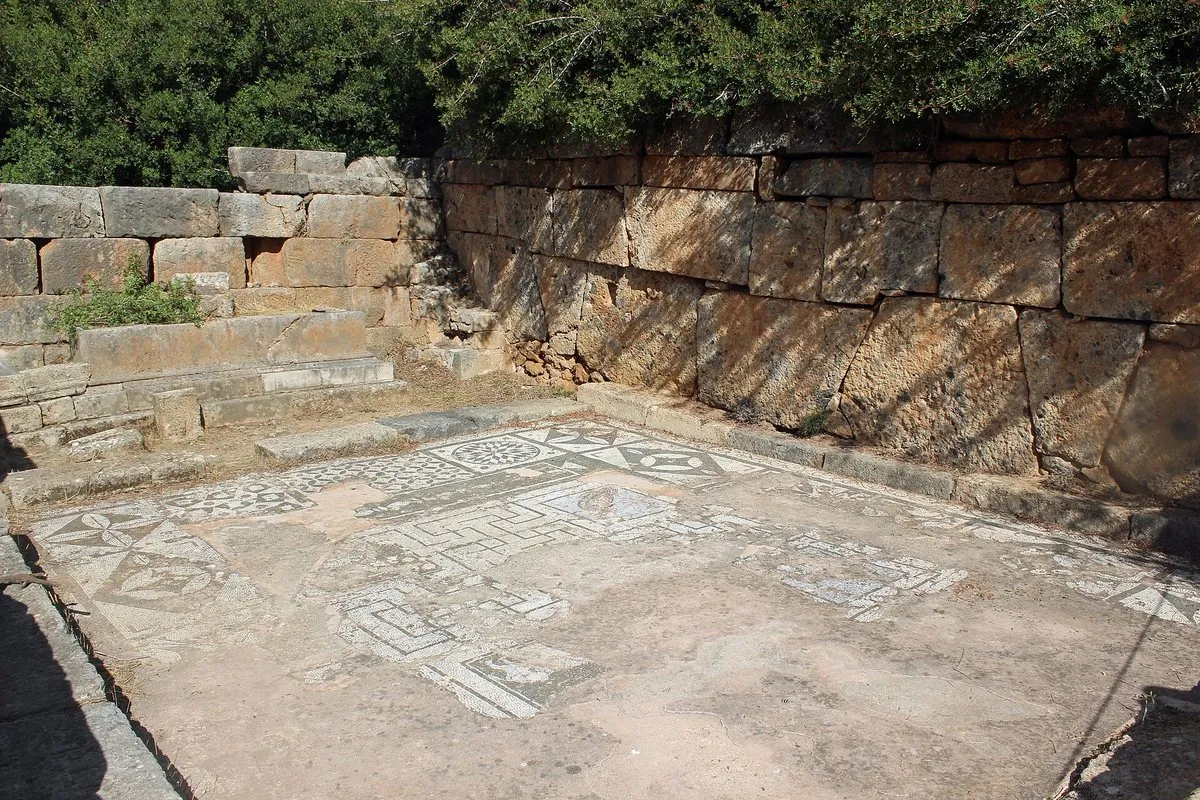
The heart of the site is the temple of Asclepius, the god of healing, built in the 3rd century BC. Its floor keeps a mosaic of animals and geometric patterns, set inside the lower courses of the temple walls. Statues found here, including figures of Asclepius and Hygeia, went to the Archaeological Museum of Chania, so what you see on site is architecture rather than sculpture. Nearby are the stepped seats of a small Roman theatre, and across the valley the hillside is lined with barrel-vaulted Roman tombs.
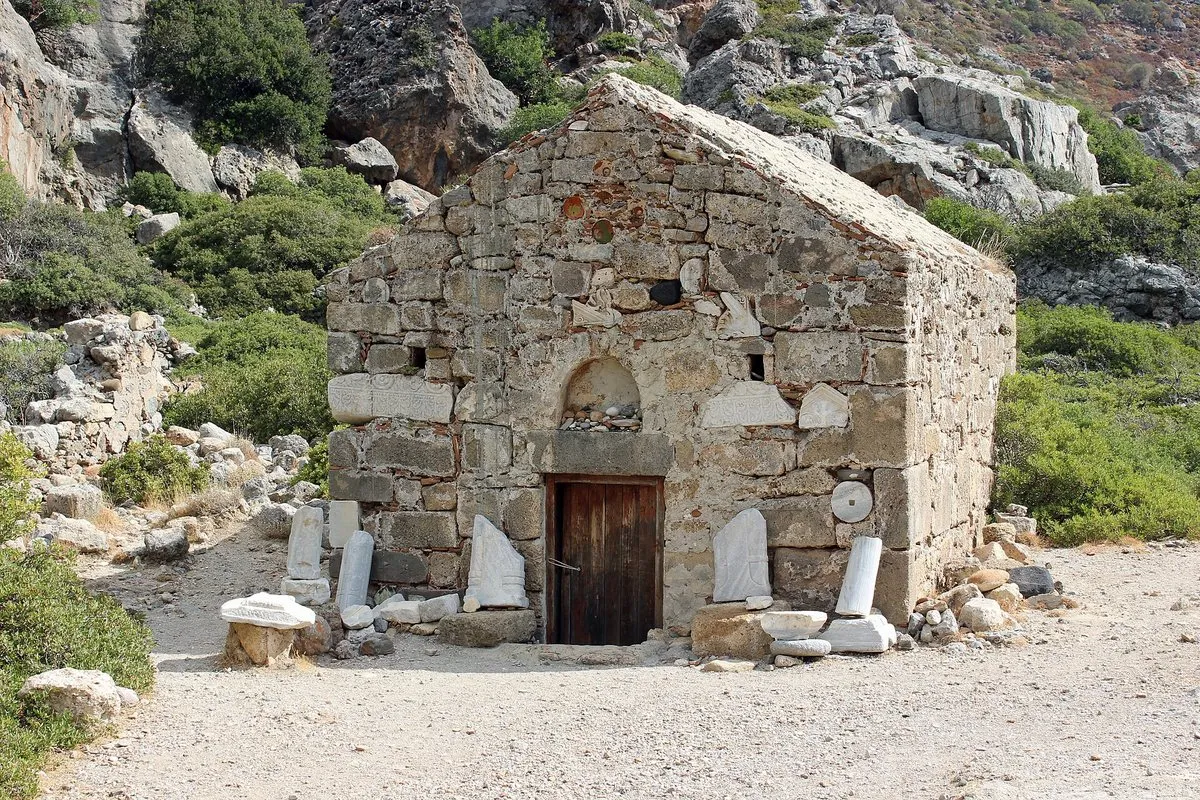
Two chapels stand among the ruins, Agios Kirykos and the Panagia. A programme of works announced in 2020 was to add paths linking the monuments and a guard post; we could not confirm whether the site is now staffed or charges a fee.
Planning it
Check the fire-risk map the evening before: on a category 4 or 5 day the path is legally closed. Take a hat, sun cream and more water than feels necessary. If you are staying in Sougia or Paleochora, Lissos fills a morning; from Paleochora the whole coastal path is about 14.5–16 km and five to six hours, which is a different undertaking. Lissos is a section of the E4 — the long-distance route is explained in our E4 guide — and it pairs well with the Agia Irini gorge, which ends a few kilometres above Sougia.
The honest downside
The plateau is shadeless and properly hot in summer, the fire order can close the path on exactly the days you planned, and the site is modest: low walls, one mosaic floor, a scatter of tombs. Without the walk and the empty bay, few people would come for the ruins alone.
Worth it if: you are in Sougia or Paleochora, can start early, and like your antiquities with a walk and a swim attached. Skip it if: you are walking in the midday heat, have mobility problems on stony ground, or expect a staffed archaeological site.
Photos on this page: the bay, the Asklepieion mosaic and the Panagia chapel by Maesi64 (CC0), via Wikimedia Commons, resized for the web. The walk and the site are described from our own visits; distances, times, the fire-season closure and the site details were checked against walking sources, Greek press reports and the Region of Crete’s 2026 fire-season order for the date shown at the top of this guide. Nobody pays to be featured in a guide — no business, no sponsor, no paid mention, ever. Adverts, where they appear, are labelled as adverts.
-
The walk — West from Sougia harbour on the E4, through the small gorge, over the plateau and down to the bay.
1 Sougia → 2 Ancient Lissos
Driving times are Google's own, without traffic, checked September 2026 — the shape of the day, not a promise. Allow more on mountain roads, and more again in August.
How long is the walk from Sougia to Lissos?
About 3 to 3.5 km each way by most walking sources (one says roughly 4 km), taking around an hour and a half at a steady pace, with a climb of roughly 240 metres. It follows the E4 west from Sougia harbour through a short gorge and over the bare Kadouni plateau before dropping to the bay.
Is there shade and water on the Lissos walk?
There is pine shade for roughly the first half hour, then none on the plateau. Sources disagree about drinking water on the way, so carry all you need — plenty of it in summer — plus a hat and sun protection.
What is there to see at ancient Lissos?
The sanctuary of Asclepius from the 3rd century BC, with a mosaic floor of animals and geometric patterns; a small Roman theatre or odeon; a cemetery of barrel-vaulted Roman tombs; and two old chapels, Agios Kirykos and the Panagia. The pebble beach is about 200 metres from the site.
Can the path to Lissos be closed?
Yes. The Region of Crete's 2026 fire-season order lists the E4 path from Sougia towards Gialiskari, which is the route to Lissos, as an area closed to walkers on days rated category 4 or 5 on the national fire-risk map. The fire season runs from 1 May to 31 October; check the map the evening before.
Is there a boat to Lissos?
Walking sources mention a small boat that shuttles between Sougia and Lissos in season, useful for returning without repeating the walk. We could not confirm its schedule or season from an official source — ask at Sougia harbour on the day.
One email a month — only when something on this island actually changes. No spam, no partners, one-click unsubscribe. Read past issues before you decide.