Kallikratis and Asfendou Gorges: The Honest Guide to Sfakia's Quiet Way Down to Frangokastello
Two dry, little-walked gorges dropping about 500 metres from the Sfakia uplands to the coast near Frangokastello — no ticket, no crowds, a village with a hard history, and no easy way back to the car.
The Kallikratis and Asfendou gorges are the two quiet ways down from the Sfakia uplands to the south coast, a couple of kilometres apart, both landing near Frangokastello. Neither has a ticket booth, a coach park or a crowd, and that is the whole case for them over Imbros, the next gorge west. They are dry, sunny, about 500 metres of descent each, and point-to-point with no easy way back to the car. Described from our own visits; lengths, access and the 2026 fire-season rules were checked against published sources in October 2026.
The honest facts
- What they are
- two dry gorges from the uplands east of Askifou down to the coastal road near Frangokastello, roughly 2 km apart.
- Kallikratis gorge
- Kallikratis village (about 540 m) to Patsianos — a 4 km path by some sources, up to 6.5 km and about 3 hours by others; roughly 510 m down.
- Asfendou gorge
- Asfendou village to Agios Nektarios — about 5 km, around 500 m down, steep in places; published times up to 4 hours.
- Water and shade
- both generally dry; vegetation mostly in the streambed. Carry all your water.
- Getting to the top
- Kallikratis by road from Asi Gonia or Myriokefala, from Asfendou, or by a paved road of 25-plus hairpins up from Kapsodasos; Asfendou by a turn off the Hora Sfakion road just after the Askifou plateau.
- The catch
- both end about 500 m below where you parked, and there is no footpath between the two top villages.
- Fire season
- neither is named in the Region’s order of 16 June 2026; Imbros, next door, is on its category 5 list.
- Best months
- March to early May, by one walking source; summer is scorching.
Kallikratis: the plateau and its history
Kallikratis sits on a small plateau at about 540 m, its houses scattered in four widely separated neighbourhoods. Before 1900 it had more than 130 families; today a few tens of people live there, fewer in winter. The plateau is one of the three ways into Sfakia, which is why the village was razed in 1770 and again in 1821, and in October 1943 German forces surrounded it in reprisal for local support of the resistance, executed around thirty civilians, burned the houses and expelled the survivors. A monument with the victims’ names stands in the village, and the walk starts there, by the village church of the Panagia.
North of the plateau the E4 runs about 16 km to Argyroupoli, mostly on dirt and paved roads.
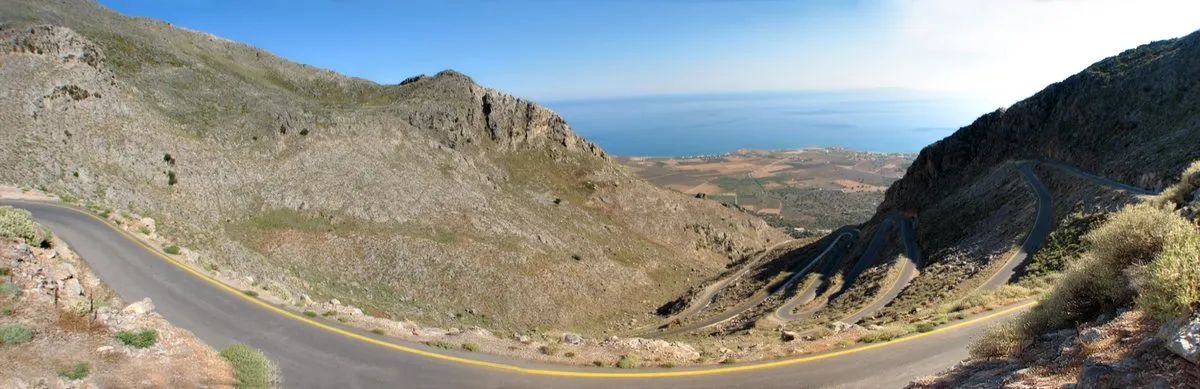
The Kallikratis gorge
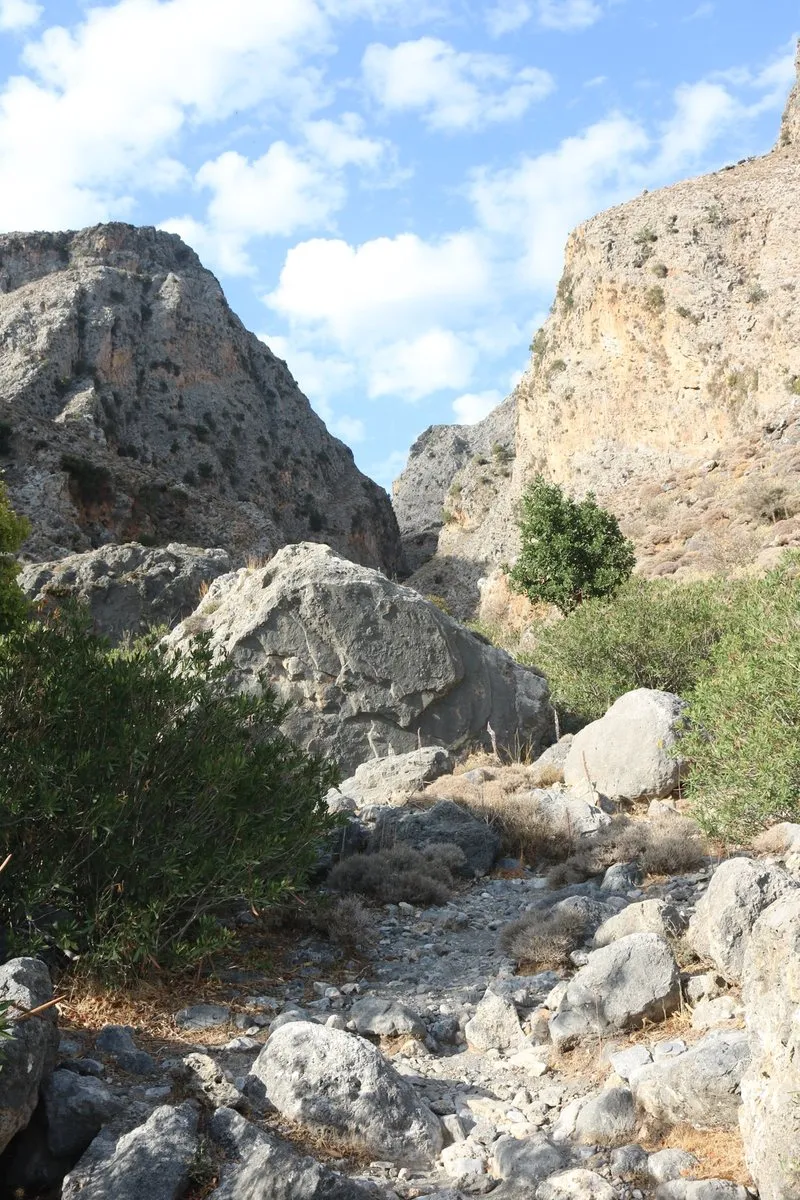
The gorge runs south-west from the village to Patsianos, a few kilometres from the sea at Frangokastello. At first an asphalt road runs parallel to the bed; then the path drops into the riverbed, which deepens as the road climbs away on the left, with views over the Libyan Sea. Road-works rubble has altered the trail in places, and heavy rain in recent years has damaged paths across Crete’s gorges.
The Asfendou gorge
Asfendou is an almost deserted village used by a few shepherds. The path down is passable but steep, mostly parallel to the streambed, and partly an old kalderimi, a paved mule path whose stones still show in places. Descriptions mention a shepherd’s cave and, shortly before the abandoned hamlet of Kolokasia, the frescoed cave church of Agios Antonios. The upper gorge is shallow, the walls drawing back; lower down it narrows and holds the heat at noon.
Near Asfendou village, a small gated cave carries rock engravings in several layers — four-legged animals that some researchers read as the island’s extinct dwarf deer, later boats and cup-marks. Their age is debated and the cave is tiny: do not plan the day around getting in.
The return problem
Both walks are one-way, ending around 500 m below the start. The answers are two cars, a pre-arranged lift, or walking back up. A round walk of about 17 km links both gorges, but the stretch between Asfendou and Kallikratis is on the road — no footpath exists. Do not count on a bus to the upper villages; the bus guide explains how KTEL Chania works.
Fire season and safety
The Region of Crete’s order of 16 June 2026 closes listed areas on category 4 and 5 fire-risk days. Neither Kallikratis nor Asfendou is on it; the Imbros and Aradena gorges are, on the category 5 list. The 2026 fire season runs to 31 October. Not being listed is not a recommendation: check the daily fire-risk map the evening before and read our heat and fire-risk guide. With no water and nobody else on the path, tell someone your plan.
Making a day of it
Both land a short drive from Frangokastello, the obvious swim afterwards. From Chania, the Askifou plateau and its war museum sit on the way to the Asfendou turn.
The honest downside
These are dry, stony walks with modest walls and no services at either end, and the logistics are the hard part: without a second car or a lift, the day becomes a 1,000-metre round trip. Paths shift after storms and summer is too hot.
Worth your time if: you want a Sfakia gorge to yourself in spring or autumn, have the transport sorted, and care about the history of the villages you walk through. Skip it if: you want shade, water and a well-trodden path — Imbros is the comfortable choice — or you are relying on buses.
Photos on this page: the Kallikratis road by Lourakis (CC BY-SA 3.0) and the Kallikratis gorge by Rudolphu (CC BY-SA 4.0), via Wikimedia Commons, resized for the web. Described from our own visits; distances, access, rules and any figures were checked against regional gorge and plateau listings, published walking descriptions, the Region of Crete’s 2026 fire-season order and the General Secretariat for Civil Protection for the date shown at the top of this guide. Nobody pays to be featured in a guide — no business, no sponsor, no paid mention, ever. Adverts, where they appear, are labelled as adverts.
-
Kallikratis gorge
1 Kallikratis 2 Patsianos
-
Asfendou gorge
-
Nearby
Tap a name to open it in your map app. These are options, not an order — pick by the day you have.
How long is the Kallikratis gorge walk?
The Kallikratis gorge runs from the Kallikratis plateau, at about 540 m, down to the village of Patsianos near Frangokastello. Sources give it as a 4 km path or up to 6.5 km and about three hours, with roughly 510 m of descent, depending on where the count starts.
How long is the Asfendou gorge walk?
The Asfendou gorge is about 5 km from the almost deserted village of Asfendou down to Agios Nektarios on the south coast road, with about 500 m of descent. It is steep in places, partly on an old paved mule path, and published times run up to four hours.
Can you walk the Kallikratis and Asfendou gorges as one loop?
Walking sources describe a round walk of about 17 km taking in both the Kallikratis and the Asfendou gorges, but warn that there is no footpath between the two upper villages: that link is on the road. The practical answer is to walk one gorge down and arrange a car or a lift back up.
Are the Kallikratis and Asfendou gorges closed on high fire-risk days?
Neither the Kallikratis nor the Asfendou gorge is named in the Region of Crete's fire-season order of 16 June 2026. The neighbouring Imbros gorge is, on the category 5 list. Check the daily fire-risk map anyway: an empty gorge with no water is the wrong place to be on an extreme day.
How do you get to Kallikratis village?
Kallikratis is reached by road from Asi Gonia or Myriokefala to the north, from Asfendou and the Askifou side, or up a paved road with more than 25 tight hairpins from Kapsodasos on the coast near Frangokastello.
What happened at Kallikratis in 1943?
In October 1943 German forces surrounded Kallikratis in reprisal for local support of the resistance, executed around thirty civilians, mostly men, looted and burned the houses and expelled the rest of the villagers. A monument with the victims' names stands in the village.
One email a month — only when something on this island actually changes. No spam, no partners, one-click unsubscribe. Read past issues before you decide.