Dia Island: The Honest Guide to the Uninhabited Island off Heraklion
The long, low island on Heraklion's horizon: a Natura 2000 site with introduced kri-kri, endemic rabbits and Eleonora's falcons, a sheltered bay with a chapel, Minoan harbour traces under the water, and nothing else at all — reached only on seasonal excursion boats.
Dia is the long, low island on Heraklion’s horizon, and a day there is a swimming day, not a sightseeing one. It is uninhabited, protected, and almost entirely bare: a sheltered bay with a jetty and a chapel, a few small beaches, clear water, and a rocky interior of scrub and cliffs. Excursion boats run in summer, and there is nothing to buy that you can count on. It suits a day in open water off a boat, not anyone expecting a village or shade on demand, and in November it may not be reachable at all. Described from our own visits; distances, prices, hours and rules are a check of published sources, November 2026.
The honest facts
- Where
- north-north-east of Heraklion’s port; published distances run from about 7 miles to some 13 km.
- Size
- about 12 km², some 5 km by 3 km; the highest point is between 220 and 266 m, depending on the source.
- Getting there
- excursion boats only, mainly from the port of Heraklion, usually to the bay of Agios Georgios; seasonal.
- Protection
- Natura 2000 site GR4310003, listed by NECCA under its eastern Crete unit.
- Wildlife
- introduced wild goats, an endemic rabbit and lizard, breeding Eleonora’s falcons; monk seals are reported around it.
- What is there
- two landing platforms, a chapel, a refuge building and small beaches at Agios Georgios.
- What is not
- residents, shops, electricity, scheduled ferries, and in November, probably boats.
An empty island on the doorstep
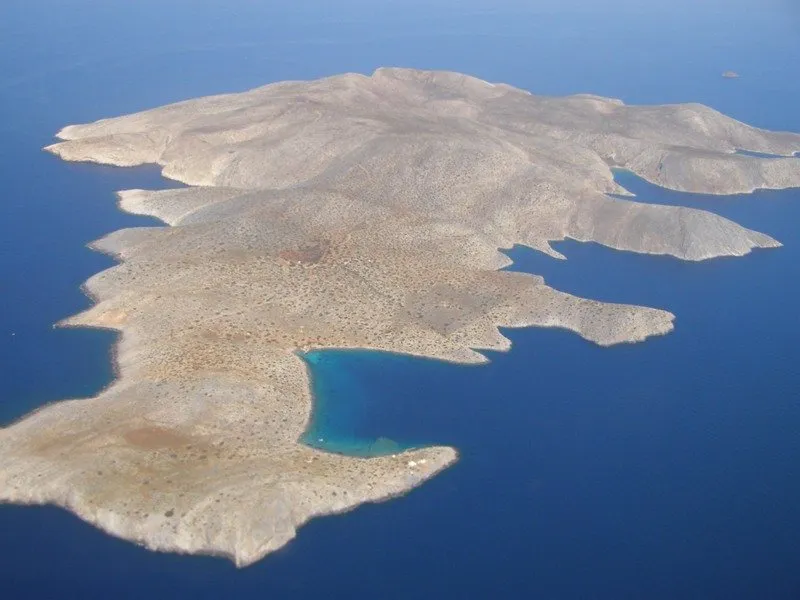
The Natura 2000 data on the NTUA biotope database gives Dia 1,188 ha of land and calls it an important site for endemic plants of the southern Aegean, with its own subspecies of wild rabbit and of the Erhard’s wall lizard. The Key Biodiversity Areas listing describes steep cliffs under phrygana and scrub, almost all of it inside protected land.
Boats use the south coast. A Greek island guide names four sheltered bays there, from Agios Georgios through Kapari and Panagia to Agrielia, with Agios Georgios holding the only small harbour and the main beaches.
The kri-kri, the falcons and the gaps
Dia’s kri-kri are the part most often oversold. The Natura site data lists the wild goat as introduced and counts its management among the island’s problems; the Region mentions a kri-kri breeding facility. Expect cliffs and scrub where goats live, not a goat at the jetty.
The birds are the stronger case. The site data lists Eleonora’s falcon among its species of concern, and reference sources, citing BirdLife International, put the breeding colony at roughly 300–380 pairs; that figure could not be checked at source. The Region’s ecotourism pages add that Dia is an important resting place for migrating birds in autumn.
Paper protection is not protection on the ground. A parliamentary question of 7 October 2025 said the island, public land, had no completed management plan, no clear framework for its guarding, and pressure from illegal fishing and uncontrolled visits, while a request by the Municipality of Hersonissos to take over its care was pending. So: take everything back, light nothing, and leave animals alone.
The harbour under the water
Dia sheltered ships from the north wind for millennia. The Region says Jacques Cousteau’s research off the south coast found the remains of wrecks from the Minoan period to modern times. The island guide adds that a walled Late Minoan harbour settlement was found near Agios Georgios, and that in 1976 Cousteau’s team found squared stones of a submerged breakwater he believed was a port of Knossos. The 2025 parliamentary question cites research by the Ephorate of Underwater Antiquities and the University of Crete pointing the same way, which puts the island under the antiquities law. None of it is laid out for visitors; on a snorkel, look and leave everything where it lies.
Boats, season and what a day looks like
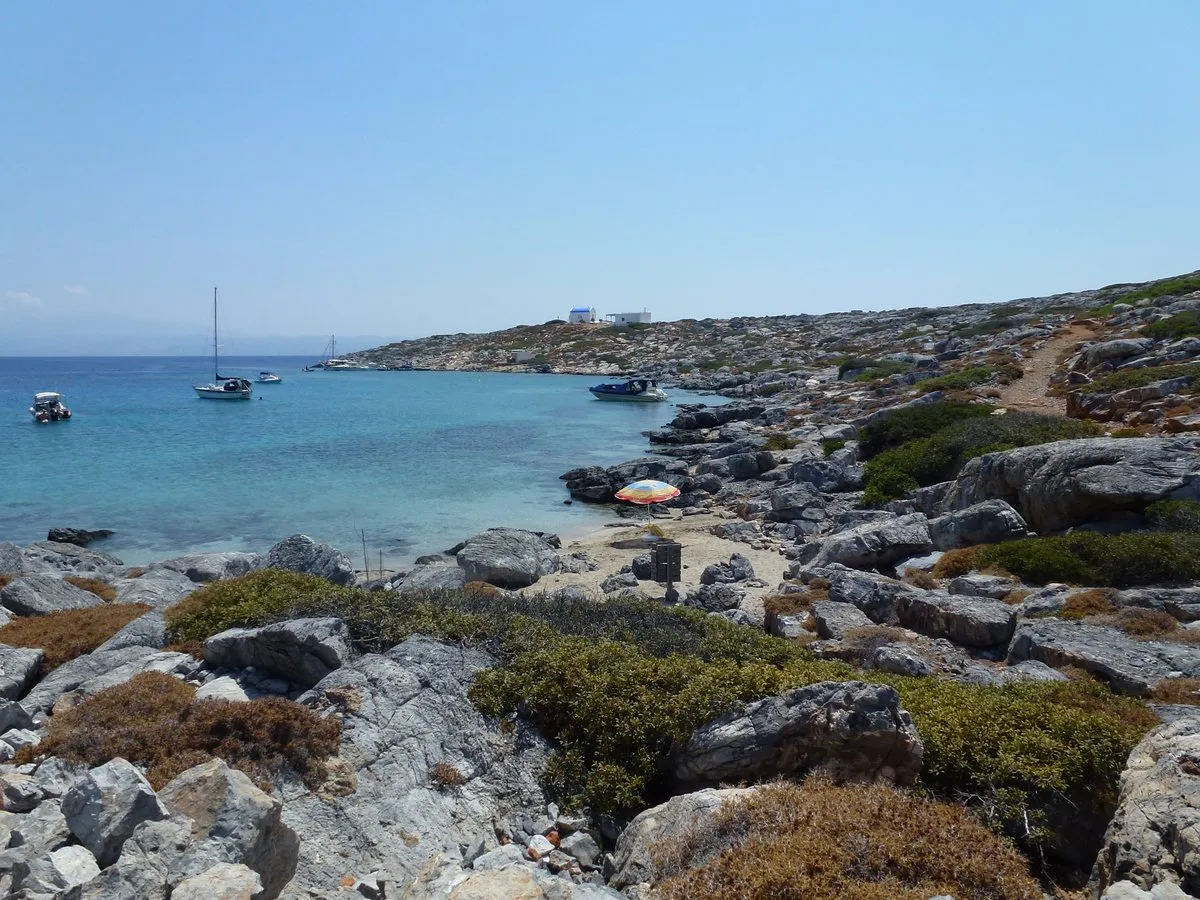
The Region says organised trips leave from the port of Heraklion and usually run daily to Agios Georgios; a Greek beach guide adds summer departures from Gouves and Hersonissos. The boat trips guide covers how the north-coast boards sell them. At Agios Georgios, a Greek beach guide says, boats tie up at two landing platforms, and a path climbs to the blue-roofed chapel of the Analipsi (the Region’s page names it after Agios Georgios) and a refuge building, where an overnight stay can be arranged with the Heraklion port authority.
The season is the catch. The beach guide describes daily trips in summer, no official source gives season dates, and summer trips are at the mercy of the north wind; the meltemi guide explains why a calm morning matters. In November assume no regular sailings, ask at the harbour, and see what stays open this late; otherwise Dia is the view from Ammoudara.
The honest downside
Dia is a bay reached by a boat you do not control: wind, season and operator decide whether you go and for how long. Shade is patchy, supplies depend on the boat, the famous goats are introduced and rarely seen, and the archaeology is underwater and unsigned. From November to April there may be no way across at all.
Worth it if: it is summer, the sea is calm, and you want one day of clear-water swimming off a boat with an empty island behind you. Skip it if: it is November to April, you need shade, food and facilities on tap, or you are going for a guaranteed kri-kri.
Photos on this page: the aerial view by Frente (CC BY-SA 2.0 de) and the anchorage by Argymeg (CC BY-SA 4.0), via Wikimedia Commons, resized for the web. Described from our own visits; distances, access, rules and any figures were checked against the Region of Crete’s tourism and ecotourism pages, NECCA’s list of protected areas in eastern Crete, Natura 2000 and Key Biodiversity Areas site data, a Hellenic Parliament question of October 2025, Greek beach and island guides, and reference sources, which disagree on the island’s height, its distance from Heraklion, the chapel’s name and whether a taverna still operates, for the date shown at the top of this guide. Nobody pays to be featured in a guide — no business, no sponsor, no paid mention, ever. Adverts, where they appear, are labelled as adverts.
How do you get to Dia island from Heraklion?
Dia is reached only by boat. The Region of Crete says organised trips leave from the port of Heraklion and usually run daily to the bay of Agios Georgios, and a Greek beach guide adds summer departures from Gouves and Hersonissos. There is no scheduled ferry, and the excursion boats are seasonal, so check what is running before planning a day around it.
Can you visit Dia island in November?
Dia excursion boats are a summer business: a Greek beach guide describes daily trips in summer, and no official timetable or season dates were found. In November, assume no regular trips and ask at the harbour in Heraklion before counting on one. A private boat is the only other way across.
Are there kri-kri on Dia island?
Dia has wild goats, but they are not native to the island: the Natura 2000 site data lists the wild goat as introduced, and the Region of Crete mentions a kri-kri breeding facility on the islet. The same data notes problems with how the goat population is managed. Excursions stay near the southern bays, so seeing one is not guaranteed.
Is there anything to buy on Dia island?
Dia has no shops, no electricity network and no permanent residents. Sources disagree on whether a taverna still operates at the bay of Agios Georgios: the Region of Crete mentions one, while a Greek beach guide describes it in the past tense. Bring your own water, food and shade, or rely on what the boat provides.
Is Dia island protected?
Dia is a Natura 2000 Special Area of Conservation, code GR4310003, overseen by NECCA's management unit for the protected areas of eastern Crete. The Natura site data lists Eleonora's falcon among its species of concern. A parliamentary question in October 2025 said the island still had no completed management plan and no clear framework for guarding it.
One email a month — only when something on this island actually changes. No spam, no partners, one-click unsubscribe. Read past issues before you decide.