How to Order Fish in Crete Without Getting Played: The Honest Guide
By the kilo, weighed in front of you, priced before the grill — the fish-taverna protocol, the farmed-versus-wild question, what is in season.
Fish is where taverna bills go to surprise people — not because Crete cheats by default, but because the by-the-kilo system rewards customers who know the protocol and quietly taxes those who wave at “the sea bream” and hope. Learn the five-step ritual and fish becomes the best-value luxury on the island; skip it and you fund someone’s winter.
The honest facts — the protocol
- 1. Go to the fridge.
- Real fish tavernas expect you at the display case. You point, you ask; menus are for the fried calamari.
- 2. Hear the price per kilo, out loud.
- It should also be written on the display or menu. “Market price” with no number is a red flag with fins.
- 3. Watch the weigh-in.
- The fish goes on the scale in front of you; you hear the weight, you do the multiplication, you nod BEFORE it meets the grill. This is normal, expected, and the whole system.
- 4. Ask farmed or wild.
- Both are legitimate; only the pricing differs honestly. Farmed sea bream/bass (tsipoura/lavraki) reasonably runs well under wild; wild and the big names — red mullet (barbouni), grouper (rofos), dentex (synagrida) — command serious per-kilo money, historically in the €45–70+ band. Verify the day’s numbers; treat the question as etiquette, not accusation.
- 5. Portion maths.
- 300–400g of whole fish feeds one normally; a 1.2kg fish is a couple’s feast, not a starter.
Reading the room
Good signs: locals eating fish on a weekday, a short case rather than a vast one, today’s names chalked with prices, the boat visibly nearby in the small harbours (Milatos, Mochlos, Sissi and their kind). Warning signs: photo menus of twenty fish “fresh daily”, greeters herding, the fridge “just restocked” at 22:00, prices only revealed with the bill.
Cheaper doors into great seafood
Not every table needs a €60 centrepiece: grilled sardines or gopes in season, fried atherina eaten like chips, marinated gavros, octopus sun-dried on the line then grilled, cuttlefish with wild greens — the small-fish and meze end of the case is where fishing villages actually eat, at a third of the money.
What a fair bill looks like
Work it backwards from the scale. A farmed sea bream or bass of 300–400g at a farmed per-kilo price is a main course at a sensible figure; a 1.2kg wild dentex at €55–70 a kilo is a €70–85 centrepiece for two, and that is the sea’s arithmetic, not a trick. The trick is arithmetic you never saw: a fish weighed out of sight, a per-kilo price that only appears on the bill, a “special” whose weight nobody mentioned. If you heard the price, watched the scale and nodded, whatever the total is, you agreed to it — and in our experience that total is almost always fair.
Where the system works best
Small harbours where the boat is visible — Milatos, Mochlos, Sissi and their kind — because the case is short and today’s, the owner knows which boat it came off, and the chalkboard carries the names and the prices. The resort fronts are where it goes wrong most often, not because the fish is bad but because the turnover of customers means nobody expects to see you twice. One street back, or one village along, the incentives change.
Ordering for a table
Share. A whole fish cut at the table, a plate of grilled sardines or fried atherina, octopus from the line, a horiatiki and a carafe of the house white is how the fishing villages eat, and it costs a fraction of four individual “sea bream” orders. Ask for the fish to be filleted at the table if bones worry you; any taverna that grills properly will do it. And if the waiter steers you away from the case and toward a menu, that steer is the information — thank him and eat elsewhere.
The honest downside
Genuinely wild fish is finite and priced accordingly — sticker shock at €65/kilo is the sea’s economics, not necessarily a scam; the scam is the skipped scale, the missing price, the “special guest fish”. The protocol exists precisely to separate the two.
Worth adopting tonight: fridge, price, scale, nod, feast. Five steps, zero surprises. Skip any taverna that resists step two or three — the resistance is the information.
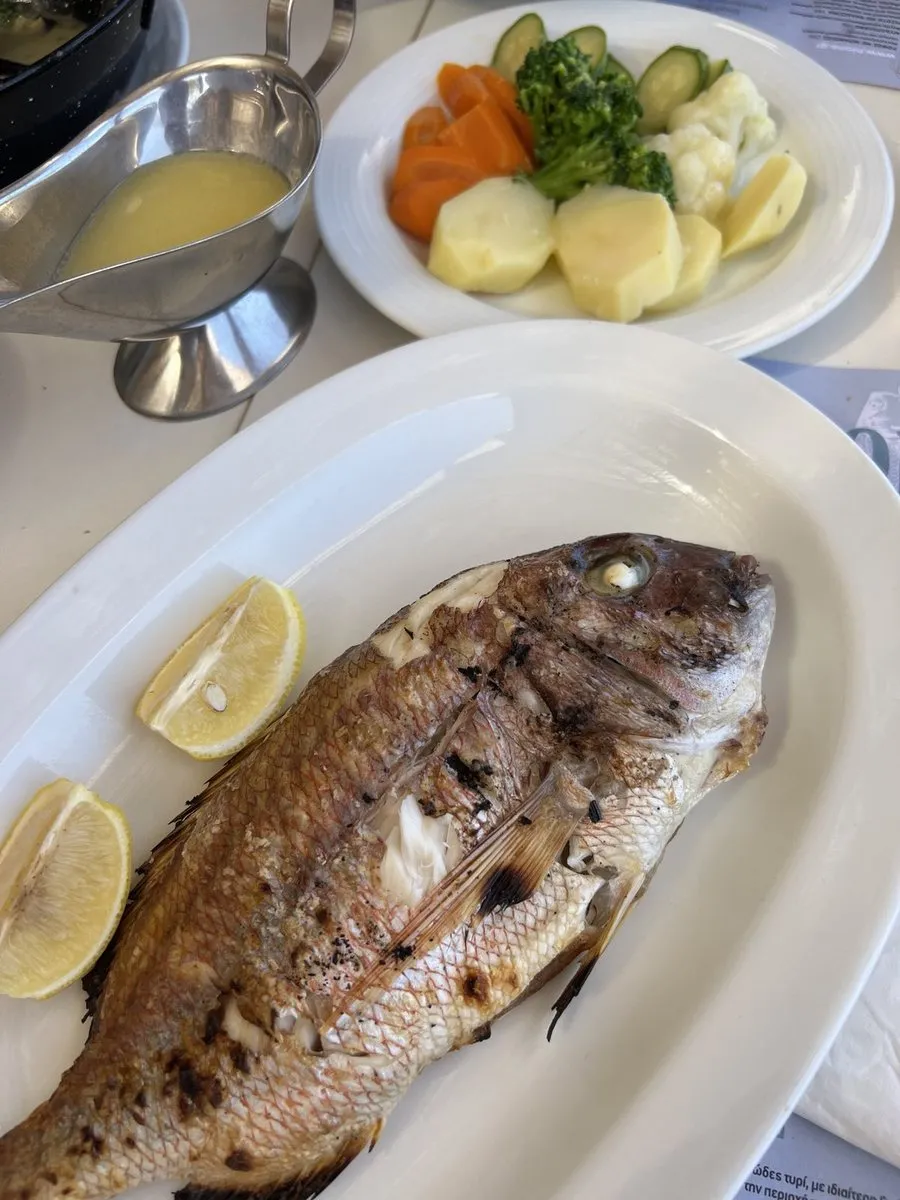
Photo on this page: our own, from a fish taverna on the east coast. Everything above was checked for the date shown at the top of this guide. Nobody pays to be featured in a guide — no business, no sponsor, no paid mention, ever. Adverts, where they appear, are labelled as adverts.
How do you order fish in a Cretan taverna?
Go to the fridge display rather than the menu. Point, ask the price per kilo out loud, watch the fish go on the scale in front of you, do the multiplication, and agree the number before it meets the grill. That sequence is normal and expected - it is the whole system.
Why is fish so expensive in Crete?
Genuinely wild fish is finite and priced accordingly. Red mullet, grouper and dentex have historically sat in the EUR45-70 per kilo band. Sticker shock at that level is the seas economics rather than a scam; the scam is the skipped scale, the missing price and the special guest fish.
How much fish do you need per person?
Roughly 300 to 400 grams of whole fish feeds one person normally. A 1.2kg fish is a couples feast, not a starter. Getting this wrong is the second most common way the bill surprises people.
What is the difference between farmed and wild fish in Crete?
Both are legitimate and the difference should be in the pricing, honestly stated. Farmed sea bream and sea bass reasonably run well under wild. Ask which you are being offered - a taverna that will not answer clearly is telling you something.
How can you tell a good fish taverna?
Locals eating fish on a weekday, a short display case rather than a vast one, todays names chalked up with prices, and the boat visibly nearby in the small harbours. Warning signs are photo menus of twenty fish fresh daily, greeters herding you in, and a case that cannot be inspected.
Is there a cheaper way to eat seafood in Crete?
Yes, and it is where fishing villages actually eat: grilled sardines or gopes in season, fried atherina eaten like chips, marinated gavros, sun-dried octopus, cuttlefish with wild greens. The small-fish and meze end of the case costs about a third of a centrepiece fish.
One email a month — only when something on this island actually changes. No spam, no partners, one-click unsubscribe. Read past issues before you decide.