Where to Stay in Agios Nikolaos — and Is Elounda Worth the Price?
A working Cretan town, a luxury resort enclave and a fishing village share one beautiful bay.
Agios Nikolaos is the first place on this coast I send people who tell me they don’t want a resort. It’s a real Cretan town of around 12,000 people that happens to sit on one of the prettiest bays in Greece — the Gulf of Mirabello — and it keeps living its own life twelve months a year. Schools, offices, a proper Saturday market, teenagers doing laps of the lake on mopeds. Tourism is layered on top of a town, not the other way round.
That’s the honest pitch. Here’s the honest catch: Agios Nikolaos is not a beach destination in the way Stalis or Malia are. The town beaches are small, and in August they’re elbow-to-elbow by 11am. If your ideal day is ten hours on a long stretch of sand in front of your hotel, you’re reading about the wrong base — go back to my comparison of the Hersonissos–Stalis–Malia strip. If your ideal day is a morning swim, a long lunch, a wander, and dinner in a town with actual character, keep reading.
Agios Nikolaos in one minute. A working harbour town on the Gulf of Mirabello, 65 km east of Heraklion (about 1 hour by car, 1–1.5 hours by KTEL bus, roughly €7.70 — last checked August 2026). Built on hills around a small lake connected to the sea. Several small town beaches plus a proper sandy one (Almyros) a half-hour walk south. Elounda, the luxury-resort enclave, is 11 km north; Plaka, the fishing village opposite Spinalonga, 5 km beyond that. Best for couples and independent travellers who want a town, not a strip.
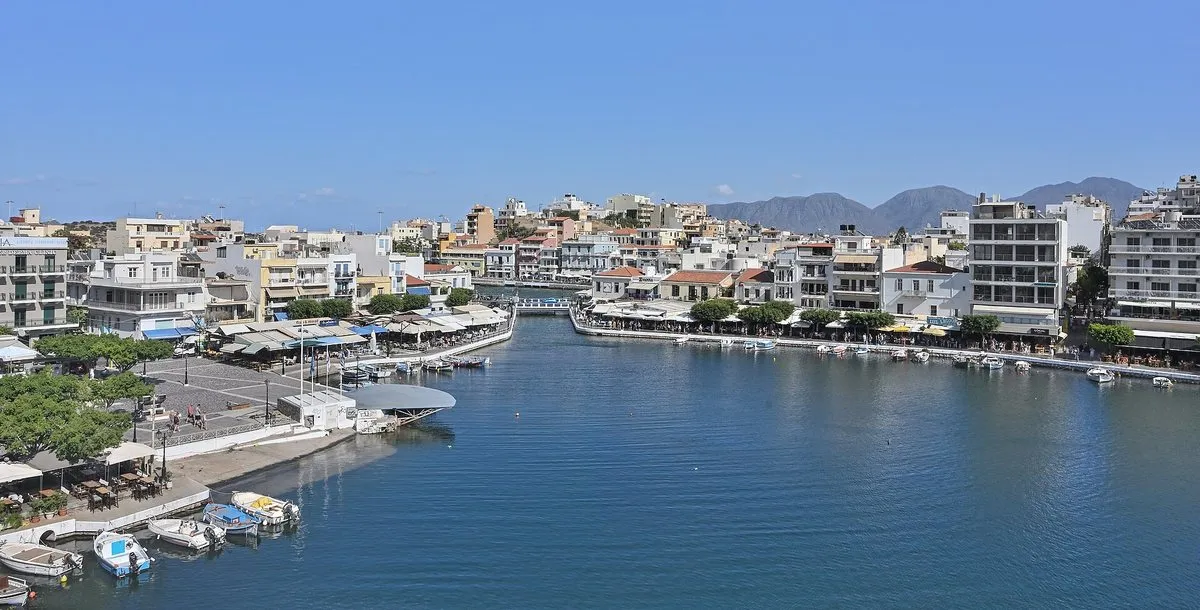
The lake, the harbour, and why the town works
The centre of Agios Nikolaos is Lake Voulismeni — a small, round, improbably deep lake joined to the harbour by a channel the locals dug in the 1860s. The lake and harbour front are ringed with café and taverna terraces, and the evening ritual is simple: everyone walks. Around the lake, up the steps, along the marina, back again. It’s pedestrian-friendly in a way few Cretan towns manage, and it gives the place a proper evening — lively without being loud. Nightlife here means bars around the harbour and a couple of late spots, not clubs. Party groups should look elsewhere and usually do.
One bit of history that explains the town’s DNA: this was the first place in Greece to do tourism properly. The bungalow-hotel era started here in the early 1960s, and for a while Agios Nikolaos was the fashionable Greek resort. It grew up with tourism rather than being bulldozed for it, which is why it still feels balanced.
The beaches, honestly
In town you have a handful of small beaches: Kitroplatia, a sand-and-pebble curve between the harbour and the marina, five minutes from anywhere, lovely for a quick swim, packed in season; Ammos, next to the marina, small and sandy, fine for children; and a couple of pocket coves north towards Ammoudi and Havania. All are organised, all are clean, none will win awards for space.
The proper beach is Almyros, about 2 km south of the centre — long, sandy, shallow, with a small river meeting the sea at one end (the water runs noticeably cold there, which is either a feature or a bug depending on the month). It’s a pleasant 25–30 minute walk along the coast or a short drive; in July and August, go before 10am for a sunbed. Further south-east, around Istron, Voulisma is the postcard: a golden-sand bay with genuinely tropical colours. It photographs so well that half of Crete now goes — arrive early or late.
The wind note that applies to this whole coast: the meltemi blows from the north in high summer and the afternoons can get properly gusty. Mornings are for swimming. Locals plan around it; you should too.
Where in town to book
Agios Nikolaos is built on hills, and the practical booking question is not “which neighbourhood” but “how many steps”. Three zones worth understanding:
Around the lake and harbour puts you inside the evening life — everything on foot, no car needed. The trade-off is noise until midnight or so in the bar lanes immediately around the lake, and few places here have parking. Ask specifically which way the room faces.
The Kitroplatia and marina side is my default recommendation: five minutes from both the beach and the centre, a notch quieter, mostly small hotels and studios of the family-run sort this town does well.
The hills above town (and the road out towards Ammoudi and Elounda) hold the bigger hotels and the sea-view apartments. The views over Mirabello are the best on this coast — but check the walk. “Ten minutes to the centre” on a listing can mean two hundred steps back up after dinner. With a car, the hillside is glorious. Without one, in August, think hard.
Price expectations, roughly, for a double room or studio in town (rates move; treat these as bands, not quotes): €50–75 in the shoulder months, €70–110 in June and September, €90–150 in peak summer, with the sea-view boutique places above that. Noticeably better value than Elounda for a better town experience — which brings us to the question everyone actually asks.
Is Elounda worth it?
Elounda, 11 km north around the bay, is the most expensive address in Crete — the enclave of the big five-star resorts, the private-pool villas, the celebrity-visit stories. And here’s the thing most guides won’t say plainly: Elounda the luxury product and Elounda the village are two different places.
The luxury product is real. The famous resorts sit on their own peninsulas and coves outside the village, with their own beaches, spas and boat jetties, and if you’re booking that product — a honeymoon, an anniversary, a once-in-a-decade blowout — Elounda delivers it as well as anywhere in Greece. You’ll pay several times the Agios Nikolaos rate, and inside the gates you’ll get what you paid for.
Elounda the village, though, is a modest place: a square, a working harbour, a strip of tavernas, a thin municipal beach by the causeway to the Kolokytha peninsula (worth walking across — the sunken ruins of ancient Olous are visible in the shallows by the old salt pans). It’s pleasant. It is not fifty-euros-a-cocktail pleasant. If you book a mid-range room in Elounda village expecting the glamour, you’ll have paid a luxury-postcode premium for a quieter, smaller, less interesting town than Agios Nikolaos — and you’ll end up driving to Agios Nikolaos most evenings anyway. I watch people make this exact mistake every summer.
So: book Elounda for the gated five-star product, book Agios Nikolaos for everything else. There’s a bus between them every hour or so in season (roughly €1.90, 15 minutes), so day-tripping in either direction is trivial.
Plaka, and the Spinalonga question
Five kilometres past Elounda, the road ends at Plaka — a genuinely small fishing village of pebble shore, a dozen tavernas known for fish, and the best view of the trip: the fortress island of Spinalonga sitting a few hundred metres offshore. Staying in Plaka is a lovely, very quiet choice for a couple with a hire car; without a car it’s too isolated for most.
Everyone in this bay goes to Spinalonga — the Venetian fortress that became Greece’s last leper colony, the island of The Island if you’ve read Victoria Hislop. Go; it earns the fuss. The practical version: boats shuttle from Plaka (about €12 return, 10 minutes, roughly every half hour), from Elounda (about €14 return, 20–30 minutes), and longer half-day cruises run from Agios Nikolaos with swim stops. Entry to the island itself is now €20 an adult (reduced €10 — the price took a real jump recently, so budget for it; last checked August 2026). From Plaka and Elounda you can take any boat back, so you’re not marched around on a timer. Go first thing or after 3pm in summer — midday is cruise-excursion hour, and the island has almost no shade.
Day trips that make this base
This is the quiet argument for Agios Nikolaos: it’s the best day-trip base in eastern Crete. Inland, the village of Kritsa and the frescoed church of Panagia Kera are twenty minutes away, with the ancient hilltop city of Lato just beyond. The Lasithi Plateau with its windmills and the Dikteon Cave is an hour’s loop. East, the palm forest beach at Vai and the town of Sitia make a long but worthwhile day. South over the hills, Ierapetra and the south-coast beaches are 40 minutes. And Heraklion — Knossos and the archaeological museum — is an easy hour on the highway or the hourly bus, no car required.
Getting here
From Heraklion airport it’s about an hour by car along the E75. A taxi or pre-booked transfer runs roughly €75–95 to Agios Nikolaos and a bit more to Elounda (worth pre-booking in August; last checked August 2026). The KTEL bus from Heraklion’s main station runs roughly hourly through the day, takes 1–1.5 hours, and costs about €7.70 — but note it leaves from the city bus station, not the airport itself, so add the short city-bus or taxi hop first. I’ve written up the airport logistics in detail in the transfer guide — the same first step applies here.
If you are weighing the town for more than a holiday: it has a hospital, a winter and a real year-round life, which is why it keeps coming up in our articles on buying a home here.
Agios Nikolaos is for people who’d rather stay in a town than a resort: real year-round life, the prettiest evening walk in eastern Crete, honest food, and the best day-trip position on this side of the island — at the cost of small, busy town beaches. Book near Kitroplatia for the best balance, check the steps before you book a view, and swim in the mornings. Elounda is worth it only for the gated five-star product; for everything else, Agios Nikolaos is more town for less money. And whichever you choose, take the early boat to Spinalonga.
Photo on this page: the lake by Cayambe (CC BY-SA 4.0), via Wikimedia Commons, resized for the web. Everything above was checked for the date shown at the top of this guide. Nobody pays to be featured in a guide — no business, no sponsor, no paid mention, ever. Adverts, where they appear, are labelled as adverts.
The quick scores
- Crowds
- 4 out of 5the east's main tourist stage
- Nightlife
- 4 out of 5the lake ring runs late
- Organised beach
- 3 out of 5small town beaches, Almyros a walk south
- Car needed
- 2 out of 5buses reach it easily
- Dinner on foot
- 5 out of 5rooms and tables at every price
- Prices
- 3 out of 5under Elounda, over Sitia
More dots means more of the thing named, never “better”. What each level means. Scored August 2026 from the reporting on this page.
Is Agios Nikolaos a good base in Crete?
It is the first place to send anyone who does not want a resort - a working Cretan town of around 12,000 on one of the prettiest bays in Greece. The catch is that it is not a beach destination: the town beaches are small and elbow-to-elbow by 11am in August.
How far is Agios Nikolaos from Heraklion?
About 65km, an hour by car or one to one and a half hours by KTEL bus at roughly EUR7.70. Checked August 2026.
What is Lake Voulismeni?
A small, round, improbably deep lake in the centre of town, joined to the harbour by a channel the locals dug in the 1860s. The lake and harbour front are ringed with cafe and taverna terraces, and the evening ritual is walking around it.
Is Agios Nikolaos expensive?
Mid-range by Cretan standards, and cheaper than Elounda next door. It was the first place in Greece to do tourism properly - the bungalow-hotel era started here in the early 1960s - so it grew up with tourism rather than being colonised by it.
Who should not stay in Agios Nikolaos?
Anyone whose ideal day is ten hours on a long stretch of sand. The town beaches are small and the good beaches need a drive. Base here for the town and use the car for the coast.
One email a month — only when something on this island actually changes. No spam, no partners, one-click unsubscribe. Read past issues before you decide.