Is Heraklion Worth Staying In? A Local's Honest Answer
Most visitors treat Crete's capital as an airport with a museum attached. A Heraklion local on what the city actually does well, what it does badly.
Let me declare the bias up front: Heraklion is my city. I live here, I work here, and I’ve spent years listening to visitors at the next table describe it as “just where the airport is”. So this guide argues with that idea — but I’ll argue honestly, because the idea didn’t come from nowhere.
Here’s the fair version of the criticism. Heraklion is not pretty the way Chania and Rethymno are pretty. It was bombed hard in 1941, rebuilt fast in concrete, and it’s a working port city of nearly 200,000 people with the traffic, noise and graffiti that implies. There is no lantern-lit Venetian harbour to drink your sunset wine on. If your Crete is a postcard, Heraklion isn’t on it, and no local will pretend otherwise.
And yet. Heraklion has the best museum in Greece outside Athens, the most important archaeological site in the Aegean twenty minutes from the centre, and — I’ll say it and stand behind it, with apologies to Chania — the best eating and drinking scene on the island, precisely because most of it exists for locals rather than for tourists. The question isn’t whether Heraklion is worth seeing. It obviously is. The question is whether it’s worth staying — and the answer depends entirely on what kind of traveller you are.
Heraklion in one minute. Crete’s capital and transport hub: main airport (HER), main port, and KTEL buses in every direction. Knossos is 5 km south; the Archaeological Museum is in the centre. A dense, walkable old core sits inside massive Venetian walls, surrounded by an unlovely modern city. City beaches at Ammoudara (west) and Karteros (east). Best as a 1–3 night city stop or a carless touring hub; wrong as a two-week beach base.
The case for staying: what Heraklion actually does well
The Minoan one-two. The Archaeological Museum holds essentially everything that matters from the Minoan world — the bull-leaping fresco, the snake goddesses, the Phaistos Disc — and it’s a genuinely world-class museum, not a provincial one. Knossos supplies the place; the museum supplies the meaning. Do them as a pair, museum first if you can. Practicalities, last checked August 2026: Knossos is €20 (reduced €10), the museum €20 full at the gate in season, and the old combined ticket has been discontinued, so budget for both separately. Book Knossos online through the official Hellenic Heritage e-ticket site and go at opening or in the last two hours — the cruise-excursion wave hits midday and queues can run past half an hour in summer.
The food, and the reason it’s good. Heraklion’s restaurants, wine bars and raki joints live or die on repeat local custom, which is the single best quality-control system a food scene can have. The centre has everything from old-school mageireia — steam-tray places doing slow-cooked Cretan standards at lunch — to a wave of modern Cretan bistros and serious wine bars pouring the island’s own bottles. I’m deliberately not listing venues here (places change hands; a stale recommendation is worse than none — my whole approach is on the about page), but the method is simple: walk the streets around the market and the old core, and eat where you hear Greek.
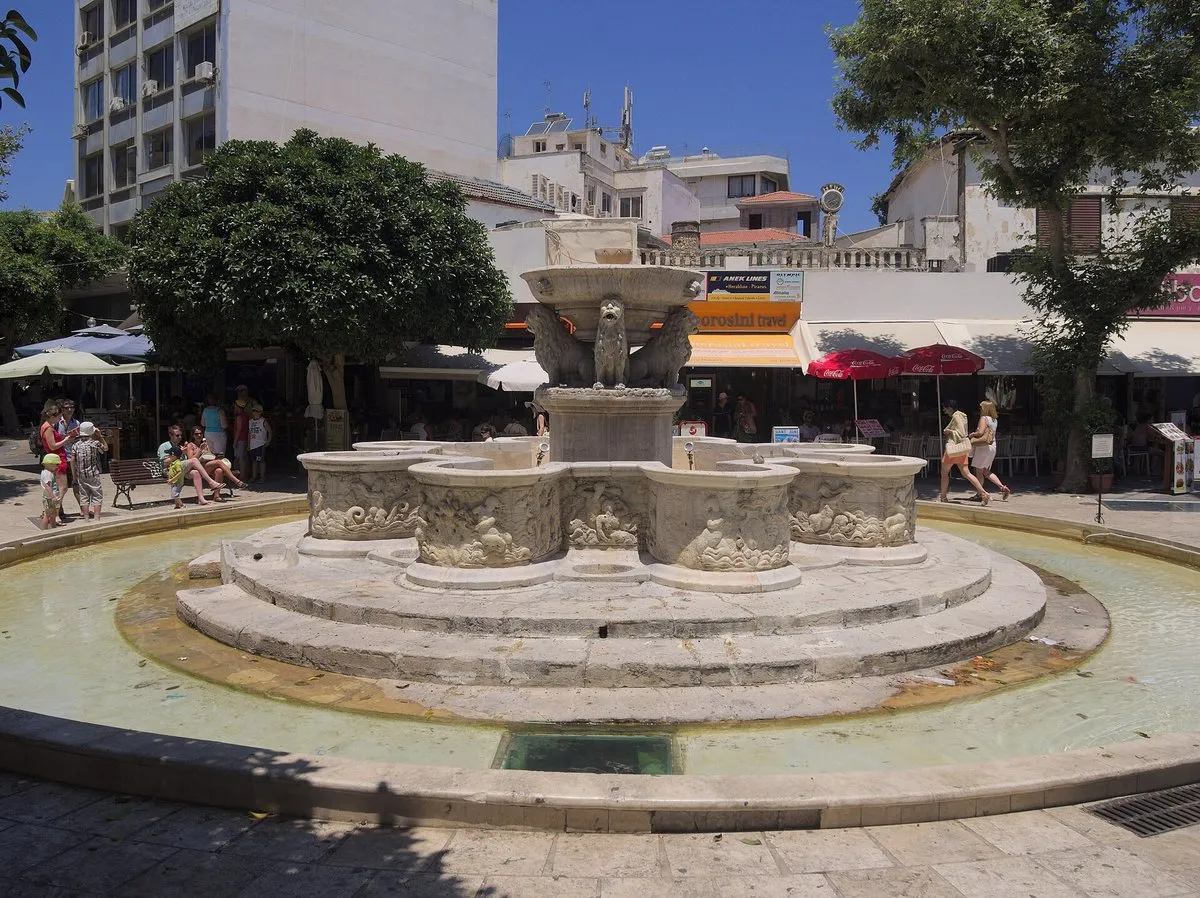
The walkable core. Inside the Venetian walls, Heraklion is a compact, likeable city: the Morosini lions fountain, the loggia, the covered lanes of the 1866 market street, the Koules fortress guarding the old harbour (a few euros to climb; the view over the sea walls is the best free-ish sunset in town), and 25 Avgoustou street running from the fountain down to the water. Walk the top of the Venetian walls themselves to Kazantzakis’ grave on the Martinengo bastion — his epitaph (“I hope for nothing, I fear nothing, I am free”) is the most Cretan sentence ever written, and the walk shows you the city’s two faces at once: monumental stone below, ordinary concrete life beyond.
The hub logic. This is the practical argument. Heraklion is the island’s crossroads: KTEL buses run west to Rethymno (about €8.30) and Chania (about €15) and east to Agios Nikolaos (about €7.70) roughly hourly through the day. If you’re touring Crete without a car, there is no better base — and even with one, Heraklion is where the routes cross. It’s also one of the only two cities on the island that stay fully alive from November to March.
The case against: what it does badly
Beach holidays. The city beaches — Ammoudara, the long sandy hotel strip immediately west, and Karteros/Amnissos east by the airport — are perfectly usable, and Ammoudara at sunset has its fans, me included. But Karteros sits under the flight path, Ammoudara backs onto a busy road, and neither is why anyone flies to Crete. If sand is the point of your trip, base on it — the Hersonissos–Stalis–Malia strip is thirty minutes east — and day-trip into Heraklion for the museum, not the other way round.
Also: driving and parking in the centre are miserable in a very Greek way, some central streets carry bar noise until late, and the seafront between the port and the western beaches is a working waterfront, not a promenade. Manage expectations and the city rewards you; arrive expecting Chania and it won’t.
If you stay: where, exactly
Inside the walls, around the core — the triangle between the lions fountain, the market and the harbour — is the default: everything on foot, the best of the eating scene at your door. The trade-off is evening noise on the café streets (the Korai quarter is the loudest and the most fun; ask which way the room faces) and near-zero parking, so if you have a car, book a place that names its parking arrangement rather than gestures at one.
Lakkos, just inside the western walls, is the interesting choice: the old working-class (and once red-light) quarter, now the city’s street-art and small-bar neighbourhood, still rough-edged and genuinely local. Guesthouses here are characterful and cheap-ish; light sleepers should ask about weekend noise.
Ammoudara is the compromise base: beach in front, city ten minutes away by bus or taxi, mostly resort-style hotels. It works well for families who want one foot in each world.
Rough price bands for a double in the centre, to set expectations rather than quote: €55–85 in shoulder season, €75–120 in summer, with the handful of design-led boutique places above that. Heraklion hotels run cheaper than equivalent rooms in Chania’s old town — one of the quiet perks of an unfashionable city.
The honest itinerary
Give Heraklion one full day and two nights and it repays you: museum in the morning, long local lunch, walls-walk or Koules in the late afternoon, Knossos at the end of the day when the coaches have gone, dinner where the Greek is loudest. Add a second day and you have Archanes and the wine villages to the south, or simply a slower version of the first day, which is the more Cretan choice.
And if the question is living here rather than staying a few nights: Heraklion is one of the two cities on the island that keep their life through the winter, which is exactly where the buying section starts.
Photo on this page: the fountain by C messier (CC BY-SA 4.0), via Wikimedia Commons, resized for the web. Bias declared: this is my home town, and I want you to like it. I’ve tried to keep the thumb off the scale — the concrete, the traffic and the flight path are all in the text above. Nobody pays to be featured anywhere on this site; the full policy is on the about page.
Heraklion is a city stop, not a beach base — and judged as a city stop, it’s excellent: the best museum-and-site pairing in Greece, the island’s most local food scene, and unbeatable transport logic. Give it one or two nights on the way in or out, base here if you’re touring by bus or visiting outside summer, and sleep elsewhere if your holiday is sand. Just don’t call it “the place with the airport” at the next table. I’ll hear you.
Is Heraklion worth staying in?
As a city stop, yes — one or two nights buys the best museum-and-site pairing in Greece, the island's most local food scene and unbeatable transport logic. As a two-week beach base, no: if sand is the point of your trip, base on it and day-trip into Heraklion for the museum.
How many nights do you need in Heraklion?
One full day and two nights repays you: museum in the morning, long local lunch, walls-walk or Koules in the late afternoon, Knossos at the end of the day when the coaches have gone, dinner where the Greek is loudest.
Does Heraklion have good beaches?
Usable rather than special: Ammoudara, the long sandy strip immediately west, has its sunset fans; Karteros to the east sits under the flight path. Neither is why anyone flies to Crete.
Is Heraklion a good base for touring Crete without a car?
The best on the island — KTEL buses run roughly hourly west to Rethymno (about €8.30) and Chania (about €15) and east to Agios Nikolaos (about €7.70), and it is one of the only two cities that stay fully alive from November to March.
One email a month — only when something on this island actually changes. No spam, no partners, one-click unsubscribe. Read past issues before you decide.