Where to Stay in Rethymno: Old Town or the Beach Strip?
Crete's most underrated city has a preserved Venetian–Ottoman old town on one side and 12 km of resort beach on the other.
Rethymno is the city Crete’s marketing forgot, and the people who love it prefer it that way. It sits halfway along the north coast — about an hour and a quarter west of Heraklion, forty-five minutes east of Chania — and it quietly offers the thing the two famous cities can’t: a genuinely atmospheric old town and a long sandy beach you can walk to, in one base, at prices a notch below Chania’s.
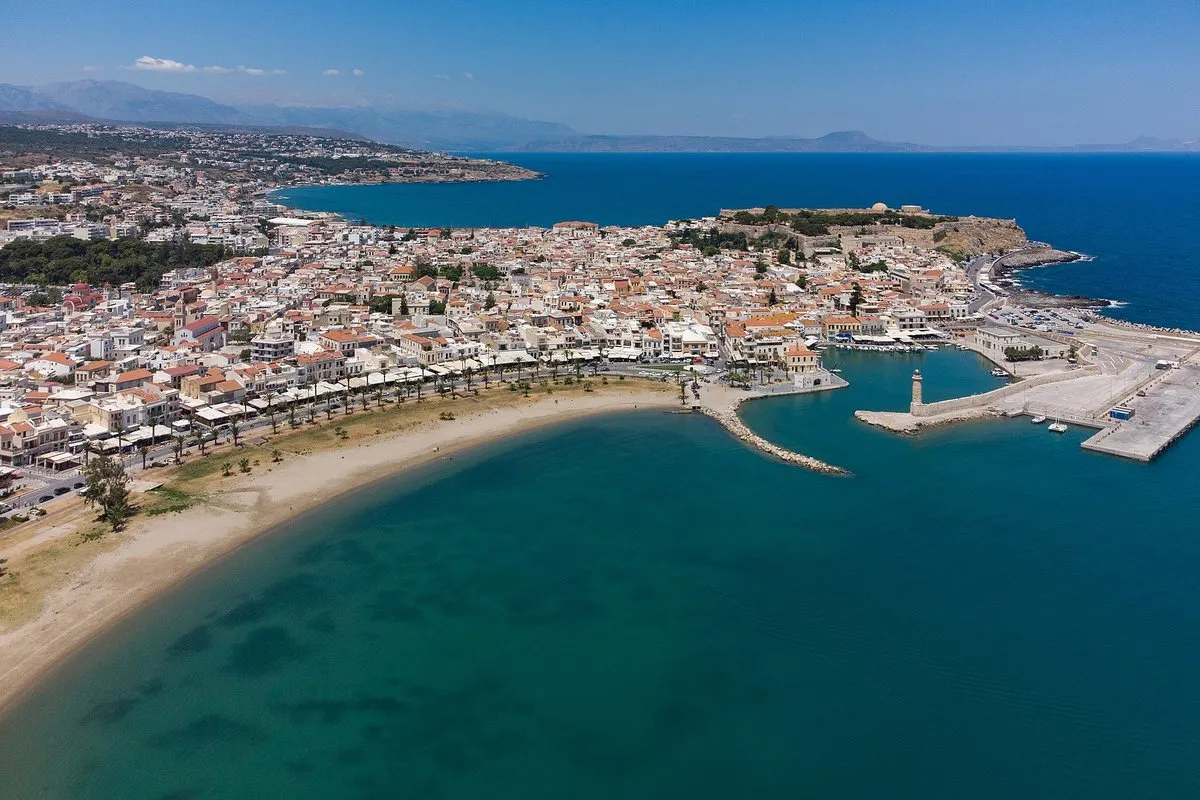
The honest framing first, though, because Rethymno gets booked wrong in a specific way. It’s really two products stapled together. West of the harbour is the old town: a dense, largely pedestrian maze of Venetian mansions and Ottoman balconies under a big fortress. East of the harbour, the beach strip: twelve-plus kilometres of sand lined with resort hotels running through Missiria, Adele and beyond. They share a name and a bus line and almost nothing else. Choose the side that matches your holiday, and Rethymno might be the best-value city base on the island. Choose the wrong side and you’ll spend your week commuting to the holiday you actually wanted.
Rethymno in one minute. Crete’s third city (~35,000 people), between Heraklion (about 1h15, roughly €8.30 by KTEL bus) and Chania (about 45–60 min, roughly €6.80) — buses roughly hourly each way, last checked August 2026. Best-preserved Venetian–Ottoman old town in Crete, crowned by the Fortezza fortress. City beach starts at the harbour and runs 12+ km east as a resort strip. A university town, so it has real winter life. Best for couples who want atmosphere on a budget and families who want the strip; day-trip heaven for Arkadi and the south coast.
The old town, honestly
Rethymno’s old town is the best-preserved in Crete — better than Chania’s, the heretics whisper, because it’s less renovated-for-retail. Venetian doorways with Latin inscriptions, Ottoman wooden balconies leaning over the lanes, a minaret rising next to church bells, the Rimondi fountain dribbling away since the 1620s, and the small Venetian harbour with its Egyptian-era lighthouse. Above it all sits the Fortezza, the huge star fortress the Venetians built after pirate raids — a few euros to enter, worth it at golden hour for the views alone, and in summer it hosts open-air performances that are the best evening in town.
Because this is a university town (the humanities campus of the University of Crete is here), the old town isn’t a museum: there are student cafés, small bars and bookshop-type places mixed in with the tourist lanes, and the city stays alive in winter when pure resort towns shutter.
Staying inside the old town means boutique guesthouses in restored Venetian buildings — some of the most characterful rooms in Crete, often at €70–110 for a double in season where the Chania equivalent would run noticeably higher (rough bands, not quotes; rates move). The trade-offs are structural and worth stating plainly: cars can’t reach most doors, so you’ll park outside the walls and walk your luggage over cobbles; ground-floor rooms in stone buildings can be dark; and a handful of lanes carry bar noise well past midnight. None of this is a scandal — it’s what a preserved old town is — but ask three questions before you book: where do I park, which floor is the room, and how close is the nearest bar.
The beach strip, honestly
The city beach starts right at the old town’s edge and runs east essentially forever — wide, sandy, organised, with the resort hotels thickening as you go through Missiria and Adele. The strip product is exactly what it looks like: bigger hotels, pools, half-board options, sunbeds in rows. It’s a perfectly good version of that product, and for families it’s the practical choice — space, shallow-ish entry, everything on site, and the old town still reachable by a flat 20–40 minute walk or a short bus hop for evening wandering.
Two honest caveats. First, the town end of the beach, nearest the harbour, is the least appealing stretch — busy road behind, busiest sand, and the water can carry seagrass after weather; the beach improves as you go east. Second, this coast is exposed to the summer meltemi, and Rethymno’s long open bay catches it properly: on windy afternoons you’ll see red flags and real waves. Surf-adjacent fun for some, a ruined swim for others — either way, the morning swim rule applies here more than anywhere on the north coast.
If you want quieter sand within reach, the coves and beaches west of town towards Episkopi are the local move, and the south coast is closer than you think — see day trips below.
So: which side?
Book the old town if your holiday is atmosphere — wandering, long dinners, a swim as punctuation rather than purpose. Book the strip if your holiday is the beach and the old town is the evening entertainment. Book the seam between them — the blocks just east of the harbour, around the start of the beach — if you genuinely want both and will accept being one notch worse at each. What I’d avoid is booking deep into the strip (3 km+ out) expecting old-town evenings; the commute kills the habit by day three, and at that point you’ve bought a generic beach resort that happens to have Rethymno’s name on it.
Day trips that argue for this base
Rethymno’s central position is its quiet superpower. Arkadi Monastery, the most important site in Cretan memory — where besieged locals chose to blow the powder magazine rather than surrender in 1866 — is 25 minutes inland and should not be skipped. The south coast is closer here than from any other northern city: the palm-forest beach at Preveli below its clifftop monastery, and the laid-back southern resort of Plakias, are each around 35–40 minutes over the mountains. Add the pottery village of Margarites, the Amari valley if you want the deep-Crete drive, and the fact that both Chania and Heraklion’s museum-and-Knossos day are an easy bus ride away, and a carless traveller can fill a week from this one base without repeating themselves.
Getting here
No airport of its own — that’s part of why it stays underrated. Fly into either Heraklion (HER) or Chania (CHQ); both work. From Heraklion airport it’s about 1h15 by car, or a taxi/pre-booked transfer at very roughly €90–110 (last checked August 2026 — worth comparing against a hire car immediately). By bus, first hop into Heraklion’s central KTEL station (the airport logistics are written up here — same first step), then the hourly coastal coach, about €8.30 and a comfortable 1.5 hours along the highway. From Chania side, the bus is about €6.80 and under an hour.
If Rethymno is somewhere you might live rather than visit — it is one of the two cities here with a proper winter life — start with the buying section before the listings.
Rethymno is the best-value city base in Crete: a real Venetian–Ottoman old town, a proper long beach, student-town life, and the island’s best day-trip position — at prices below Chania for comparable character. The whole decision is which side of the harbour you sleep on: old town for atmosphere, strip for sand, and never deep in the strip if the old town is why you came. Ask about parking, floors and bar-distance before booking a lane house, swim in the mornings, and don’t leave without seeing Arkadi.
Photo on this page: the aerial view by C messier (CC BY-SA 4.0), via Wikimedia Commons, resized for the web. Everything above was checked for the date shown at the top of this guide. Nobody pays to be featured in a guide — no business, no sponsor, no paid mention, ever. Adverts, where they appear, are labelled as adverts.
The quick scores
- Crowds
- 4 out of 5busy, and less performed than Chania
- Nightlife
- 4 out of 5a university town, so year-round
- Organised beach
- 4 out of 5city sand from the harbour, 12 km east
- Car needed
- 1 out of 5old town and beach both on foot
- Dinner on foot
- 5 out of 5student prices beside the Venetian ones
- Prices
- 3 out of 5the middle one of the three cities
More dots means more of the thing named, never “better”. What each level means. Scored August 2026 from the reporting on this page.
Why choose Rethymno over Chania or Heraklion?
It is Cretes third city and the one its marketing forgot - the best-preserved Venetian and Ottoman old town on the island, less renovated-for-retail than Chania, with a university keeping it alive in winter. Prices sit meaningfully below Chania.
What is the difference between Rethymnos old town and the beach strip?
They are two products stapled together. West of the harbour is the dense pedestrian maze of Venetian mansions and Ottoman balconies; east runs the long hotel-and-apartment beach strip. Booking the wrong one for your purposes is the specific way Rethymno goes wrong.
How far is Rethymno from Heraklion and Chania?
About an hour and a quarter from Heraklion at roughly EUR8.30 by KTEL bus, and 45 to 60 minutes from Chania at roughly EUR6.80. Buses run roughly hourly each way. Checked August 2026.
Is Rethymno old town noisy at night?
Less than Chania, but there is a bar cluster - ask which lane before booking. The university crowd keeps things lively rather than raucous, and the city stays alive outside the season in a way the resort strips do not.
Is Rethymno good for families?
The beach strip east of town works well - long sand, hotels with pools, everything walkable. The old town suits couples and anyone who prefers stone lanes to sunbeds. Many families split the difference by staying at the strips western end.
One email a month — only when something on this island actually changes. No spam, no partners, one-click unsubscribe. Read past issues before you decide.