Agia Triada: The Honest Guide to the Minoan Villa Next to Phaistos
A few kilometres west of Phaistos, the Minoan villa of Agia Triada produced the painted sarcophagus, the Harvester Vase and the Boxer Rhyton now in the Heraklion museum. What is left on site, how it fits a Phaistos day, and what this check could and could not confirm about hours and tickets.
Agia Triada is the extra hour that completes a Phaistos morning. A few kilometres west of the palace, on the banks of the Geropotamos river, a Minoan villa complex produced objects that people now cross the Heraklion museum to see: the painted sarcophagus, the Harvester Vase, the Boxer Rhyton. On site you get walls, stairways, courts, a 14th-century chapel and the Messara around you. Go after Phaistos, with the museum seen first or planned for later. Described from our own visits; distances, prices, hours and rules are a check of published sources, October 2026.
The honest facts
- Where
- a few kilometres west of Phaistos (published figures run from about 2 to 4 km), on the banks of the Geropotamos.
- What it was
- a Minoan villa complex of about 1600 BC that the Region of Crete calls a “little Minoan palace”.
- The famous finds
- the painted sarcophagus, the Harvester Vase, the Boxer Rhyton and the Chieftain Cup, all in the Heraklion Archaeological Museum.
- Also on site
- the 14th-century church of Agios Georgios Galatas.
- Hours
- 10:00–17:00 daily on the Region’s page, 09:00–16:00 in a regional guide; verify seasonally.
- Tickets
- the Ministry’s price list could not be checked for this guide; budget for a ticket of its own.
- Access
- a paved road; the Region lists the site as not accessible for people with disabilities.
What Agia Triada was
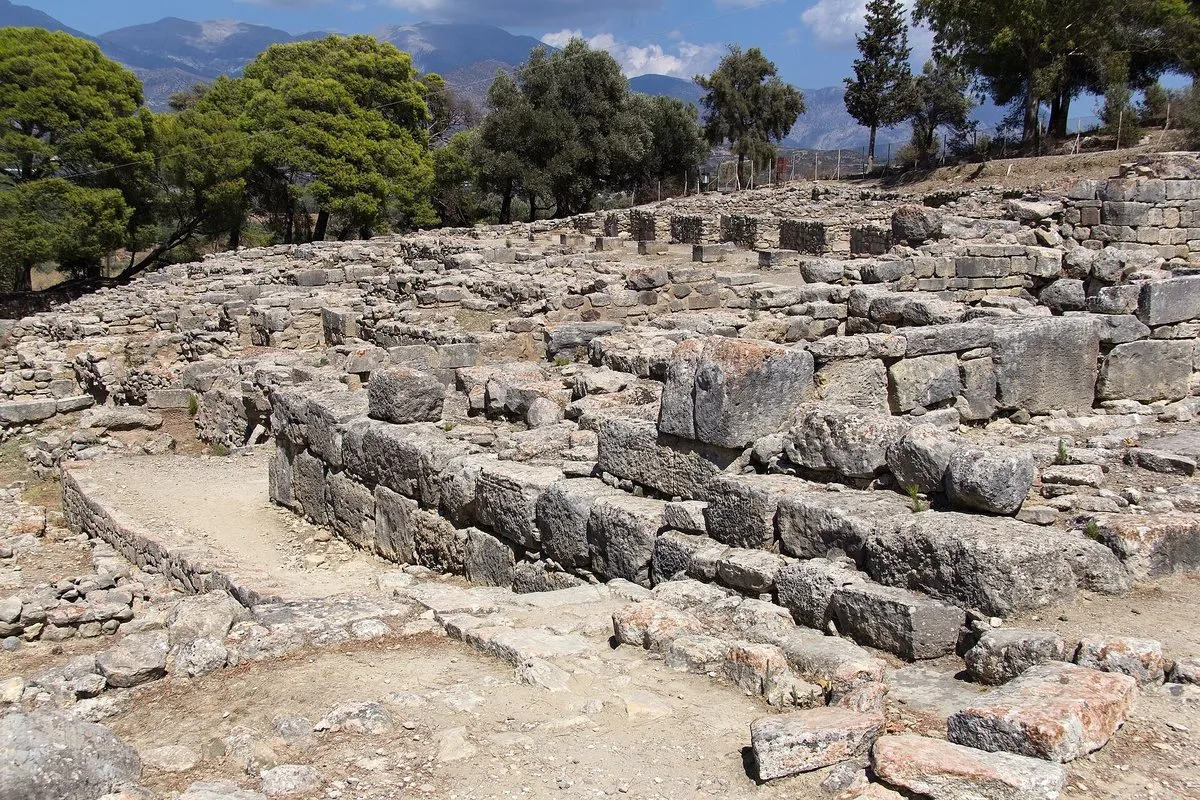
The Region of Crete describes a villa of about 1600 BC, built as two wings forming an irregular L, with an upper floor: living quarters around a peristyle court and a light-well, storerooms, shrines, workshops, stairwells, porticoes, terraces and an archive of clay sealings. What it was for is argued over. A regional guide repeats the idea of a summer residence for the rulers of Phaistos, while other accounts describe a well-off town with a local administrative centre. On the west side the Region marks a stepped road it calls the “ramp of the sea”; Kommos, on the coast, was the harbour town that served Phaistos and Agia Triada.
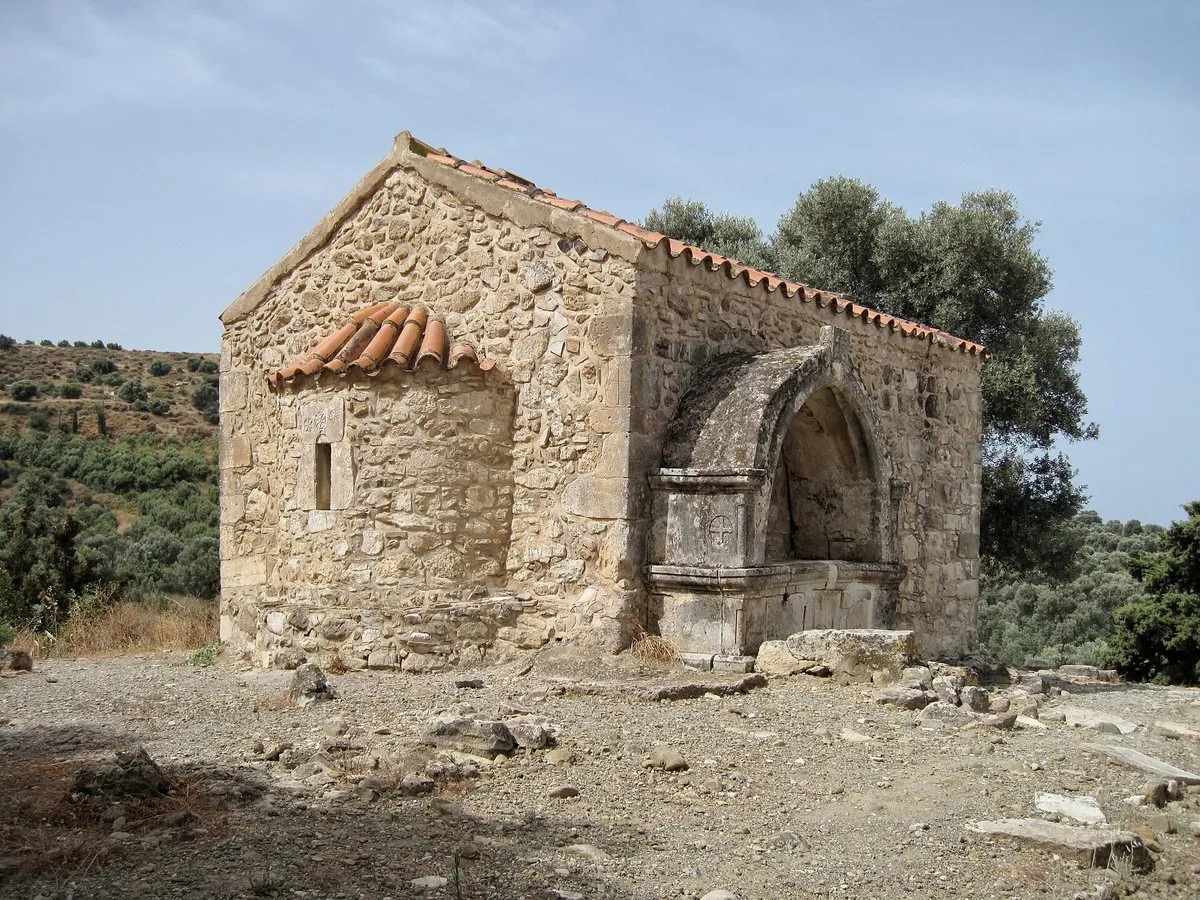
The hillside did not empty when the villa fell. Accounts of the site describe destruction by fire, rebuilding and use well into the historic period, including, one regional guide says, a Hellenistic sanctuary of Zeus Velchanos. The latest layer still stands: the church of Agios Georgios Galatas, which a regional guide dates to the 14th century, in Crete’s Venetian period.
The finds are in Heraklion
The objects that made Agia Triada famous are not here. The Region lists the painted sarcophagus, with its scenes of Minoan ritual, and three carved stone vessels, the Harvester Vase, the Boxer Rhyton and the Chieftain Cup, and says all are displayed in the Heraklion Archaeological Museum. The sarcophagus was found in a tomb at the site in 1903. See them before you come and the bare rooms make sense; it is the same museum-first logic as in our Knossos or Phaistos comparison.
Hours, tickets and the Phaistos day
Neither the hours nor the price could be checked against the Ministry of Culture’s own page for Agia Triada, which could not be opened for this guide, so treat the figures here as provisional. The Region’s tourism page lists 10:00–17:00 daily and a regional guide 09:00–16:00, and Greek sites have moved to shorter winter hours on 1 November in recent years. On tickets, the Ministry’s Heraklion museum page confirms only that the Knossos and museum combined ticket is no longer valid. Nothing opened for this check shows whether a joint Phaistos and Agia Triada ticket is sold, so budget for two and ask at Phaistos.
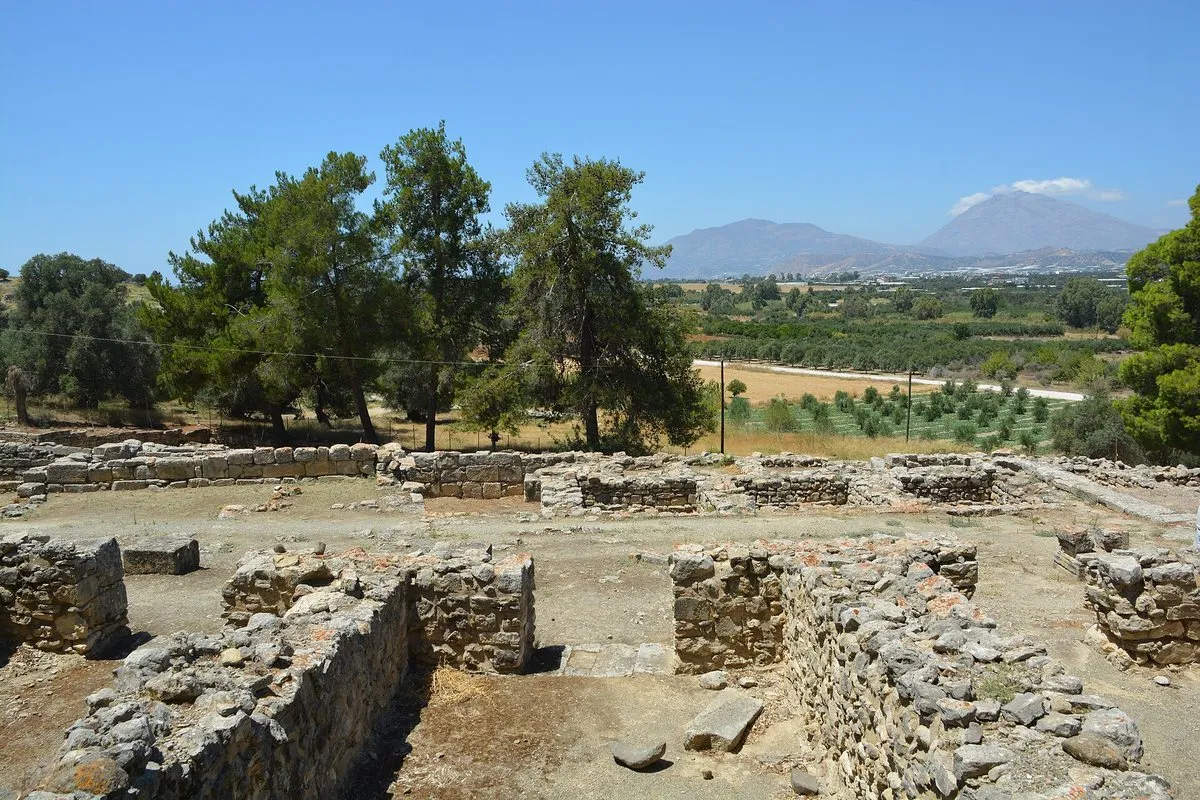
The shape of the day: Phaistos first, Agia Triada after, then south-west to the coast for a swim at Kommos or the caves at Matala. Vori, with its ethnology museum, lies just north of Phaistos for the afternoon.
The honest downside
Agia Triada is walls, stairways and rooms rather than objects: what made it famous is about an hour away in the Heraklion museum, and without that context the plan is hard to read. This check could not confirm the price, the exact hours or whether a combined ticket with Phaistos exists, and the Region lists the site as not accessible for people with disabilities.
Worth it if: you are already at Phaistos, you have seen or will see the sarcophagus and the stone vases in Heraklion, and you want one more Minoan site before the beach. Skip it if: ruins without objects or reconstruction leave you cold, you are short of time on a hot day, or step-free access matters.
Photos on this page: the excavated buildings by Zde (CC BY-SA 4.0), the chapel by Olaf Tausch (CC BY 3.0) and the settlement walls by Jonashtand (CC BY-SA 4.0), via Wikimedia Commons, resized for the web. Described from our own visits; distances, access, rules and any figures were checked against the Region of Crete’s tourism site, the Ministry of Culture’s Heraklion museum page and regional guides for the date shown at the top of this guide; the Ministry’s own page for Agia Triada could not be opened, so its hours and price are not confirmed here. Nobody pays to be featured in a guide — no business, no sponsor, no paid mention, ever. Adverts, where they appear, are labelled as adverts.
-
Around Phaistos
1 Agia Triada 2 Phaistos 3 Vori 4 Kommos beach 5 Matala
Tap a name to open it in your map app. These are options, not an order — pick by the day you have.
What is Agia Triada in Crete?
Agia Triada is a Minoan archaeological site a few kilometres west of Phaistos on the Messara: a villa complex dated to about 1600 BC, which the Region of Crete calls a little Minoan palace. Its finds include the painted Agia Triada sarcophagus, the Harvester Vase, the Boxer Rhyton and the Chieftain Cup. All of them are now in the Heraklion Archaeological Museum.
How far is Agia Triada from Phaistos?
Agia Triada lies a few kilometres west of Phaistos; published figures range from about 2 to 4 km. A paved road reaches the site, so the two are easily combined in one morning by car. Phaistos is the bigger visit and the natural first stop.
Is there a combined ticket for Phaistos and Agia Triada?
Whether a combined Phaistos and Agia Triada ticket is sold in 2026 could not be confirmed for this guide, because the Ministry of Culture's pages for the two sites could not be opened. The Ministry's Heraklion museum page does confirm that the old combined ticket for Knossos and the museum is no longer valid. Budget for separate tickets and ask at the Phaistos ticket office.
What was found at Agia Triada?
Agia Triada's best-known finds are the painted sarcophagus, with scenes of Minoan ritual, and three carved stone vessels: the Harvester Vase, the Boxer Rhyton and the Chieftain Cup. The Region of Crete says all of them are displayed in the Heraklion Archaeological Museum. On site you see the villa's rooms, stairways and courts rather than objects.
What are the opening hours of Agia Triada?
The Region of Crete's tourism page lists Agia Triada as open daily from 10:00 to 17:00, a regional guide gives 09:00–16:00, and neither is the Ministry of Culture's own timetable. Greek archaeological sites have moved to shorter winter hours on 1 November in recent years. Verify seasonally, for example on +30 28920 91564, the number the Region lists.
One email a month — only when something on this island actually changes. No spam, no partners, one-click unsubscribe. Read past issues before you decide.