Azogires: The Honest Guide to the Village of the Holy Fathers near Paleochora
A small Selino village a few kilometres north-east of Paleochora, known for the cave and monastery of the Holy Fathers — the 99 hermits of a local legend — a protected plane tree and a small museum. What is there, what no source confirms, and how to fit it into a Paleochora stay.
Azogires is a small Selino village a few kilometres from Paleochora with one story to tell, and it is a good one: the cave where, by tradition, 98 hermits of the tenth century died together on a single day. The cave, a 19th-century monastery on the traditional site, an evergreen plane tree and a small museum make an hour’s visit — an outing from a Paleochora stay rather than a trip in itself. What no official source publishes is when the doors are open. Described from our own visits; distances, prices, hours and rules are a check of published sources, October 2026.
The honest facts
- Where
- a village of Selino a few kilometres north-east of Paleochora, on an asphalt road.
- The cave
- the cave of the Holy Fathers, which the Region of Crete calls impressive and open to the public, without hours or access details.
- The monastery
- founded in 1864 near the village, on the spot where tradition says the Fathers settled.
- The plane tree
- in the monastery grounds; a protected natural monument that, unusually for a plane, keeps its leaves in winter.
- The museum
- a small one at the monastery, with later church relics and folk objects; no published hours.
- The feast
- 7 October, the day of the Holy Fathers.
- Fire order
- Azogires is not named in the 2026 order; the nearby Anydri gorge is.
The Holy Fathers and their cave
The tradition, as regional sources tell it, begins in the tenth century with hermits who left Egypt for Cyprus, where more joined them, and then the coast of Asia Minor, where their number reached 99. Bound for Crete, they were driven by a storm onto Gavdos, then crossed to the mainland and settled in Selino, under a plane tree beside a cave. One of them, John the Hermit, went on alone and ended his days at Katholiko on the Akrotiri peninsula, which our Akrotiri monasteries guide covers. The other 98, the story goes, asked to die on the same day, and did, together in the cave at Azogires.
Under Venetian rule the cave became a place of worship. The Region of Crete lists it as open to the public and puts the Holy Fathers’ feast on 7 October, when, by regional accounts, pilgrims come and stay in the cells around the monastery.
The monastery, the plane tree and the museum
The monastery of the Holy Fathers stands in a wooded spot near the village. A long-running regional guide says the Cretan chieftain Konstantinos Kriaris founded it in 1864 on the traditional site, and describes its church as a single nave. In the grounds stands the plane tree under which the Fathers are said to have settled: a protected natural monument which keeps its leaves through the winter, and in whose branches local belief counts 99 crosses, one for each Father.
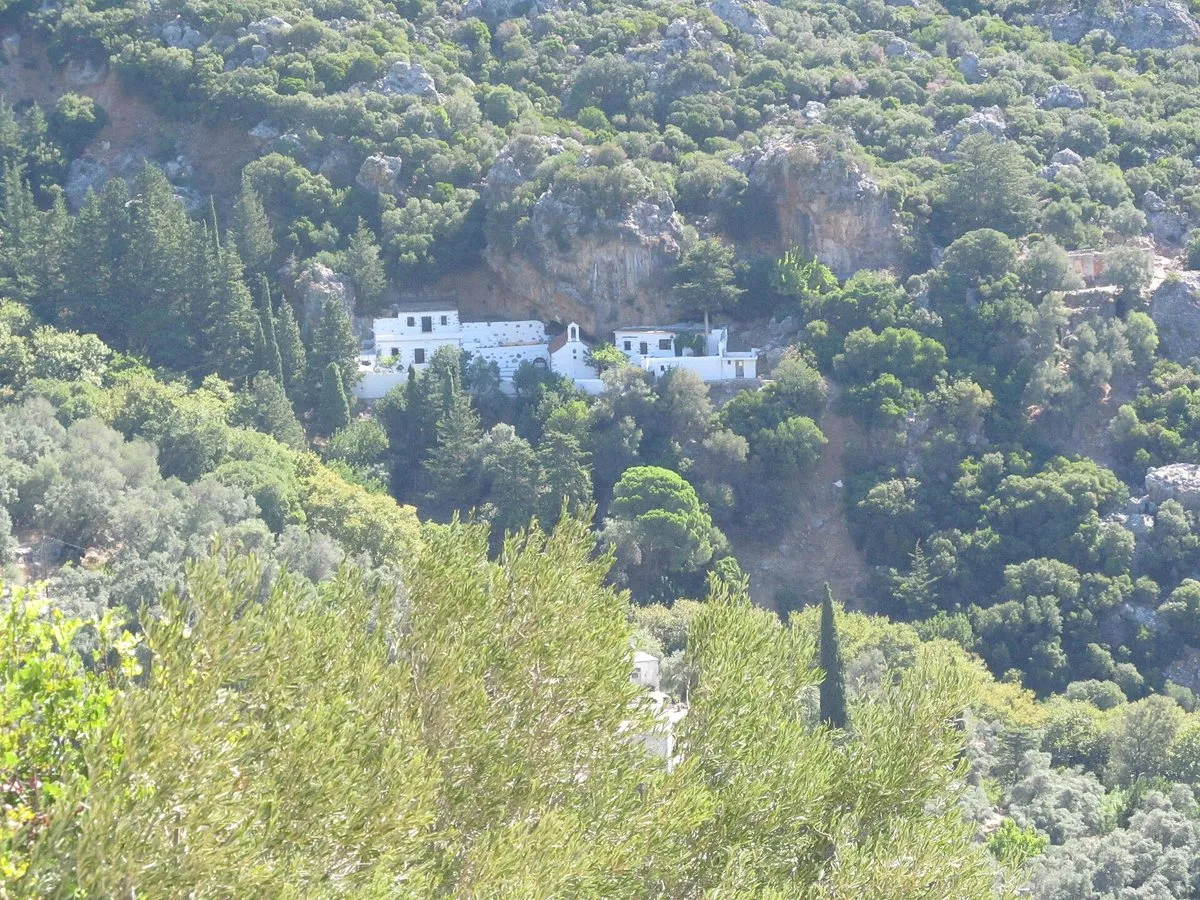
A small museum on site holds later church relics and historical and folk objects. No official source publishes opening hours for the church, the museum or the cave, so ask in the village rather than plan around a time, and dress for a church.
Getting there and when to go
Azogires lies a few kilometres north-east of Paleochora, and the regional guide gives the access as asphalt; do not count on a bus. Spring and autumn suit a visit best, and the feast on 7 October is the day to expect company. In summer, go early or late in the day.
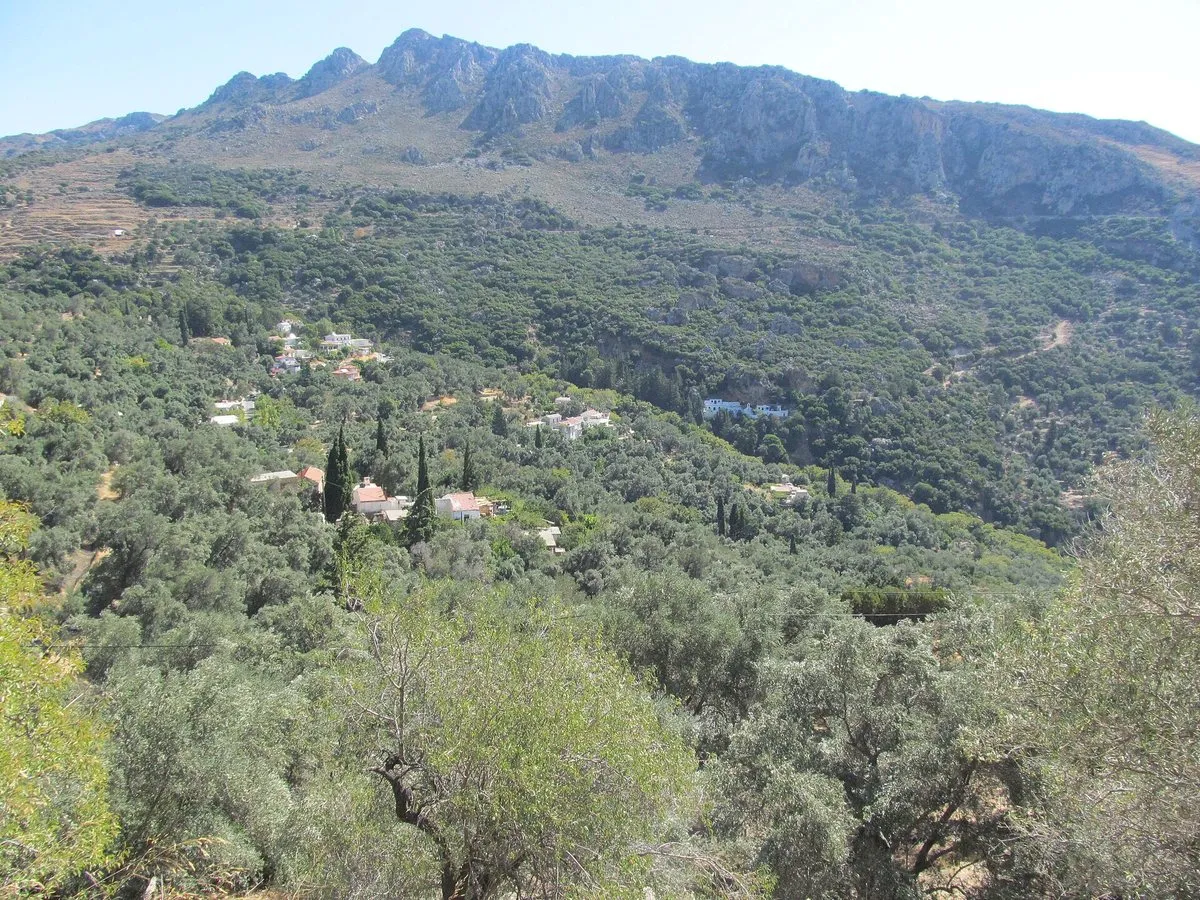
Azogires is not named in the Region of Crete’s 16 June 2026 fire-season order, which applies to the end of the fire season on 31 October; the Anydri gorge close by is, on its category 5 list, closed on red fire-risk days.
The morning around it
Azogires pairs naturally with Anydri, a few kilometres away, whose church of Agios Georgios has frescoes dated 1323 and whose gorge runs down to Gialiskari beach; our Anydri gorge guide has the walk. The painted churches along the inland road through Kandanos belong to the same Selino story.
Then swim. Paleochora’s two town beaches, Pacheia Ammos and Chalikia, and Grammeno to the west are all on the 2026 Blue Flag list; Grammeno and Krios covers the beaches beyond town, and our Sougia and Paleochora guide the base itself.
The honest downside
Azogires is a short visit built on a legend, and almost everything that makes it worth the drive depends on someone being there: no official source publishes hours for the church, the museum or the cave. On a quiet weekday you may find the plane tree, the outside of the monastery and little else, and on its own it does not justify a long drive.
Worth it if: you are staying in Paleochora and want a quiet hour inland — a legend, a cave and an old plane tree — paired with Anydri or a swim. Skip it if: you need a sight with set hours and a ticket desk, or you are based in Chania: on its own, it does not justify the drive.
Photos on this page: both of Azogires by Gortyna (CC BY-SA 4.0), via Wikimedia Commons, resized for the web. Described from our own visits; distances, access, rules and any figures were checked against the Region of Crete’s religious-heritage pages and its 16 June 2026 fire-season order, Blue Flag Greece, the Ministry of Climate Crisis and Civil Protection, and regional and reference sources for the date shown at the top of this guide. Nobody pays to be featured in a guide — no business, no sponsor, no paid mention, ever. Adverts, where they appear, are labelled as adverts.
-
Azogires and around
1 Paleochora 2 Azogires 3 Holy Fathers cave, Azogires 4 Anydri
Tap a name to open it in your map app. These are options, not an order — pick by the day you have.
Where is Azogires?
Azogires is a small village in the Selino district of south-west Crete, a few kilometres north-east of Paleochora, reached by an asphalt road. Azogires is known for the cave and monastery of the Holy Fathers, and it makes a short outing from a stay in Paleochora.
What is the cave of the Holy Fathers at Azogires?
The cave of the Holy Fathers is where, by local tradition, 98 hermits who had come from Egypt by way of Cyprus died together on a single day in the tenth century; a 99th, John the Hermit, had gone on alone to Akrotiri. The cave became a place of worship under Venetian rule, and the Region of Crete describes it as open to the public, though no official source gives hours or access details.
When is the Holy Fathers feast in Azogires?
The feast of the Holy Fathers at Azogires is on 7 October, according to the Region of Crete's calendar of religious festivals. Regional sources say pilgrims stay in the cells around the monastery for it, so expect the village to be busy that day.
Is there a museum in Azogires?
Azogires has a small museum at the monastery of the Holy Fathers, which regional sources say holds later church relics and historical and folk objects. No official source publishes its opening hours, so ask in the village rather than plan around a time.
Is Azogires closed on high fire-risk days?
Azogires and its cave are not named in the Region of Crete's fire-season order of 16 June 2026. The nearby Anydri gorge is on the order's category 5 list and closes on red fire-risk days during the fire season, which runs from 1 May to 31 October.
One email a month — only when something on this island actually changes. No spam, no partners, one-click unsubscribe. Read past issues before you decide.