Knossos or Phaistos? Which Minoan Palace to Visit, Honestly
Knossos or Phaistos with one day for the Minoans? Tickets, crowds, reconstruction against bare ruins, drive times from the north coast — an honest side-by-side.
If you will only see one Minoan palace in Crete, see Knossos — at eight in the morning, with a ticket bought in advance, and with the Heraklion museum either before or after it. If you have already done that, or you know that painted concrete and a queue would spoil the Bronze Age for you, Phaistos is the better morning, and Gortyna next door is the better surprise. They are not rivals so much as answers to two different questions, and most people only need to work out which question they are asking.
The honest facts
- Tickets
- Knossos €20 full, €10 reduced, checked against the culture ministry’s listing. Phaistos around €15 and €8; Gortyna around €10 and €5. Verify when you book — the prices page tracks changes.
- Getting there
- Knossos is twenty minutes by city bus from Heraklion centre, 30–40 minutes’ drive from the Hersonissos–Stalis–Malia coast. Phaistos is about 60km south, an hour to an hour and a quarter via the Agia Varvara climb, on good road.
- Time on site
- Knossos 1.5–2 hours at a civilised pace; Phaistos about an hour and a half; Gortyna an hour, more if you wander the free half.
- What you actually see
- Knossos is ruins plus a century-old reconstruction that makes the plan readable. Phaistos is unreconstructed stone on a ridge above the Messara plain, with Psiloritis behind it.
- Crowds
- Knossos is a procession from mid-morning to mid-afternoon in season; be there at opening or after 4pm. Phaistos rarely feels busy. Neither has much shade.
- Both
- are part of the Minoan palatial centres UNESCO listing since 2025.
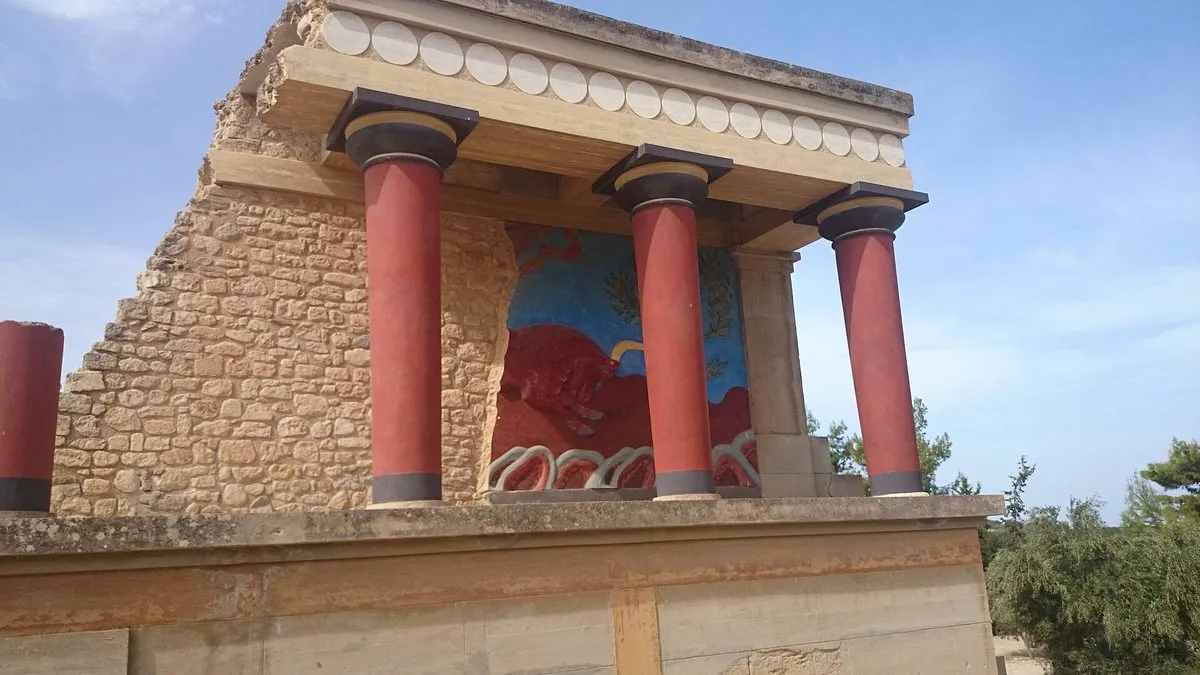
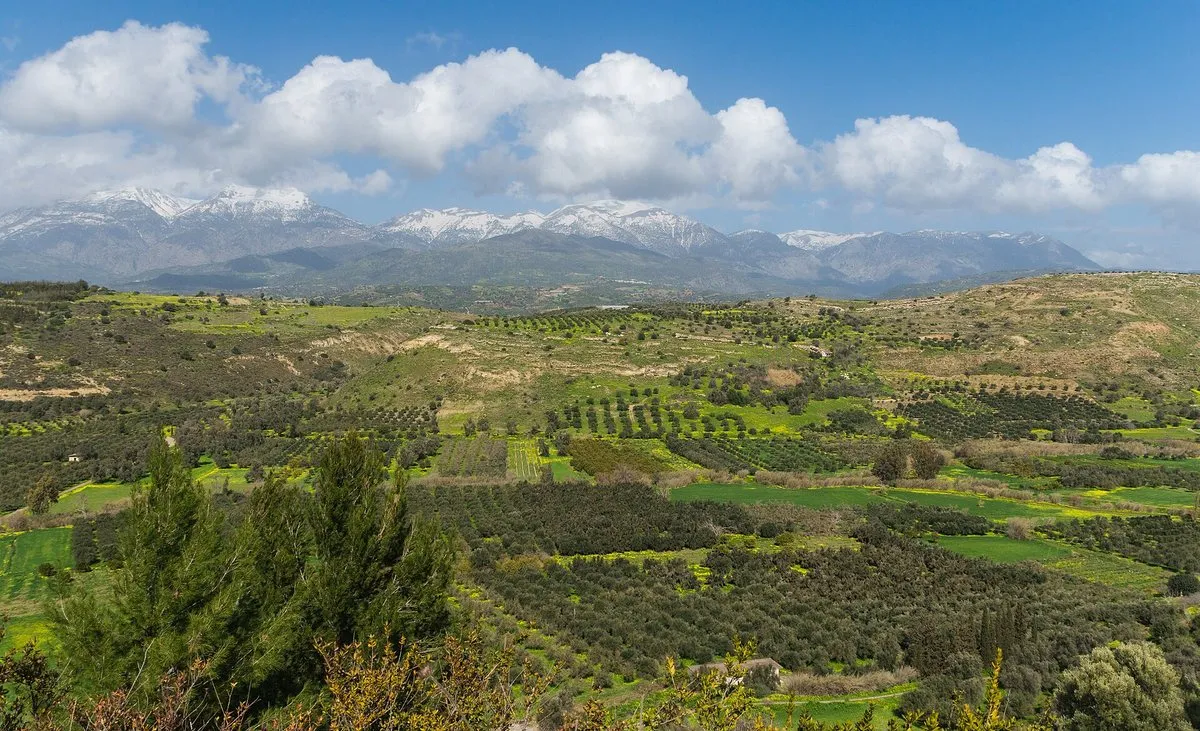
The case for Knossos
Knossos is the one everybody has heard of, and for once that is a reason to go rather than a reason to avoid it. The palace is the largest of the Minoan centres, the labyrinth story is attached to it, and Arthur Evans’s reconstructions — the red columns, the painted rooms, the concrete that archaeologists still argue about — turn a plan only a specialist could read into something a visitor can walk through and understand. Treat the concrete as a second historical layer, a century-old argument about how to show a Bronze Age palace, and it stops being a disappointment.
The other argument is the museum. The original frescoes, the snake goddesses and the Phaistos Disc are in the Heraklion Archaeological Museum, not at any site, and Knossos is the palace that makes the most sense when paired with it — there is a combined ticket for the two, and a guide or a decent book does the rest. Do the museum first if you can; the stones make more sense once you have seen what came out of them.
The catch is entirely about the clock. At 8am in summer you share the site with a few dozen people and the light is kind. At 11am in August it is the single most crowded patch of ground in Crete, unguided, in radiating heat. Same stones, completely different visit.
The case for Phaistos
Phaistos is what Knossos would look like if Evans had never arrived: the second Minoan palace, left as excavated, laid along a ridge with the whole Messara plain below and the mountain above. People who find the Knossos concrete hard to forgive tend to fall for Phaistos within the first ten minutes, and it is honest to say the setting earns the ticket more than the stones do. You are paying to stand somewhere that beautiful; the palace is the reason you are standing there.
It comes with a bonus that Knossos cannot match. Twenty minutes east, right on the main road, Gortyna was the Roman capital of Crete: the odeon, the roofless sixth- or seventh-century basilica of Agios Titos, and a stone wall inscribed with a law code older than almost anything else you will read about on the island. Half of it lies unfenced across the road through the olive groves — temples, a praetorium, a theatre on the acropolis slope — free to wander and almost never visited. With decent shoes and an extra hour, that free half is the better half.
The honest trade is distance and services. From the north coast it is an hour and a quarter each way, a pleasant drive, but it turns the Minoans into a full day rather than a morning. There is a café with a terrace and the same view at the Phaistos entrance, and five minutes away the village of Vori has one of the best small museums in Crete; beyond that you are on your own with the sun.
Pick by who you are
- First time in Crete, one free morning: Knossos at 8am, museum after, done by lunch.
- You have seen Knossos, or you are allergic to reconstruction: Phaistos and Gortyna, leaving by eight.
- Children in tow: Knossos — the reconstructions give them something to look at, and it fits in under two hours. Gortyna’s free half is the only part of the southern pair most kids enjoy.
- You want the Bronze Age without either crowd or drive: the unreconstructed Minoan palace of Malia is the quiet third palace, 20–30 minutes’ walk from the Malia strip, and most visitors to the resort never go.
- Photographs are the point: Phaistos, for the ridge and the plain; at Knossos the good light is gone by nine.
Can you do both?
Outside high summer, yes: Knossos at opening, then the hour-and-a-quarter drive south puts you at Phaistos around eleven and at Gortyna after lunch, swimming on the south coast by mid-afternoon. In July and August the same plan has you at Phaistos in the worst of the heat, and the ministry has shut these sites from noon to five in heatwaves. In summer, give each palace its own morning from a north-coast base, and you will enjoy both instead of surviving both.
The honest downside
Both are stone in full sun with little shade, and both reward preparation and punish drifting in. Knossos without context at midday is a box ticked in a crowd; Phaistos without the weather is a long drive to a hot hill. Read ten minutes the night before, carry more water than feels reasonable, and go early — that single habit fixes most of what people dislike about either.
Worth your time if: you can be at Knossos when it opens, or at Phaistos before eleven, and you arrive knowing roughly what you are looking at. Skip both if: you need a site to be fully interpreted and shaded to enjoy it. The Heraklion museum will give you the Minoans in air conditioning, and it has the best of them anyway.
Photos on this page: the North Entrance by CMOSPOWER (CC BY-SA 4.0) and the Messara view by Jebulon (CC0, public domain dedication), via Wikimedia Commons, resized for the web. Every figure here is the same one in our separate Knossos and Phaistos guides, last checked on the ground in July and August 2026; this page only puts them side by side. Nobody pays to be featured.
-
Minoan day — Knossos is twenty minutes from Heraklion; Phaistos and Gortyna are an hour south across the Agia Varvara climb.
Tap a name to open it in your map app. These are options, not an order — pick by the day you have.
Is Knossos or Phaistos better?
For a first visit, Knossos — it is the famous one, the reconstructions make the plan readable, and the original treasures are twenty minutes away in the Heraklion museum. Phaistos is the better morning if you have already seen Knossos, or if you would rather stand among unreconstructed stone on a ridge with a view than in a crowd around painted concrete.
How much do Knossos and Phaistos cost?
Knossos is €20 full and €10 reduced, checked against the culture ministry's listing. Phaistos is around €15 full and roughly €8 reduced; Gortyna, twenty minutes from Phaistos, around €10 and €5. Verify when you book — our prices page tracks changes.
Can you visit Knossos and Phaistos in one day?
Yes, outside high summer. Knossos at opening (8am in summer), then the hour-and-a-quarter drive south via Agia Varvara puts you at Phaistos around eleven — fine in May or October, a furnace in July, when heatwave closures from noon to five have happened. In summer give each palace its own morning.
Is Phaistos less crowded than Knossos?
Much less. Knossos between mid-morning and mid-afternoon in season is a procession; Phaistos rarely feels busy, and the free, unfenced half of Gortyna across the road is almost empty. The trade is shade and services: Phaistos has a café with the view at the entrance and not much else.
How do you get to Knossos and Phaistos without a car?
Knossos is easy: the city bus from Heraklion centre runs frequently and takes about twenty minutes, and a taxi is ten to fifteen minutes. From the Hersonissos–Stalis–Malia coast it is a 30–40 minute drive, or the coastal bus into Heraklion plus the city bus. Phaistos without a car is a coach-tour proposition; it is about 60km south and the buses are few.
Which palace is better for kids?
Knossos, because the reconstructions give them something to look at and the visit fits in under two hours; go at eight and it is pleasant. Phaistos is bare stone in full sun, which most children read as a car park with a view. Gortyna's free half, wandering through olive groves to a Roman theatre, is the one small archaeologists tend to enjoy.
One email a month — only when something on this island actually changes. No spam, no partners, one-click unsubscribe. Read past issues before you decide.