Matala and the South Coast: An Honest Day Trip from the North
The famous caves, the hippie myth fifty years on, Phaistos without the crowds, and the loop through the Messara that makes this the best full-day drive.
Let me deflate the myth before you drive an hour and a quarter for it: the Matala of the stories — Joni Mitchell, the cave-dwelling hippies, the free life under the Cretan moon — ended around fifty years ago. What’s there now is a small, cheerful, unashamedly touristy beach village that sells the memory of all that on t-shirts. If you arrive expecting a counterculture, you’ll find a car park and a queue for sunbeds.
And yet I still send people, because the honest version is good enough: a genuinely striking cove backed by a sandstone cliff drilled with ancient caves, a proper sandy beach with clear water, and — this is the real argument — a drive through the Messara plain that lets you stack two or three of Crete’s best sights into one unhurried day. Done as a loop, this is the strongest full-day trip from the Hersonissos–Stalis–Malia coast. Done as a pilgrimage to Matala alone, it’s a long drive for a swim.
The one-minute version. A full-day loop, car required: over the island’s spine to the Messara plain (about 1h15–1h30 each way from the resort coast), Phaistos palace in the morning, Matala for the caves, the swim and lunch, then Gortyna’s Roman ruins or Kommos beach on the way home. The caves are real and worth seeing; the hippie era is heritage, not reality. South coast bonus: when the meltemi hammers the north coast, it’s often calm down here.
The drive, and why it’s half the value
You cross the island at one of its narrowest points: up from Heraklion through Agia Varvara, over the watershed, and down into the Messara — the broad agricultural plain that has fed central Crete since Minoan times. Olive groves to the horizon, mountain villages hanging off the slopes, and a kind of working-Crete normality that the north-coast strip filters out. The roads are good by island standards. With a hire car it’s an easy drive; without one, organised coach tours do exist from the resorts, but they own your clock on a day where the freedom to linger is the point.
Phaistos first, and the quiet heresy
Do the archaeology in the morning cool, and do Phaistos — Crete’s second-great Minoan palace, spread over a hilltop with a view across the whole Messara. Now the heresy, which I half-committed in my Knossos guide and will complete here: many people who see both prefer Phaistos. It has a fraction of Knossos’s visitors, almost none of the concrete reconstruction, and a setting Knossos can’t match. What it lacks is the interpretive drama — fewer signs, fewer rebuilt columns to help your imagination. If you’ve already done the Heraklion museum, Phaistos rewards you quietly. Entry has been in the single-digit euros historically — verify current prices and summer hours when you go.
Gortyna, twenty minutes east, makes a good second stop either now or on the return: a Roman provincial capital scattered through olive groves, with an odeon and the famous stone-carved law code. Half an hour does it justice.
Matala itself, honestly
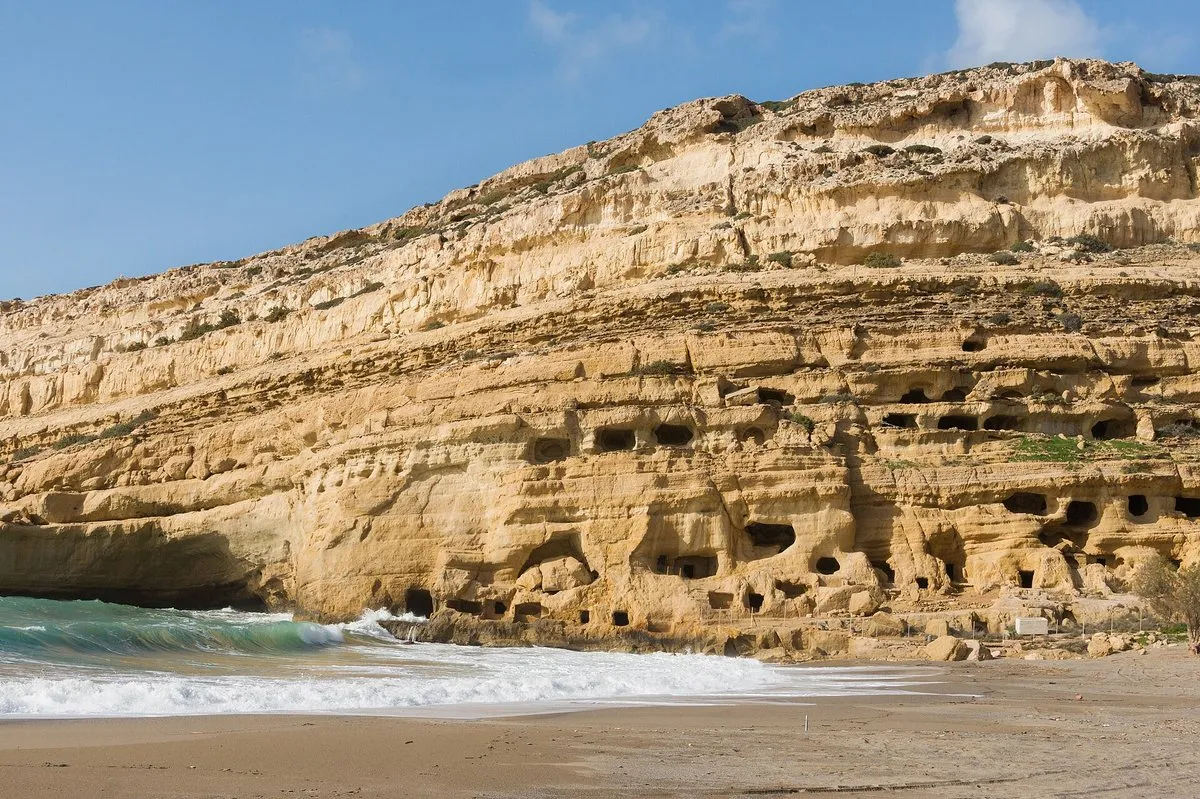
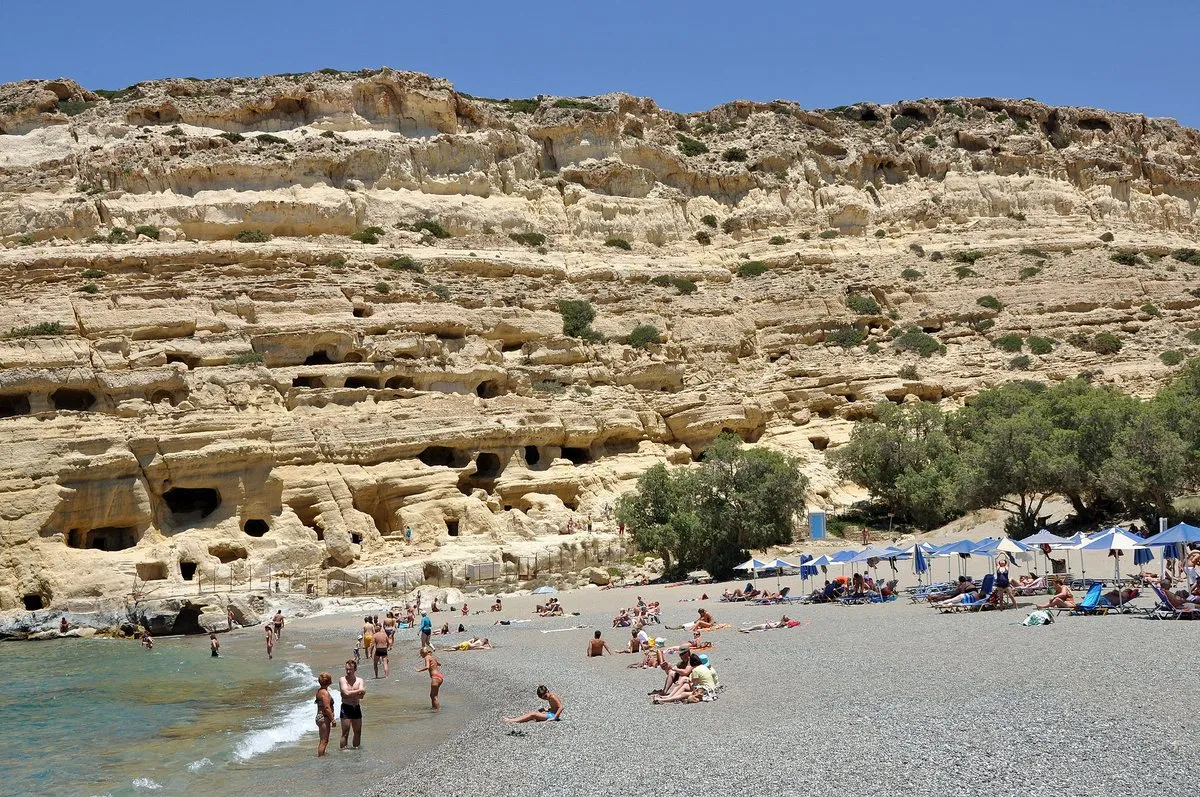
Park in the big paid car park (it fills by late morning in season), walk two minutes, and there it is: the cove, the cliff, the caves. The caves are genuinely old — carved as tombs in the Roman and early Christian eras, squatted much later by the world’s most photographed backpackers — and you can climb through the fenced section for a small fee, or admire them perfectly well from a towel. The beach is sandy, shelving, organised with sunbeds, and the water is clear with the occasional refreshing cold current. The village is two streets of tavernas and shops trading warmly on 1970. Lunch on the beachfront is fine and priced for the view; a street back is calmer.
If Matala’s crowd density disappoints, two escapes: Kommos, ten minutes north, a long, wilder sandy beach with a Minoan harbour site fenced at its edge and far fewer people per metre; or the Red Beach — a 20–30 minute rocky footpath over the headland from Matala, proper shoes required, rewarded with a small, semi-wild cove that keeps a whiff of the old freedom (and, fair warning, some visitors dressed accordingly).
Making the day work
Leave the coast by 8:30–9:00. Phaistos by 10, Matala by 12 for swim and lunch, Kommos or Gortyna mid-afternoon, back over the mountains by early evening — that’s a full but unhurried day. Take water and a hat for the sites, cash for small entries and parking, and swim gear obviously. One seasonal note worth repeating from the month-by-month guide: on days when the north wind wrecks your home beach, the south coast is often flat calm. Locals use the south as their meltemi escape hatch; you can too.
Go — but go for the loop, not the legend. Phaistos in the morning, the caves and a swim at midday, Kommos or Gortyna after: that day competes with anything on this island. Matala alone is a pleasant, crowded cove wearing a fifty-year-old story. With no car and no appetite for a coach tour’s schedule, spend your day east instead — the Agios Nikolaos run gives more per kilometre.
Photos on this page: the caves by Jebulon (CC0, public domain dedication) and the beach by Marc Ryckaert (CC BY 3.0), via Wikimedia Commons, resized for the web. Everything above was checked for the date shown at the top of this guide. Nobody pays to be featured in a guide — no business, no sponsor, no paid mention, ever. Adverts, where they appear, are labelled as adverts.
Is Matala worth visiting?
As part of the Messara loop, yes — Phaistos in the morning, the caves and a swim at midday, Kommos or Gortyna after makes one of the strongest full days from the north coast. As a pilgrimage to Matala alone it is a long drive for a swim; the hippie era is heritage, not reality.
Can you visit the Matala caves?
Yes — carved as tombs in the Roman and early Christian eras, they can be climbed through in the fenced section for a small fee, or admired perfectly well from a towel on the beach below.
How far is Matala from the north coast resorts?
About 1h15–1h30 each way by car from the Hersonissos–Stalis–Malia coast, over the island's spine and into the Messara plain. A hire car makes the day; organised coach tours exist but they own your clock.
What if Matala is too crowded?
Kommos, ten minutes north, is a longer, wilder sandy beach with far fewer people per metre. The Red Beach is a 20–30 minute rocky footpath over the headland — proper shoes required — for a small, semi-wild cove that keeps a whiff of the old freedom.
One email a month — only when something on this island actually changes. No spam, no partners, one-click unsubscribe. Read past issues before you decide.