Rodakino & Korakas: The Honest Guide to the Coast Between
The twin villages and long dark-sand beaches on the empty road between Plakias and Sfakia — wartime escape history, tamarisk camps of old.
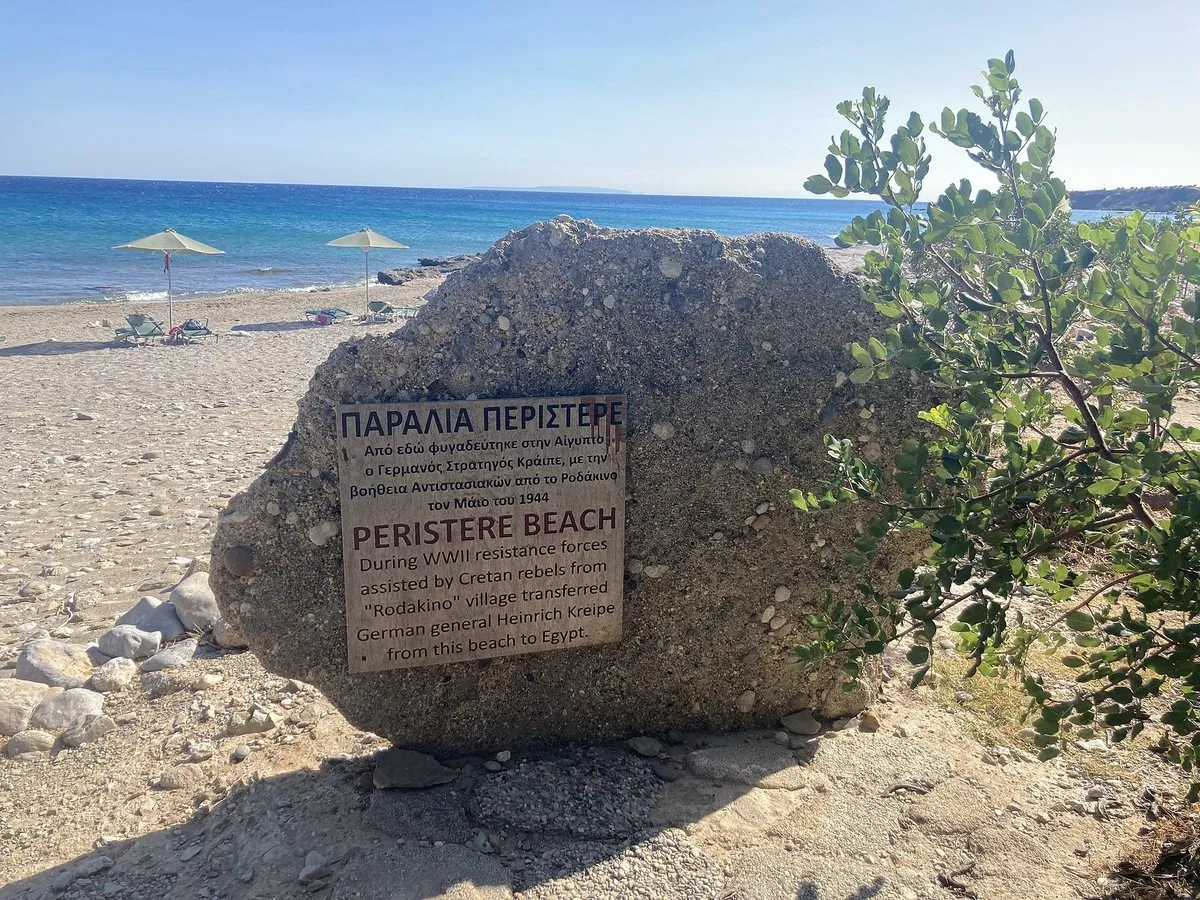
West of Plakias the tourism thins with every headland until Rodakino: twin villages (Ano and Kato) stacked on a gorge mouth, and below them the long dark-sand runs of Korakas and Polyrizos — beaches that hold three tavernas, scattered rooms and more history than infrastructure. It was from this shore in 1944 that the abducted German general Kreipe was spirited off the island; the commemorative marker stands where the story left.
The honest facts
- Position
- ~20 minutes west of Plakias on the increasingly cinematic Sfakia road; the villages sit above, the beach access roads drop steeply but paved.
- The beaches
- Korakas and its continuations — long, dark sand mixed with pebble, tamarisk clumps, sparse sunbed presence near the tavernas (€6–9 when present), open horizon to Africa. Usually room to lose your neighbours entirely.
- Eating & sleeping
- a handful of family tavernas at beach level and in the villages, simple rooms above them — value pricing, direct arrangements, genuine welcomes.
- The water
- clear, quickly deepening, exposed to south swell on rare days; no lifeguards, standard south-coast self-reliance.
- The history
- the Kreipe embarkation marker and the villages’ fierce wartime record give the place a weight the emptiness amplifies.
The Kreipe evacuation and the burning of 1943
The marker stands at Peristeres, the westernmost of Rodakino’s beaches. General Heinrich Kreipe was seized on the road between Archanes and Heraklion on the night of 26/27 April 1944 by a team led by Patrick Leigh Fermor and Stanley Moss, with Cretan resistance fighters. After more than two weeks on foot across Mount Ida and the Amari valley, the party was taken off from Peristeres on 14 May 1944 aboard the British motor launch ML 842, reaching Mersa Matruh in Egypt the next day. The villages had already paid for their resistance: on 20 August 1943 German forces surrounded, looted and burned Rodakino in reprisal for a clash three days earlier, and the Municipality of Agios Vasileios still holds a commemoration every 20 August.
Three beaches, east to west
Published guides split the shore into three. Korakas, below the villages, is the main and busiest stretch at around 400 m. Polyrizos lies about half a kilometre west along a paved shore road: shorter (roughly 200 m), with finer sand and shallower water that one guide rates as good for children, ending at the rocky hill of Kastelos. Beyond it, Peristeres runs to roughly 600 m and is reached by turning left about 500 m after Polyrizos onto a narrow, winding road; it is the last beach before Sfakia, named for the wild pigeons in the caves at its eastern end. Listings mention sunbeds, umbrellas, showers, a few changing cabins and parking near the sand, plus a summer canteen at Peristeres — verify seasonally.
On wind the sources disagree outright: one local guide reports generally little of it, another names frequent strong winds as the area’s main drawback, and a third notes the beaches are open to southerlies. All three can be true. Rodakino sits at a gorge mouth, and on meltemi days gorges funnel the northerly onto south-coast beaches while nearby coves stay calm — the guide to swimming in the meltemi has the sheltered alternatives. A southerly, rarer, pushes swell straight in. Check a wind forecast before the drive.
Getting there without the coach routes
By road Rodakino is roughly 13 km from Plakias and about the same from Frangokastello, around 15–20 minutes either way; from Rethymno it is about 55 km, roughly an hour and a half via Argyroupoli or Armeni. The bus is the weak link. KTEL Chania-Rethymno does list Ano Rodakino as a stop, but published listings show a thin village service from Rethymno (one gives a single weekday), and there is no bus along the coast to Plakias or Frangokastello — route planners send a Plakias–Rodakino trip back via Rethymno at over three hours, the pattern the KTEL guide explains. A taxi from Plakias is estimated at roughly €15–20; agree the fare first. With a car, Frangokastello’s castle and shallow sand pair naturally with a Rodakino lunch on the way east to Plakias.
Who this coast fits
Solitude-first beach people with a car; Sfakia-road drivers wanting the swim-and-lunch that coach routes skip; and returners for whom Plakias now counts as busy. Families manage fine at the taverna-adjacent stretches; toddler-infrastructure seekers should stay east.
The honest day
Arrive late morning, claim tamarisk or open sand to taste, swim the deep blue, taverna lunch where the Greek tables cluster, siesta, one last swim as the light goes copper, and either back east or onward into Sfakia’s drama. Overnighting buys the empty-morning version few visitors ever see.
The honest downside
Dark sand runs hot by July afternoons, facilities are deliberately thin, and the beauty here is austere-open rather than cove-pretty — travellers wanting turquoise pockets should aim elsewhere. The steep access lanes also want calm brakes.
Worth your time if: “a beach with almost nobody and one good taverna” is your definition of success. Skip it if: you need organisation or scenery that performs — this coast underplays everything except space.
Photo on this page: the memorial by Derhuti (CC BY-SA 4.0), via Wikimedia Commons, resized for the web. Everything above was checked for the date shown at the top of this guide. Nobody pays to be featured in a guide — no business, no sponsor, no paid mention, ever. Adverts, where they appear, are labelled as adverts. Sections added in October 2026 were checked against published sources rather than on a new visit.
-
Villages and sands
Tap a name to open it in your map app. These are options, not an order — pick by the day you have.
Where is Korakas beach?
Below the twin villages of Ano and Kato Rodakino, about 20 minutes west of Plakias on the Sfakia road. The access roads drop steeply from the villages but are paved.
What are the beaches at Rodakino like?
Long dark sand mixed with pebble, tamarisk clumps, an open horizon toward Africa, and sparse sunbed presence near the tavernas at EUR6-9 when present. There is usually room to lose your neighbours entirely.
Is there anywhere to stay at Rodakino?
A handful of family tavernas at beach level and in the villages, with simple rooms above them - value pricing, direct arrangements and genuine welcomes rather than anything resembling a resort.
What is the wartime history at Rodakino?
The Kreipe embarkation marker is here - the point where the abducted German general was taken off the island in 1944 - and the villages have a fierce wartime record. The emptiness amplifies the weight of it.
Is it safe to swim at Korakas?
The water is clear and deepens quickly, and it is exposed to south swell on rare days. There are no lifeguards - standard south-coast self-reliance applies.
Is there a bus to Rodakino?
KTEL Chania-Rethymno lists Ano Rodakino as a stop, but published listings show a sparse village service from Rethymno, with one listing giving a single weekday. There is no bus along the coast between Plakias, Rodakino and Frangokastello, so a car or a taxi from Plakias (roughly 13 km) is the practical way to reach the beaches.
One email a month — only when something on this island actually changes. No spam, no partners, one-click unsubscribe. Read past issues before you decide.