Lake Agia: The Honest Guide to Chania's Spring-Fed Wetland
A small reservoir on an old marsh south-west of Chania, fed by White Mountain springs and protected twice over under Natura 2000 — an hour's flat walk among reedbeds and herons, a restored 1929 hydroelectric station, and a village whose prison is tied to the 1941 “Prison Valley”.
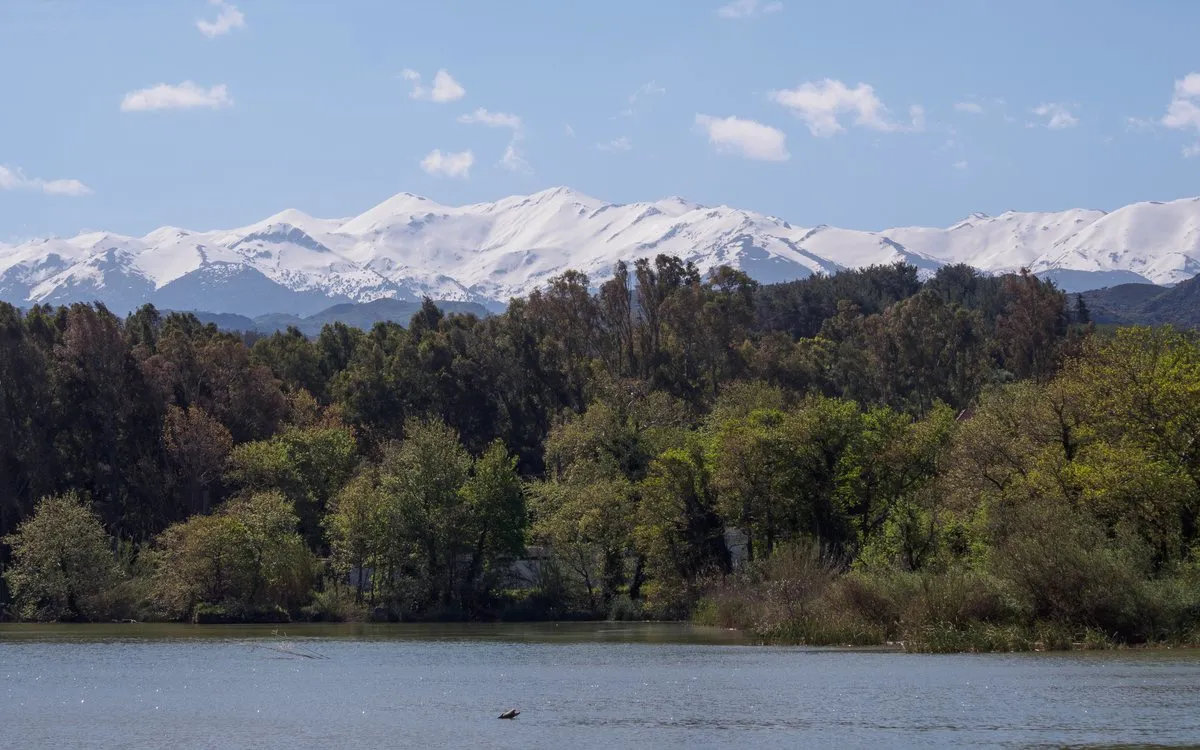
Lake Agia is the best easy hour of nature within reach of Chania, and nothing more than that. It is a small reservoir built on a marsh in the 1920s, fed by springs from the White Mountains, ringed by reeds, willows and plane trees, and protected under two Natura 2000 designations. You walk round it on a flat path, look at herons and ducks, and perhaps step into the old power station beside it. It suits birdwatchers, families and anyone wanting a quiet morning off the beach, not swimmers. Described from our own visits; distances, prices, hours and rules are a check of published sources, November 2026.
The honest facts
- Where
- beside the village of Agia, about 9 km from Chania on the provincial road towards Omalos and Sougia; south-west of the city on the map.
- What it is
- an artificial lake of about 45 hectares on a former marsh, fed by karst springs from the White Mountains, per the Agia hydroelectric station’s site.
- Protection
- two Natura 2000 sites, which the station’s site describes as a Site of Community Importance (GR4340006) and a Special Protection Area for birds (GR4340020); both are listed by NECCA.
- Birds
- more than 200 species recorded, by birdwatching references; spring and autumn are best.
- The walk
- a path round the lake, about an hour at an easy pace; flat, with a viewing platform.
- Swimming
- not a swimming lake — no source checked describes swimming, and it is a protected reservoir that helps supply Chania’s water.
- The station
- open Monday–Friday 09:00–14:00, free entry; verify seasonally.
A marsh turned into a reservoir
This was a marsh on a tributary of the Keritis river until it was dammed to feed the small hydroelectric station of Agia, which Eleftherios Venizelos inaugurated on 22 July 1929, according to the station’s history page. An earth dam 435 m long holds the water, and the station ran until 2008, by its own account. The Region of Crete was granted the use of both in 2011 and laid walkways along the shore; the building is now a renewable-energy exhibition around the original machinery.
The springs also feed Chania’s water supply, and that has a cost: in August 2025 the lake fell to historic lows after a dry winter and heavy summer demand, press reports said, and a citizens’ group argued its Natura 2000 protection was not being upheld.
The walk and the birds
The path runs along the shore and, past the bridge, circles the whole lake in about an hour at a stroll, as a 2022 Greek travel report describes it. It is flat. Birdwatching references describe a viewing platform and a footbridge at the southern end, and advise avoiding Sundays, when local walkers fill the path.
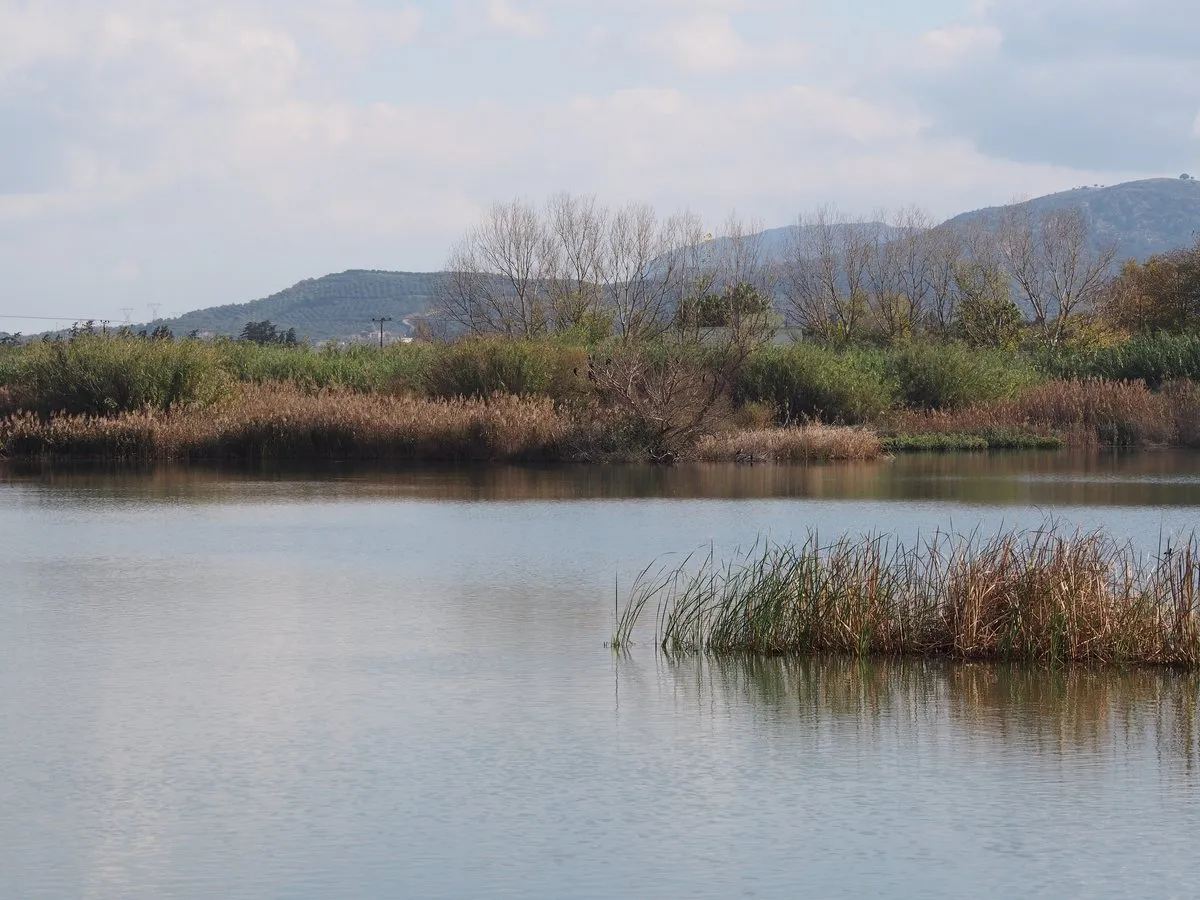
The Region of Crete credits this artificial lake with perhaps the island’s richest variety of wetland plant communities; the station counts more than 130 plant species. For birds it is both a stopover for migrants heading to Africa and a wintering site, so it has birds in every season, late autumn included. Published lists name ferruginous duck, marsh harrier, booted eagle, purple heron and three species of crake, and the station adds migrant waders passing through. No source gives a best hour, but early morning, before the walkers, is the usual birding choice. The less welcome residents are American bullfrogs and red-eared sliders, both introduced from North America: reference sources say the bullfrog has displaced the native Cretan frog, and the sliders share the water with the native Balkan terrapin.
Agia in 1941
Reference sources say the 1941 battle zone around Alikianos became known as “Prison Valley” after a prison farm, its most prominent building. A then-and-now study of wartime photographs shows the prison at Agia, on the main road to Chania, still standing, and records German paratroopers using it as a base from 20 to 25 May 1941. Under the occupation its cells held resistance fighters condemned to death, and a plot a few metres away known as Golgotha was an execution site, To Vima reported in 2021. The cells sit inside a working detention centre, so the plan described then was a digital museum and restoration, not public visits. The wider campaign is in the Battle of Crete guide.
Getting there and pairing it
By car it is a short drive from Chania, with free parking next to the station. KTEL lists services from Chania to Omalos and Sougia, where this road leads, but no stop at the lake was confirmed; ask at the bus station, and see the KTEL guide for how the network works.
The lake is the natural first stop of a morning up the Keritis valley, towards Alikianos, Fournes and Meskla. The Region’s ecotourism pages list it alongside the island’s other notable lake, Kournas, further east.
The honest downside
It is small, it is a reservoir, and an hour covers it. Its level depends on the rain and the city’s taps, and in a dry year the margins shrink. It is not for swimming, the loudest residents of the reeds are an invasive frog, and the station keeps weekday office hours, opens on Saturdays only by arrangement and shuts on Sundays.
Worth it if: you are staying near Chania and want an easy, flat hour among birds and reeds, ideally in spring or autumn, perhaps at the start of a morning up the Keritis valley. Skip it if: you want to swim, or you are short of time and hoping for something to do rather than something to watch.
Photos on this page: the lake with the White Mountains and the reedbeds by C messier (CC BY-SA 4.0 and CC BY-SA 3.0), via Wikimedia Commons, resized for the web. Described from our own visits; distances, access, rules and any figures were checked against the Agia hydroelectric station’s own website, NECCA’s list of protected areas in western Crete, the Region of Crete’s ecotourism pages, press reports from 2021, 2022 and 2025, and birdwatching and wartime history references for the date shown at the top of this guide. Nobody pays to be featured in a guide — no business, no sponsor, no paid mention, ever. Adverts, where they appear, are labelled as adverts.
Where is Lake Agia and how far is it from Chania?
Lake Agia lies beside the village of Agia, about 9 km from Chania on the provincial road towards Omalos and Sougia; on the map it is south-west of the city. The old hydroelectric station that stands next to it gives its address as the 10th km of that road. By car it is a short drive, with free parking at the station.
Can you swim in Lake Agia?
Lake Agia is not a swimming lake. It is a protected reservoir whose spring water feeds Chania's supply, its banks are largely reedbed, and no official source describes swimming there. Go for the walk and the birds, and swim in the sea.
How long is the walk around Lake Agia?
The path that circles Lake Agia takes about an hour at an easy pace, according to a 2022 Greek travel report. Birdwatching references describe it as flat and easy, with a hide or viewing platform and a footbridge at the southern end. The Region of Crete pedestrianised the shore path after it was granted use of the site in 2011.
Is Lake Agia good for birdwatching?
Lake Agia is a well-known birding site in western Crete: birdwatching references count more than 200 species recorded, and the station's website says the lake is a Natura 2000 Special Protection Area for birds. Spring and autumn migration are the best seasons, and the lake also holds wintering birds. Species named include ferruginous duck, marsh harrier, purple heron and several crakes.
Is the Agia hydroelectric station open to visitors?
The Agia small hydroelectric station, inaugurated in 1929 and now an exhibition space on renewable energy, is open Monday to Friday from 09:00 to 14:00, on Saturdays by arrangement, and closed on Sundays, according to its own website. General admission is free; guided group tours cost roughly €2–2.50 per adult. Verify seasonally before going.
One email a month — only when something on this island actually changes. No spam, no partners, one-click unsubscribe. Read past issues before you decide.