Panigiria: The Honest Guide to Cretan Village Festivals
Free food, a lyra that starts at eleven, and dancing that goes until the light comes. How to find a village festival, what actually happens.
The best night you can have in Crete is not sold anywhere. It happens in a village square on a saint’s day, it starts around eleven at night, the food is free or nearly, the wine is from someone’s barrel, and a lyra player who has been doing this for forty years will keep going until the sky changes colour. Every summer thousands of visitors leave the island without knowing these exist.
The one-minute version. A panigiri is a village feast on its church’s saint’s day. Concentrated in summer, with 15 August the biggest across the island. Price varies: some free, many €16–20 with full food, wine and raki, or around €10 for drinks only — it is printed on the poster. Music starts around 23:00, dancing peaks after 01:00. Not advertised in English anywhere — ask locally. Bring cash, bring patience, do not drive home.
What actually happens
It begins as a church event. There is a service — usually a vespers the evening before and a liturgy on the day — and if you are in the village you are welcome to stand at the back, quietly, and then leave when it feels right.
The rest happens in the square. Long trestle tables, plastic chairs, a whole animal cooking somewhere out of sight, bread, cheese, salad, and wine that arrives in jugs and does not stop arriving. Some of these are still free, funded by the church committee and local families. Many are not: a printed price of around €16–20 covering full food, wine and raki is now common, often with a cheaper drinks-only rate near €10 alongside it. The figure is on the poster, and it is worth photographing rather than guessing.
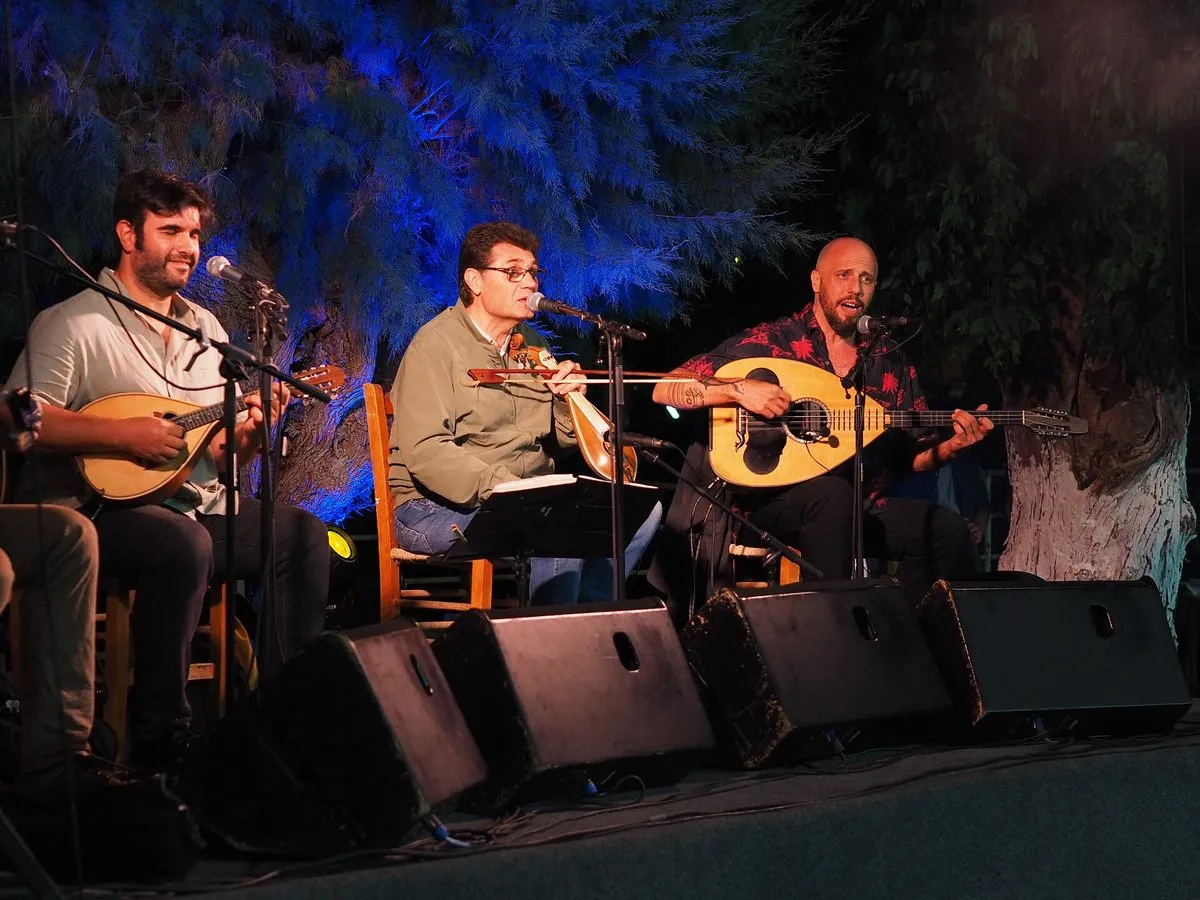
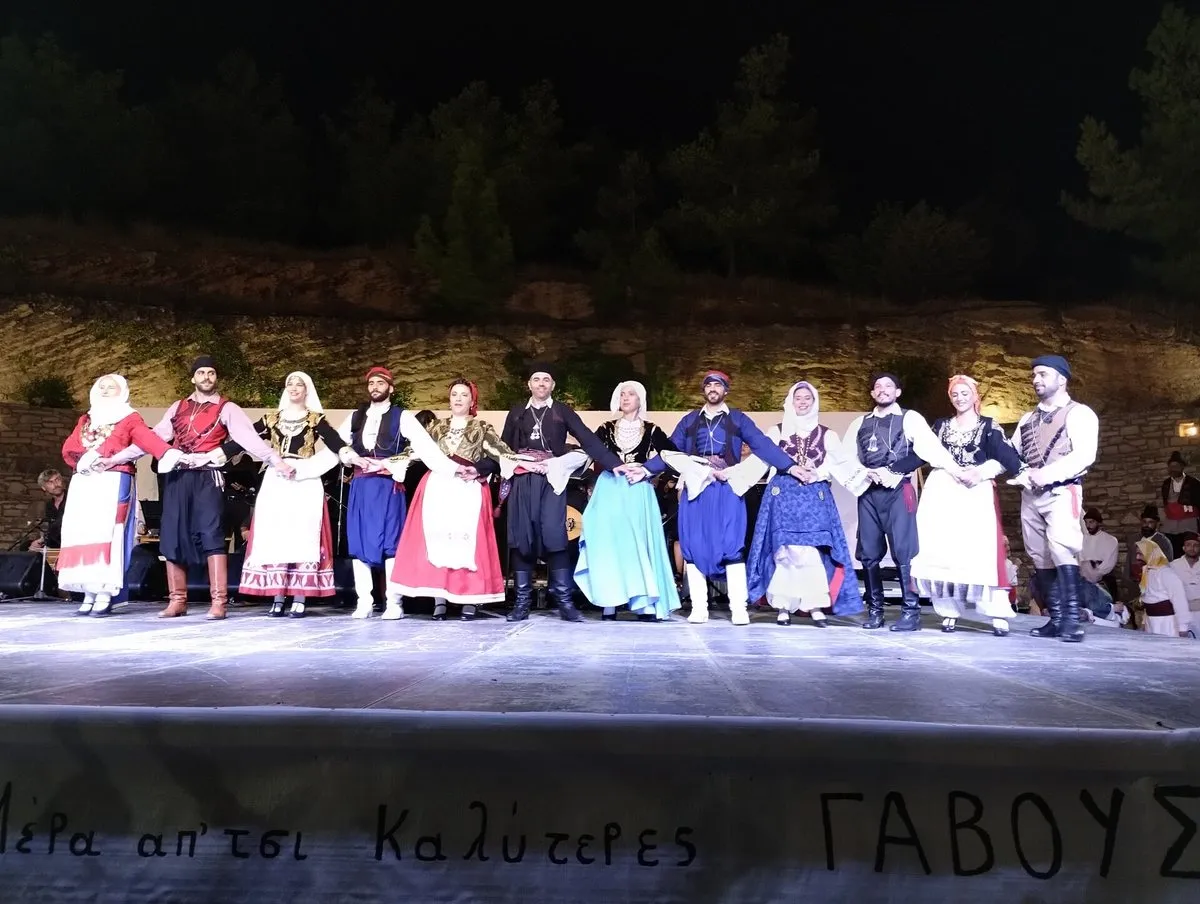
Then the music. A lyra player, a laouto or two, sometimes a singer, on a small stage with a PA that is louder than the square needs. Whose names to look for on the poster is a subject of its own, and it is the single thing that most changes what kind of night you get. The first hour is listening. Then someone starts a syrtos, the circle forms, and it does not really stop. Pentozali, sousta, maleviziotis — the dances are specific, the older people know them exactly, and the teenagers know them too, which is the part that surprises visitors most.
How to find one
This is the real obstacle, and there is no clean solution.
Ask your host. Anyone running rooms or a small hotel knows what is happening in their own village and the three next to it. This is the single most reliable method and almost nobody uses it.
Look at lamp posts. Posters go up a week or two ahead — usually a saint’s icon, a date, and the name of the musicians in large letters. They are in Greek, but the date and place are readable and a photo on your phone can be shown to someone who will explain.
Ask at the kafeneio. The old men outside the village kafeneio know every panigiri within thirty kilometres. Language is less of a barrier than you expect for a question this specific.
Watch the calendar. 15 August, the Dormition of the Virgin, is celebrated almost everywhere and is the safest single date to plan around. Villages with churches dedicated to Agios Ioannis, Agia Marina, Agios Panteleimon and so on have their own dates through July and August.
How to behave
Not complicated, but worth saying.
Accept what is offered. Refusing food or wine reads as rejection rather than restraint. Accept a small amount; nobody counts.
Do not photograph the church service. The square is fair game, the liturgy is not.
Join the dance late, or not at all. Nobody will mind if you sit and watch all night. If you do join, take the end of the line, never the front — the lead position is earned and someone specific has it.
Bring cash and put something in the church box, especially if the food was free. That is how next year’s is paid for.
Arrange your way home. The wine is generous and the roads back to the coast are mountain roads. A taxi booked in advance, a designated driver, or a room in the village.
The honest downsides
The timing is brutal if you have small children or an early flight. Nothing meaningful happens before eleven and the good part is after one.
It is loud. Cretan PA systems are set to a level that makes conversation impossible near the stage.
Some are more commercial than others. Larger villages near the resorts run events with ticket prices and set-piece dance displays, which are perfectly enjoyable but are a performance rather than a night out. The real thing is in a village you had to be told about.
You will feel like an outsider for the first hour. Then somebody’s uncle will decide you need more wine and you will not feel that way again.
The mountain villages are where these are best — the Amari valley, the Apokoronas, the villages above the Hersonissos strip, and anywhere in the Lasithi interior. Houdetsi, with its musical instrument museum, is a reasonable place to start understanding the music before you hear it live.
The most worthwhile evening available on this island, and the hardest to arrange — free or nearly free, entirely unpackaged, and the one context in which you see Crete being itself rather than hosting you. Ask your host, watch for posters, plan around 15 August if you need a fixed date, and sort out how you are getting home before the first glass. Skip it if you need an early night or a printed start time: this is an event with no schedule and no end, and that is precisely the point of it.
Photos on this page: music trio by C messier (CC BY-SA 4.0); dancers by Pavlos1988 (CC BY-SA 4.0), via Wikimedia Commons, resized for the web. Nobody pays to be featured on this site.
What is a panigiri in Crete?
A village festival held on the feast day of the local church's saint. There is a service, then food and wine in the square, then live music and dancing that regularly runs past three in the morning. Some are free; many now charge a set price — commonly around €16–20 including full food, wine and raki, or roughly €10 for drinks only. Almost none are advertised anywhere a visitor would look.
When are the Cretan village festivals?
Scattered through the year but concentrated in summer. The big fixed dates are 15 August for the Dormition of the Virgin, which is celebrated across the island, plus saints' days like 29 August and 8 September. Individual villages have their own dates depending on which saint their church is dedicated to.
Can tourists go to a Cretan panigiri?
Yes, and you will be made welcome — often uncomfortably welcome, in the sense that someone will insist on filling your glass. These are open community events, not private ones. Arrive with a bit of respect for what the evening actually is and you will have a good time.
How do you find out about a panigiri?
Ask, essentially. Village kafeneia, your accommodation host, printed posters on lamp posts and shop windows, and local Facebook pages. There is no central listing and the tourist offices rarely have them. This is the honest barrier to going.
What time do Cretan festivals start?
Later than you think. Food might be out by nine or ten, the musicians rarely start properly before eleven, and the dancing peaks somewhere after one in the morning. Turning up at eight means sitting in an empty square watching people set up chairs.
One email a month — only when something on this island actually changes. No spam, no partners, one-click unsubscribe. Read past issues before you decide.